
FY26 targets raise optimism, but exports show little progress
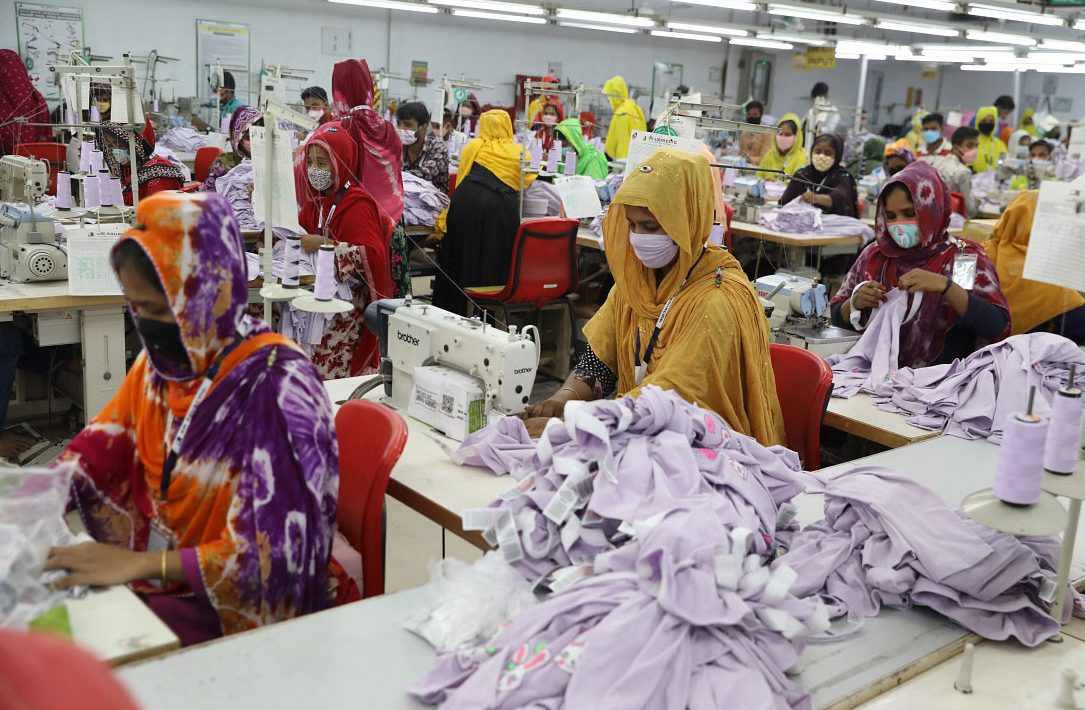
Bangladesh’s commerce ministry has set an ambitious export target of $63.5 billion for FY26, offering hope for growth, but exporters warn that domestic challenges could hold back progress.
The main hurdles are not global competition but domestic bottlenecks such as gas shortages, customs delays, banking sector issues, and high interest rates.
From readymade garments to emerging sectors like leather, agriculture, and plastics, the business community believes the target is achievable—but only if long-standing domestic problems are addressed and global market access is maintained.
Of the total, goods exports are expected to contribute $55 billion, a 13.4 percent increase over FY25, while services exports are projected at $8.5 billion, an ambitious 18.7 percent rise.
Recent changes in U.S. tariff policies have provided Bangladesh a competitive edge, particularly in the garments sector. With an average tariff of 36.5 percent—lower than many global competitors—the U.S. market offers a rare opportunity to expand exports.
AK Azad, chairman of Ha-Meem Group, one of the country’s largest RMG exporters to the U.S., noted that while tariff advantages exist on paper, practical challenges remain. “Yes, we have a window of opportunity, but buyers are negotiating harder and asking to share the tariff burden,” he said.
Exporters also caution against overreliance on a single market. “We have been caught off guard before by sudden rule changes. Even a new administration could revoke tariff benefits quickly,” said a Chattogram-based exporter, speaking anonymously.
Despite favorable global conditions, domestic obstacles—particularly energy shortages, banking sector problems, and customs inefficiencies—are seen as the biggest threats to achieving the FY26 target.
Mohammad Hatem, president of the Bangladesh Knitwear Manufacturers and Exporters Association (BKMEA), said, “There is global demand, and we are competitive. But how can we meet higher orders when gas supply is irregular, power outages occur, and LC processing is delayed due to banking issues?”
The energy crisis has already led to lost production hours and higher costs. Exporters stress that uninterrupted energy supply is critical for energy-intensive sectors like textiles and leather.
High interest rates and banking inefficiencies have further burdened exporters, who are calling for urgent reforms to improve access to affordable credit.
Commerce Secretary Mahbubur Rahman’s announcement of a joint meeting next week with energy and banking stakeholders is being seen as a step in the right direction. Rahman said he would meet exporters from 22 sectors to identify key obstacles and work toward solutions.
The RMG sector, accounting for over 80 percent of goods exports, has been tasked with generating $44.49 billion—$20.79 billion from woven (14.3 percent growth) and $23.70 billion from knitwear (12 percent).
“There is demand from the U.S. and EU, especially as China retreats from low-end apparel. But we must act quickly to scale capacity and diversify designs,” said Anwar-ul Alam Chowdhury Parvez, president of the Bangladesh Chamber of Industries. He questioned whether government initiatives are truly aimed at supporting exporters or merely announcing targets.
Leather and leather goods have a target of $1.25 billion, a 9.2 percent increase. Exporters say compliance issues, low-value raw exports, and infrastructure bottlenecks, particularly at Savar Tannery Estate, limit growth. Nasir Khan, managing director of Jenys Shoe, said, “We could meet the target if customs acted as facilitators rather than creating delays and demanding bribes.”
Jute exports are projected at $900 million, up 9.7 percent. Exporters support improvements in lab testing and R&D, but stress the need for faster implementation and more stable market access, particularly in India, where non-tariff barriers remain a challenge.
Agriculture exports have been given a 22.4 percent growth target, totaling $1.21 billion. While there is global demand, producers are concerned due to declining trends over the past three years. Some exporters noted that reopening land ports with India would be crucial to achieving growth.
Hatem of BKMEA summed it up: “Aiming high is good. But this time, we need to solve domestic issues—gas, banking, and port logistics. Fix those, and not only will we hit the target, we could exceed it.”
Publisher: Mustakim Nibir
Copyright © 2026 The Times OF Dhaka. All rights reserved. প্রিন্ট করুন
 সেভ করুন