
Most Garment Factories in Ashulia Shut Down Amid Wage Protests and Clashes With Police
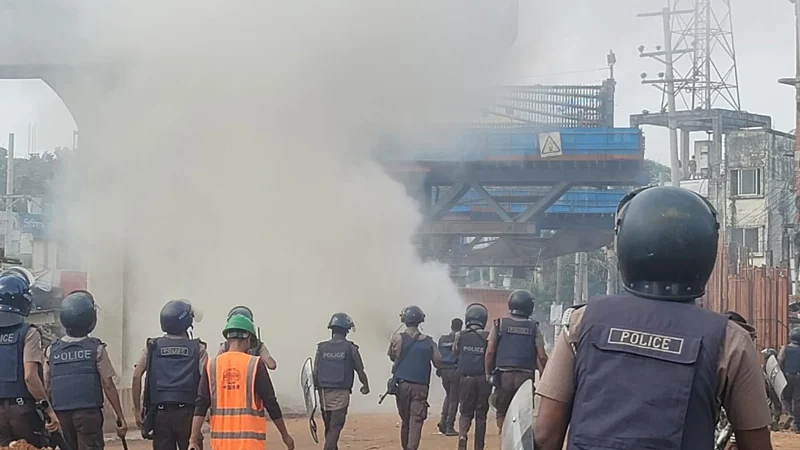 Most garment factories in Ashulia and surrounding industrial areas of Savar, on the outskirts of Dhaka, have announced closures amid continuing labour unrest over demands for a minimum monthly wage of Tk 30,000.
Ashulia Industrial Police Superintendent Mominul Islam Bhuiyan confirmed the closures, adding that round-the-clock security would remain in place across the industrial zone.
Garment workers have been protesting for several days in Dhaka and neighbouring industrial areas, demanding an increase in the minimum monthly wage. In Gazipur’s Kaliakair, workers blocked the Dhaka-Tangail Highway for the fourth consecutive day on Monday, taking positions on roads in Chandra, Palli Bidyut, Harinhati and Safipur from the morning. The demonstrations brought traffic on the highway to a halt.
Workers also took to the streets in the Ashulia industrial zone on Monday morning, triggering several clashes with police. Law enforcement personnel fired tear gas and sound grenades to disperse protesters. A covered van was also set on fire during the unrest.
Workers from several factories stopped working and joined the demonstrations. Additional police personnel were deployed as authorities attempted to bring the situation under control.
Mominul Islam Bhuiyan alleged that outsiders and troublemakers had joined the workers’ movement. He said additional police had been deployed across the industrial zone and that authorities were working to restore calm.
Regarding the covered van set on fire, he said legal action would be taken. He added that police had information about the alleged involvement of outsiders and would take necessary measures.
Industrial police had not made any arrests at the time of the report, but efforts were underway to identify and detain those involved.
The police superintendent said security arrangements would remain in force around the clock. He added that personnel from Dhaka district police were also assisting in managing traffic and maintaining order amid road blockades, fires and reported attempts to set vehicles ablaze.
The unrest follows similar demonstrations in Dhaka’s Mirpur on Sunday, where workers protested, blocked roads and clashed with police. Workers and law enforcement personnel were injured in the clashes, while several people were detained. Authorities subsequently ordered closures at numerous garment factories in the district on security grounds.
BGB deployed in Gazipur
Meanwhile, 10 platoons of the Border Guard Bangladesh (BGB) have been deployed in Gazipur to help maintain law and order amid the ongoing labour unrest.
The Gazipur district administration confirmed the deployment on Monday morning. District Commissioner Nurul Karim Bhuiyan said BGB personnel were carrying out field duties under the leadership of 21 executive magistrates.
The deployment aims to contain unrest over workers’ wage demands and other grievances, while preventing further disruption across industrial areas. BGB personnel have taken positions at different locations in the district and metropolitan area as security agencies remain on alert.
Government forms six-member wage board
Amid the protests, the government has formed a six-member Minimum Wage Board to reassess wages in the ready-made garment industry.
Labour and Employment Minister Ariful Haque Chowdhury announced the formation of the board at a press conference at the Secretariat on Sunday morning. He urged workers to return to their workplaces, saying their demand for a new wage board had been addressed.
The minister held separate meetings with labour leaders on Friday and representatives of the Bangladesh Garment Manufacturers and Exporters Association (BGMEA) and the Bangladesh Knitwear Manufacturers and Exporters Association (BKMEA) on Saturday. Following discussions with both sides, he announced the formation of the board.
The board will be chaired by Senior District and Sessions Judge Sheikh Ashfakur Rahman. Its other members include ABM Shamsuddin, a director of BGMEA, representing factory owners; Babul Akhtar, general secretary of the Bangladesh Garments and Industrial Workers Federation (BGIWF), representing workers; Asif Ayub, joint secretary-general of the Bangladesh Employers’ Federation; and two independent members, Mosleh Uddin Ahmed and Anwar Hossain.
The board will recommend minimum wages for workers across all grades. Based on its recommendations, the government will announce a revised wage structure and publish it in an official gazette.
The previous minimum wage for garment workers was set at Tk 12,500 in December 2023 and came into effect the following month.
Minimum wage boards for the garment sector have traditionally been formed every five years. However, amendments to the Labour Act passed by Parliament on April 10 reduced the wage revision interval from five years to three. Under the revised timeline, a new minimum wage board was expected to be announced in November.
Publisher: Mustakim Nibir
Copyright © 2026 The Times OF Dhaka. All rights reserved. প্রিন্ট করুন
 সেভ করুন