
More than 50 shrimp farms set up in Maheshkhali after clearing mangroves, natural storm barrier destroyed
Mangroves of Sonadia Vanishing: Shrimp, Salt and the Grip of Influential Land Grabbers
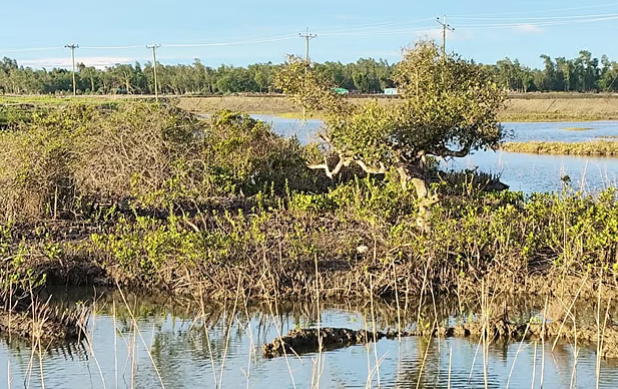
From the bridge over the Ghatibhanga canal in Kutubjom Union, one can spot lines of tamarisk trees in the distance on Sonadia Island. A small canal branches off here, once a natural waterway leading to the island. At its mouth now stands a massive earthen embankment. Inside, salt pans stretch across the cleared land where dozens of workers are piling freshly harvested salt.
A short walk further reveals a disturbing sight—thousands of cut stumps scattered like the aftermath of a storm. This land, once dense with mangroves, is now stripped bare. Shrimp farms and salt fields have replaced forests that once acted as a natural shield against cyclones. Locals confirmed that the canal itself has been fragmented and turned into shrimp enclosures, no longer recognisable as a waterway.
Encroachment backed by power
Salt farmer Md. Sohel of Ghatibhanga admitted the mangroves were cleared over recent years. The destruction, he said, was driven by influential figures who converted forestland into shrimp and salt farms. When pressed about names, he declined to speak further.
Records from the Maheshkhali Forest Division show the first case of mangrove land grabbing was filed in 1989. Since then, nearly 200 cases have been filed, with over 900 people named as accused. Many of the names are politically connected.
Among them are BNP and Awami League leaders, including former MPs, local union chairmen, and party organisers. Allegations suggest that successive governments turned a blind eye, with powerful individuals lobbying against enforcement. Forest officials admit that attempts to take legal action were often blocked by political intervention.
Shrimp and salt drive destruction
The mangroves are being cut down largely for two purposes: shrimp cultivation during the rainy season and salt production in the dry season. Both are highly profitable.
Environmentalists estimate that one acre of salt pans yields 1,000–1,300 maunds of salt annually. At Tk 500–600 per maund, income from just one acre can reach Tk 800,000 a year. A 20-acre farm, therefore, can generate around Tk 16 million (1.6 crore). Shrimp projects, which often cover hundreds of acres, earn several times more—bringing in Tk 20–25 million annually.
The investment needed to grab and clear mangrove land is significant—Tk 5 to 10 million for dredging canals, building embankments, and paying labourers. Yet the long-term returns are so high that local elites and business groups continue to pour money into such projects.
A legal system stuck in limbo
Despite nearly 200 cases filed by the forest department since 2010, virtually no convictions have been secured. Officials admit that lawsuits stall for years, often because accused persons never appear in court. Even when proceedings begin, bureaucratic delays, transfers of officers, and witness unavailability drag cases out for a decade or more.
A forest officer acknowledged that in his tenure he had not seen a single verdict carried out. Instead, most of those prosecuted are low-level workers, while the financiers and organisers remain untouched.
Ecological collapse
The ecological toll has been devastating. Sonadia’s mangroves once supported a rich ecosystem—250 species of fish, 150 kinds of mollusks, 50 species of crabs, 40 species of shrimp, and around 170 bird species. Rare species such as the spoon-billed sandpiper were still seen here until 2015; now they are gone. Dolphins, sea turtles, fishing cats, and mangrove plants have also rapidly declined.
Migratory birds that once flocked to the island no longer appear. Locals say biodiversity has been cut by more than half, with once-abundant species now either vanished or reduced to remnant populations.
A shield dismantled
For coastal residents, this is not just about trees. In the 1991 cyclone, hundreds of thousands perished in Cox’s Bazar and Maheshkhali. The mangroves planted afterward became a vital natural barrier, reducing the impact of tidal surges and storms.
Today, with climate change driving more extreme weather, the destruction of this shield exposes the coast to catastrophic risks. Embankments are already weakening, and if a major storm hits, the outcome could be disastrous.
Local teacher and poet Sirajul Haque warned: “We survived the 1991 cyclone because of the mangroves that were later planted. If they disappear completely, nothing will protect us from the next disaster.”
Authorities scrambling
Forest officials acknowledge that more than 12,000 acres of mangrove land are already occupied. The interim government has recently revoked Bangladesh Economic Zones Authority’s (BEZA) allocation of Sonadia and returned the land to the forest department. Local administration has also requested Tk 42 million to demolish illegal embankments.
Environmentalists, however, argue that without permanent forest outposts, Ansar camps, and strong legal enforcement, the destruction will continue.
SM Rubel of Youth for Ecology Conservation noted: “Investors remain hidden, while workers are punished. If the real patrons had been stopped years ago, Sonadia’s mangroves would still be standing.”
Summary:
The once-thriving mangrove forests of Sonadia have been systematically destroyed by politically backed land grabbers, who converted them into shrimp and salt farms worth millions. Despite nearly 200 legal cases, prosecutions have failed, while biodiversity has collapsed and coastal communities are left exposed to future disasters.
Publisher: Mustakim Nibir
Copyright © 2026 The Times OF Dhaka. All rights reserved. প্রিন্ট করুন
 সেভ করুন