
Strong stance from government sought for February polls
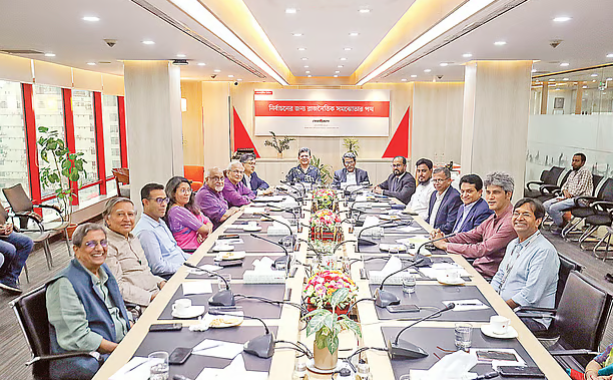
National Election in February Crucial to Prevent Instability, Say Experts
Bangladesh must hold its 13th parliamentary election in the first half of February, or the country risks both internal unrest and threats to national security. This was the central concern raised at a roundtable titled “The Path to Political Consensus for Elections”, organized in Dhaka by Prothom Alo on Saturday. Representatives from the National Consensus Commission, political parties, and civil society took part in the discussion.
Professor Ali Riaz, vice-chair of the National Consensus Commission, argued that the upcoming election should not just be about voting but about ensuring structural reforms in the state. Without such changes, he warned, the polls may not bring meaningful transformation. He outlined three possible scenarios: (1) political parties agree on election prerequisites, (2) the government takes a firm stance, or (3) nothing is done and elections are held automatically in February—with uncertain consequences.
Ali Riaz stressed that a decisive government role is unavoidable. While consensus is desirable, he cautioned that delay could worsen instability.
Matiur Rahman, editor of Prothom Alo, opened the session by highlighting past failures to deliver promised reforms. He noted that over 30 political parties have already reached consensus on key reform issues through long negotiations, and urged the government to seize this rare opportunity to implement them.
Uncertainty as the Biggest Crisis
Former caretaker government adviser Hossain Zillur Rahman identified uncertainty as the country’s most dangerous challenge. He argued that ongoing indecision is eroding public trust and causing long-term economic and social damage. Rising poverty, unemployment, and school dropouts were cited as symptoms of this instability.
He warned against dishonoring the sacrifices of those who died in July’s protests, saying that democratic transition requires trust, not division. Bangladesh, he argued, currently suffers from an “absent government syndrome” and needs a return of effective governance.
Private Sector Calls for Urgent Elections
Business leader AK Azad, chairman of Ha-Meem Group, insisted that elections must be held by February to safeguard national security. He supported the commission’s reform proposals but said implementation has been delayed too long. An interim government, he argued, lacks the full capacity of an elected one, especially in law enforcement, jobs, and investment.
Mahfuz Anam, editor of The Daily Star, criticized political leaders for failing to reach consensus, leaving ordinary citizens to suffer. He accused the government of failing both in reform and in governance, pointing to widespread instability and even absurd criminal cases against journalists, judges, and politicians.
Badiul Alam Majumdar, a member of the National Consensus Commission, reminded parties that many reforms have already been agreed upon—it is now about implementation. He warned that unless state institutions are rebuilt, Bangladesh risks repeating the crises of past controversial elections.
Preparing the Stage for Elections
Economist Debapriya Bhattacharya, of the Centre for Policy Dialogue, urged leaders to “prepare the stage and not test the patience of the audience.” He argued that excessive constitutional tinkering could open new crises, but warned that unresolved reforms will worsen inflation, labor unrest, unemployment, and falling investment.
Sociologist Samina Luthfa of Dhaka University cautioned that without a culture of compromise, February’s election risks becoming violent, with citizens as the first victims. She added that the interim government has failed to inspire public confidence in law and order.
Party Positions
-
BNP’s Salahuddin Ahmed said they want elections in the first half of February, before Ramadan. While supporting reforms, he rejected making elections conditional on judicial or reform processes, noting that justice takes time but polls cannot be delayed. He stressed that constitutional changes should be pursued through the next parliament.
-
Jamaat-e-Islami’s Matiur Rahman Akand echoed that February elections are non-negotiable, warning of worse chaos otherwise. He suggested holding a referendum to give constitutional legitimacy to the July Accord.
-
NCP’s Akhtar Hossain argued that reforms must happen before the vote; otherwise, elections alone won’t produce desired results.
-
Gonosanghati Andolon’s Zonayed Saki emphasized creating legal obligations to implement already-agreed reforms, warning against exploiting mistrust to push narrow agendas.
Security Concerns
Retired Lieutenant General Mahfuzur Rahman, chairman of the Osmani Centre for Peace and Security Studies, stressed that Bangladesh faces both traditional and new security threats, especially along the southeastern border. Interim governments, he argued, cannot provide long-term strategic direction. He called for restoring the army’s role as a defense force rather than a politicized institution, saying, “The sooner we return to an elected government, the better.”
Publisher: Mustakim Nibir
Copyright © 2026 The Times OF Dhaka. All rights reserved. প্রিন্ট করুন
 সেভ করুন