NCP Manifesto Unveiled: Truth Commission Among New Pledges

- Update Time : 08:12:47 am, Wednesday, 4 February 2026
- / 269 Time View

NCP Unveils Election Manifesto Featuring Truth Commission and Wide-Ranging Reforms
The National Citizen Party (NCP), a new political force that emerged from the July uprising, has officially entered the electoral race with the release of its election manifesto. A central pledge of the document is the establishment of a Truth and Reconciliation Commission, modeled on post-Nazi Germany and post-apartheid South Africa, alongside commitments to ensure exemplary trials for all crimes against humanity committed during the rule of the Awami League, whose political activities are now banned.
According to the party, the proposed commission would offer a pathway back into mainstream society for individuals within the administration, security forces, and civilian population who were affiliated with the Awami League but were not involved in criminal offenses. Through formal admissions of wrongdoing and public apologies, such individuals would be reintegrated under a framework of what the party describes as “social justice.”
Not a New Concept, but a Renewed Push
The idea of a truth commission is not entirely new in Bangladesh. Following the events of January 11, 2007, a caretaker government had formed the “Truth and Accountability Commission,” which allowed alleged offenders to seek immunity through confessions. That initiative ultimately failed to gain traction and was later declared unconstitutional by the High Court.
After its formation, the NCP announced a 24-point political charter on August 3 last year, calling for a new constitution and the creation of a “Second Republic.” Building on those principles, the party has now expanded its agenda into a 36-point election manifesto, incorporating new proposals such as the truth commission.
From Uprising to the Ballot Box
The July 2024 uprising brought an end to more than 15 consecutive years of Awami League rule. Leaders of that youth-led movement went on to establish the NCP in February 2025. The party is contesting the 13th parliamentary election—scheduled for February 12—in alliance with ten other parties, including Jamaat-e-Islami.
From its inception, the NCP has taken a firm stance in favor of banning the Awami League, prosecuting its leadership, and removing it permanently from political life. The party has also labeled the existing constitution “fascist” and has demanded its repeal—an issue now being put to a referendum alongside the general election.
Key Promises in the Manifesto
Accountability and Justice
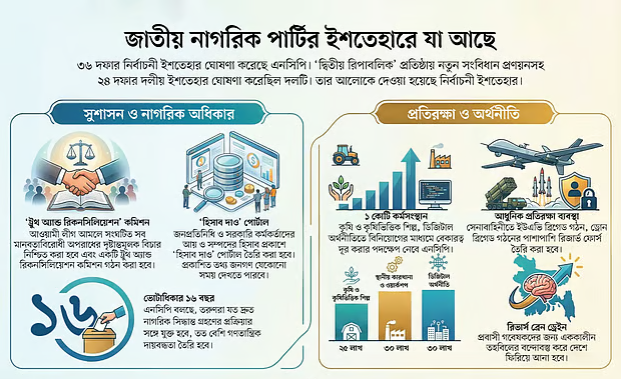
The second point of the manifesto commits to prosecuting mass killings, enforced disappearances, extrajudicial killings, the BDR mutiny case, the Shapla Chattar incident, and all other crimes against humanity allegedly committed during the Awami League era, while simultaneously forming the Truth and Reconciliation Commission.
Lower Voting Age
The NCP proposes reducing the voting age from 18 to 16, arguing that earlier participation in civic decision-making will strengthen democratic responsibility among young people.
Labor and Social Welfare
The party pledges to set a national minimum wage of 100 taka per hour, enforce zero tolerance against extortion through a dedicated hotline similar to 999, and mandate six months of paid maternity leave and one month of paid paternity leave across all institutions.
Regional Integration
The manifesto includes a commitment to pursue Bangladesh’s inclusion in ASEAN.
Defense and Security Reforms
The NCP proposes major restructuring of the security sector. Its plans include:
-
Formation of a reserve force twice the size of the regular armed forces
-
Establishment of a UAV (drone) brigade within the army over five years
-
Procurement of at least eight medium-range surface-to-air missile batteries
The party estimates a one-time cost of 5 billion taka for the reserve force, with an annual budget of 4 billion taka. Around 30,000 young people would receive 10 weeks of military training each year, followed by annual refresher courses.
Law Enforcement and Intelligence Overhaul
If elected, the NCP says it will dissolve the Rapid Action Battalion (RAB) and reorganize the Directorate General of Forces Intelligence (DGFI). RAB would be replaced by a modern elite police unit operating under a clear legal framework to prevent political misuse and human rights violations. Parliamentary oversight of intelligence agencies would be strengthened.
Reversing Brain Drain
To attract expatriate and foreign researchers back to Bangladesh, the NCP promises a “reverse brain drain” program. Over five years, 100 high-caliber researchers would receive national research grants, each project funded with an average of 50 million taka. Senior researchers would earn 200,000 taka per month, while PhD researchers would receive 60,000 taka. The program’s annual budget is projected at 1.2 billion taka.
Employment and Citizen Services
The party aims to create at least 10 million dignified jobs within five years across agriculture, manufacturing, construction, the digital economy, and infrastructure. It also plans to establish 2,000 citizen service centers nationwide through public-private partnerships.
Transparency and Digital Governance
The manifesto promises a public “Account Portal” where annual income and asset declarations of ministers, MPs, senior officials, and details of public spending will be published and regularly updated. All government services would eventually be accessible using a single National ID card.
Administrative Reform
To improve governance capacity, the NCP supports expanding lateral entry into mid-level and senior bureaucracy positions, prioritizing expertise in economics, technology, healthcare, environment, infrastructure, and policy analysis, with safeguards against political favoritism.
Specialized Healthcare Zones
The party pledges to establish specialized healthcare zones in northern and southern Bangladesh to treat complex conditions such as heart disease, cancer, trauma, infertility, and advanced surgical cases—reducing dependence on overseas medical travel. Each zone would cost an estimated 20 billion taka to build, with additional annual operational funding.
Support for Migrant Workers
The manifesto includes pension and investment benefits linked to remittance flows, travel rewards for expatriates, and a “Diaspora Digital Portal” offering one-stop online access to passports, NID services, birth registration, consular support, and investment facilities. The party also promises stricter oversight to prevent harassment at airports and embassies.
Social Housing
Finally, the NCP proposes large-scale social housing projects through public-private partnerships and waqf-based financing, centered around transport corridors and underused public land near Dhaka, with commute times limited to 30–40 minutes from the city center.