Did Female Voters Play a Decisive Role in Jamaat’s Defeat?

- Update Time : 11:18:50 am, Tuesday, 17 February 2026
- / 209 Time View

In Bangladesh’s 2026 national election, Bangladesh Jamaat-e-Islami achieved a major breakthrough. A party that had never won more than 17 parliamentary seats in previous elections secured 77 seats this time through alliances, capturing roughly 31 percent of the total vote. Long marginalized in national politics due to its controversial historical legacy, the party’s success marked a significant political comeback.
That, however, is only one side of the story. During the final phase of campaigning, Jamaat grew increasingly confident, with leaders and sympathetic commentators predicting that the party would form the government. Such claims prompted debate over whether voters would overlook the country’s traumatic memories of 1971.
One possible reason those expectations did not fully materialize may lie in the behavior of female voters.
Campaign Messaging and Gender Perceptions
Jamaat leaders repeatedly emphasized that they alone could safeguard the honor and security of women. Party chief Shafiqur Rahman told a rally in Barishal that he would sacrifice his life if necessary to ensure women’s safety. At the same time, he argued that regardless of their educational or professional achievements, women should not surpass men and should remain behind them.
The notion of men as protectors of women is centuries old. Yet in contemporary society, women have increasingly stepped beyond patriarchal constraints and, in many cases, become providers and decision-makers within their families. Women have led governments, served as judges in supreme courts, and commanded armed forces in various countries.
Women are not only mothers and sisters; they are colleagues, spouses, partners, and professionals. Rather than seeking protection alone, many expect equality, dignity, and mutual respect.
Policy Proposals and Concerns Among Working Women
Critics pointed to Jamaat’s proposal to reduce women’s working hours to five hours per day to help with household responsibilities and childcare. While presented as supportive, many working women interpreted the idea as an attempt to confine them to domestic roles.
For example, a domestic worker in Dhaka reportedly insisted on returning to her village to vote, explaining that if the party’s electoral symbol came to power, women might be prevented from working outside the home. Such concerns were echoed among garment workers and other employed women, who may have chosen alternative candidates.
Women’s Participation and Political Autonomy
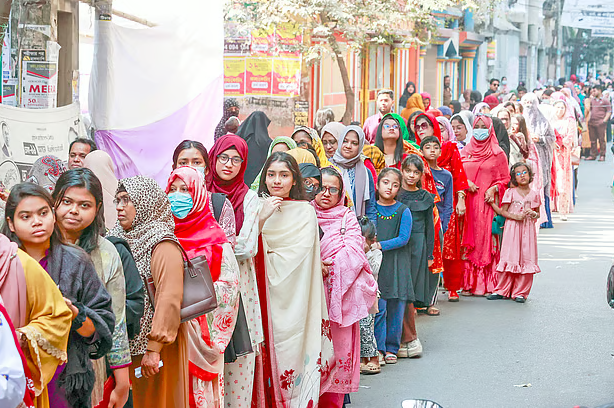
Many female voters said they had been unable to vote in previous elections or found their ballots already cast. This time, with improved access, they arrived at polling stations in large numbers, sometimes accompanied by family members. Their participation reflected a growing sense of political autonomy.
Women constitute roughly half of Bangladesh’s population and electorate. Media reports and visual coverage indicated that female turnout was substantial and proportionate.
Economic Empowerment and Voting Behavior
Women’s participation in the workforce has risen significantly in recent decades. According to the International Labour Organization, women now make up about 44 percent of the labor force. Bangladesh’s garment industry — a pillar of the national economy — relies heavily on female workers, many of whom are primary earners and household decision-makers.
Bangladeshi scholar Naila Kabeer of the London School of Economics has shown that access to paid employment can transform women’s ability to make strategic life decisions and challenge patriarchal structures. Economic empowerment often strengthens confidence in political decision-making, including voting choices.
From this perspective, Jamaat’s stance on women’s roles may have raised concerns among working women, influencing voting behavior. While isolated anecdotes cannot prove that women’s votes alone determined the outcome, demographic realities and turnout patterns suggest they may have played a significant role.
Changing Gender Dynamics in Muslim-Majority Countries
Across Muslim-majority nations, women’s political participation has expanded. In Turkey, the ruling Justice and Development Party (AKP) includes one of the world’s largest female memberships and has increased women’s participation in decision-making at national and local levels. Female representation in Turkey’s legislature has risen from about 2.4 percent in 1995 to around 20 percent today, with women serving as provincial mayors.
Similarly, in Indonesia, women hold about 21 percent of parliamentary seats, and the Islamist-oriented Prosperous Justice Party (PKS) includes roughly 30 percent female lawmakers.
These changes reflect recognition of women’s legitimate political roles rather than symbolic gestures. If political leadership in Bangladesh moves beyond rhetoric about protecting women and instead affirms their equal status and rights, the country could take another step forward socially and politically.