
418-Year-Old Laskar Khanbari Mosque Still Stands Strong
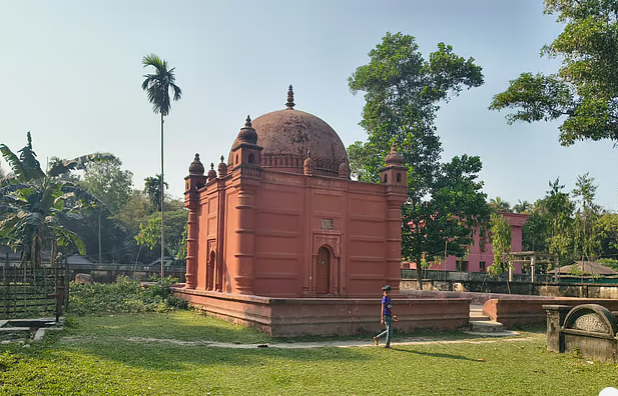
In the village of Ghaghra Laskar in Jhenaigati upazila of Sherpur stands the historic Ghaghra Laskar Khanbari Jame Mosque, a lasting reminder of the Mughal era. For centuries, this mosque has remained an integral part of the religious and cultural life of the local community, continuing to reflect its rich past.
Based on architectural features and markings on its walls, historians believe the mosque was built during the Mughal period, possibly around the time of the rebel leader Hirangi Khan of the Boxer uprising. Local heritage researchers suggest that Azimullah Khan established the mosque. It became known as the Ghaghra Laskar Khanbari Jame Mosque after the name of the village.
The mosque has a single central dome and measures approximately 30 feet in length and width. Surrounding the main dome are ten small and large মিনার (turrets). There are two windows on the north and south sides and one entrance on the eastern side. Inside, visitors can see two arches, a mihrab, and decorative motifs of flowers and vases once painted in various colors along the walls. The four-foot-thick walls were constructed using lime and surki (a traditional mixture of brick dust and lime).
About 30 worshippers can pray inside the mosque in three rows, while the open veranda and courtyard can accommodate around 100 more. The mosque stands on 58 শতাংশ land—17 শতাংশ occupied by the main structure and veranda, and the remaining 41 শতাংশ used as a graveyard.
Architecturally, the structure shows elements influenced by Greek and Corinthian styles, giving it a distinctive character. Recognizing its archaeological importance, the Department of Archaeology took responsibility for its preservation in 1999 and listed it as a protected heritage site.
A recent visit to the site reveals that the mosque is located about 12 kilometers from Sherpur town, surrounded by greenery. After traveling roughly two kilometers west along a rural পথ from the Koyerut road, the single-domed Mughal-era mosque becomes visible in the middle of open মাঠ. Two ponds sit beside it. The interior has been painted entirely white, making the original colorful decorations less visible. Prayer arrangements remain in three rows inside, and additional prayers are held outdoors on a raised platform under the open sky.
Local teacher and poet Shahinur Shimul believes the mosque was established around 1608 during the Mughal period, possibly during Hirangi Khan’s time. He notes that the mosque attracts visitors daily, many of whom also offer prayers there. However, despite its age and beauty, there appears to be limited effort toward proper conservation and restoration. With adequate initiatives, he believes the mosque could become a significant tourist attraction in the district.
Mosque committee president Md. Ferdous Khan states that the mosque was built nearly 500 years ago. Responsibility for its care has passed down through generations—from his grandfather to his father, and now to him. Five daily prayers are regularly held, with an appointed imam and muezzin. He also mentions that two ponds belong to the mosque, and income from them helps cover maintenance expenses. People from distant areas visit to see this Mughal-era structure. He adds that the interior once featured multicolored decorations, but after being painted white by the archaeology authorities, much of its original visual charm has faded.
Publisher: Mustakim Nibir
Copyright © 2026 The Times OF Dhaka. All rights reserved. প্রিন্ট করুন
 সেভ করুন