Dispute Over Large Boats Puts Sundarbans Golpata Harvest at Risk

- Update Time : 07:04:17 am, Friday, 6 March 2026
- / 19 Time View

Uncertainty Over Golpata Harvesting in the Sundarbans Amid Dispute Over Boat Size
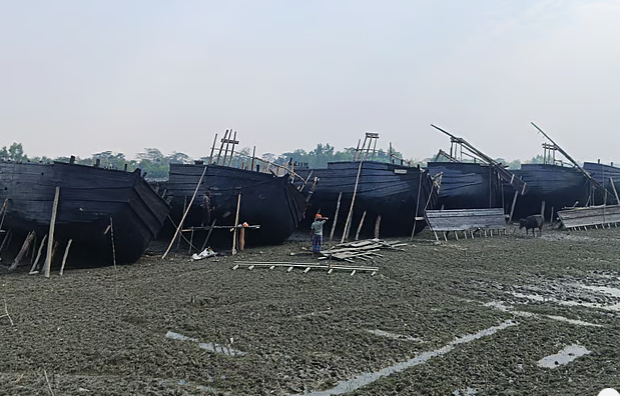
For weeks, communities along the coastal riverbanks had been busy preparing for the annual golpata harvesting season in the Sundarbans. Old boats were being repaired in some places, while others were installing new wooden decks or completing last-minute arrangements. Bawalis (forest collectors) were expecting to enter the forest from March 3 to cut golpata leaves, and most had already finished their preparations.
However, at the last moment the activity has become uncertain after the Forest Department raised objections regarding the size of the boats.
Officials from the Forest Department said there had been a plan to allow golpata collection in the Sundarbans between March 3 and March 31. According to regulations, each boat is permitted to carry a maximum of 186 quintals (around 500 maunds) of golpata. Based on that rule, authorities decided that boats with a maximum capacity of 1,000 maunds would be allowed.
But after measuring the vessels, officials found that most boats prepared for the season were larger than the permitted size. As a result, those boats are currently not being granted permission to enter the Sundarbans.
Nasir Uddin, an official of the Kashiyabad Forest Station under the Khulna Range, said he personally measured each boat using a measuring tape. According to him, nearly all the boats exceeded the 1,000-maund capacity limit. The measurements and photographs of the boats have already been sent to higher authorities for review.
Forest officials explained that in previous years many collectors paid revenue for transporting around 500 maunds of golpata but actually carried 1,500 to 2,000 maunds using larger boats. There have even been instances where valuable timber logs from the Sundarbans were secretly transported beneath stacks of golpata leaves. Authorities say the stricter enforcement of boat capacity limits aims to prevent such irregularities.
People involved in forest-based livelihoods say that large amounts of golpata naturally grow along the banks of rivers and canals inside the Sundarbans. Every year during the harvesting season, nearly 10,000 people from surrounding areas participate in collecting, transporting, and selling the leaves.
Bawali Abdul Gani said they had invested several lakh taka in preparing their boats. Arrangements for boatmen, laborers, and supplies were already completed. “Now the Forest Department is saying our boats are too large and we cannot get permission. But last year we were allowed to enter the forest with the same boat,” he said.
Mir Kamruzzaman, president of the Sundarbans Bawali Federation, said collectors usually receive permission to cut golpata for 56 days in two phases each year. This year, the Forest Department initially indicated that at least one phase of 28 days would be allowed. Based on that information, collectors repaired their boats and completed other preparations.
He argued that the authorities had renewed the boats’ permits in June last year. “If they had measured the boats then, we wouldn’t be facing this problem now,” he added.
According to him, preparing each boat costs about 200,000 taka on average, and the total investment made by collectors this year exceeds 18 million taka. If permission is not granted, many families could suffer significant financial losses.
The Forest Department, however, says strict enforcement of regulations is necessary to protect the Sundarbans. A.Z.M. Hasanur Rahman, divisional forest officer of the Sundarbans West Division, stated that collectors had already been informed about the decision. In previous years, they had to visit the forest office to have their boats measured, but this time officials went directly to the riverbanks to reduce their expenses.
“From now on, rules will be strictly followed to protect the Sundarbans,” he said.
According to Forest Department records, revenue was once collected from 12 different resources in the Sundarbans, including timber, fish, crabs, golpata, and honey. In 1989, logging of most tree species was banned by law, except for limited harvesting of gewa and goran trees. After the devastating cyclones Sidr (2007) and Aila (2009), harvesting of those trees was also stopped. Currently, revenue mainly comes from fish, crabs, golpata, honey, and tourism.
A senior forest official, speaking on condition of anonymity, said the authorities are trying to reduce pressure on the Sundarbans by gradually limiting resource extraction. The decision to ban boats with capacities exceeding 1,000 maunds is considered a significant step. However, he acknowledged that in the past such measures sometimes faced political pressure.
Environmental activists have also supported stricter rules to protect the forest. Mohammad Tarikul Islam, president of the civic group Coastal and Sundarbans Protection Movement, said dependence on forest resources must gradually decrease and the government should create alternative income opportunities for forest-dependent communities.
“The Sundarbans is a national treasure. It cannot be put at risk just to protect the interests of a small group,” he said.
Imran Ahmed, the Conservator of Forests for the Sundarbans Khulna region, said authorities initially considered suspending golpata harvesting this year. Later, following requests from collectors, they agreed to allow harvesting for 28 days starting from March 3, on the condition that the specified boat size regulations would be followed.
“Past practices are not the main issue,” he said. “If everyone follows the rules from now on, a proper system will be established.”