
Jungle Salimpur Brought Under Administrative Control
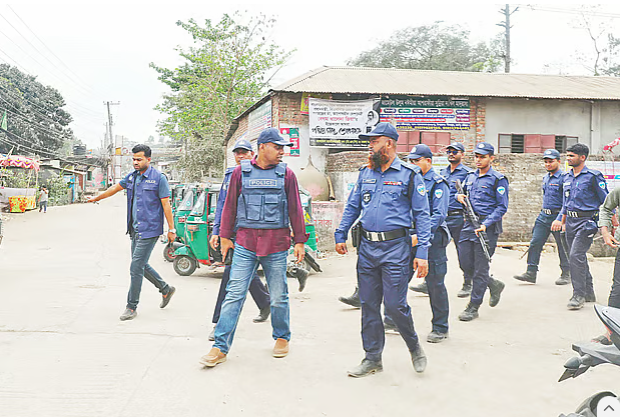
Jungle Salimpur in Sitakunda Now Under Administrative Control After Years of Lawlessness
Only a month ago, Jungle Salimpur in Sitakunda upazila of Chattogram was widely known as a place filled with fear and criminal dominance. Armed guards from local criminal groups controlled the entrance to the hill-surrounded area. Anyone entering had to show a special identification card. Even government officials and law enforcement personnel often could not enter the area. Previous attempts by authorities to conduct operations ended with attacks, forcing them to retreat.
That situation has now changed. Following a large joint operation on March 2 involving the army, Rapid Action Battalion (RAB), police, and Border Guard Bangladesh (BGB), Jungle Salimpur has come fully under government control.
For the first time, a major operation in the area concluded without violence. Law enforcement officers were not attacked, and most identified criminals fled before the forces entered. After the operation, joint forces established control of the area. Two temporary police camps have been set up, and security patrols are continuing regularly. Armed criminals are no longer seen openly, and residents are moving around the area freely. A visit to the area on Friday showed signs of this transformation.
However, the changes go beyond security alone. The area has a long history involving hill cutting, illegal occupation of government land, a lucrative land-plot trade worth hundreds of millions of taka, politically backed land grabbers, and stalled government development projects.
For decades, about 3,100 acres of land in the region had been under the control of illegal occupants. The recent operation marks the first visible establishment of government authority over the entire area.
Long History of Criminal Control
The hill-covered area began falling under criminal influence in the early 2000s. Several attempts by previous governments to regain control failed due to resistance from armed groups. In some cases, law enforcement personnel were attacked and forced to withdraw.
During an earlier operation under the interim government, a member of RAB was killed when criminals launched an attack.
Chattogram Divisional Commissioner Md. Ziauddin said the entire area is now under the control of law enforcement agencies. He added that the next step will be reclaiming illegally occupied government land. A 29-member committee has already been formed to evaluate land, environmental conditions, and other realities before recommending government development projects.
Residents Feeling Relief
Jungle Salimpur can be reached from the Bayezid–Faujdarhat road, opposite the Asian University for Women, where a road leads into the hills.
Visitors on Friday morning saw a completely different environment compared to a month earlier. People were moving freely along both narrow and wider roads carved through the hills. Shops were open, markets were busy, and children were playing beside the roads. Police patrols were visible in several places.
A shrine stands along the main road, followed by SM Pilot High School, near which a market and shopping area have become active again. Vendors selling fish, meat, vegetables, and daily goods reported a steady flow of customers, suggesting that residents are gradually returning to normal life.
Abdul Mannan, who has lived there for about ten years and works as a cook, said life has improved. Originally from Panchagarh, he explained that the area previously experienced frequent clashes between rival criminal groups and the arrival of armed outsiders at night. Now the fear has lessened because police patrols are present and criminals are no longer visible.
Other residents, including Mansur Alam, Rabiul Islam, and Kefaet Ullah, said the area has seen many shifts in power among rival groups over the years. They hope the current peace will last.
Two temporary police camps have been established—one at SM Pilot High School, where about 130 officers are stationed, and another at Alinagar High School, where around 230 members of RAB, police, and the Armed Police Battalion are deployed.
Additional Superintendent of Police Ariful Islam Siddiqui, who was on patrol, said no visible criminal activity is currently present and residents are cooperating with law enforcement. Regular patrols will continue to maintain stability.
Land Plot Business Worth Crores
At the heart of Jungle Salimpur’s problems lies a massive illegal land-plot business created by cutting down hills. At least 30 hills have been gradually flattened and divided into small plots for housing.
These plots were marketed at relatively low prices to attract buyers from various professions looking for affordable land near the city.
Police and district administration sources say that in Alinagar, a plot measuring about 2.5 kathas was being sold for roughly 3 million taka. Smaller plots were sold for about 500,000 taka. There are around 26,000 small plots, of which about 23,000 have reportedly already been sold.
Overall, locals estimate that the land trade in the area may have generated tens of billions of taka over the past four decades.
In the Alinagar residential area, many plot entrances remain locked. Some plots are empty, while others have houses built on them. Security guard Akkas Uddin said he lives with his family inside one such plot. The owner is trying to sell the land, but middleman Rahmat Ullah said no new buyers are coming after the recent operation. Even previous buyers are uncertain about the future.
Local residents claim that plots in Alinagar were mainly sold through the Alinagar Multipurpose Cooperative Society, run by associates of a man named Yasin. In other parts of Jungle Salimpur, especially the settlements of displaced people, land was sold through another group known as the Metropolitan Landless Slum Dwellers’ Struggle Council.
Operations Previously Faced Violent Resistance
For years, attempts to conduct operations in Jungle Salimpur were met with attacks. Informants at the entrance points would alert criminal groups whenever security forces arrived. From the hills, attackers would throw stones, homemade bombs, or even open fire.
The most recent fatal incident occurred on January 19, when RAB officer Motaleb Hossain Bhuiyan, an assistant director of RAB-7, was killed during an operation to recover illegal weapons.
Earlier incidents include attacks on officials in September 2023, when an eviction drive was targeted and more than 20 officials were injured, including an executive magistrate and a police station officer.
Several other operations between 2022 and 2023 also faced resistance.
The March 2 Operation
The operation on March 2 was different in scale and planning. About 3,200 personnel from various forces entered Jungle Salimpur in a coordinated effort.
Before the operation, criminals attempted to block access roads with trucks and even destroyed a culvert. Security forces repaired the culvert using bricks and sand, cleared the barricades, and launched a nine-hour operation from 5 a.m. to 2 p.m., eventually taking control of the entire area without bloodshed.
During the operation, authorities recovered 30 firearms and other locally made weapons. Three cases were filed at Sitakunda Police Station, and 22 people were arrested. However, several suspected criminals—including Yasin, Rokon, Mashiur Rahman, Nurul Haque Bhandari, Gazi Sadek, and Golam Gafur—remain at large.
Chattogram Range Deputy Inspector General Ahsan Habib Palash said the main objective was to establish state authority over the vast area, and that goal has been achieved. Two security camps are now operating there, and authorities are ready to strengthen their security if necessary.
Government Projects May Move Forward
With the area now under state control, previously stalled government development plans have returned to discussion.
In June 2022, authorities proposed dividing the area into 11 zones to build several projects, including Chattogram Central Jail-2, a model mosque, a Novotheatre, and an IT park. These plans could not proceed earlier because the land remained under illegal occupation.
Officials say the new situation could allow these projects to move forward.
A 50-acre site had already been selected for the new central jail because the existing facility holds more than three times its capacity. The location is also suitable due to its proximity to the court, medical college, and police lines.
Chattogram Central Jail’s senior superintendent Iqbal Hossain said building the new prison there would be beneficial.
According to district administration sources, at least 48 government and semi-government institutions have applied for land in Jungle Salimpur for various facilities, including military establishments, city corporations, sports authorities, Bangladesh Betar, RAB-7, Chattogram Development Authority, police, WASA, the National Housing Authority, and the Fire Service.
District Commissioner Mohammad Zahidul Islam Mia said the projects will be implemented gradually under a comprehensive master plan, with careful consideration given to preserving the natural environment of the hills.
Challenges Remain
Security analysts warn that although the government has regained control, significant challenges remain. The area contains densely populated settlements built over decades after hills were cut down. Thousands of families may require rehabilitation, and environmental restoration will also be necessary.
Security expert Major (Retd.) Mohammad Emdadul Islam said authorities must act quickly to ensure that government land is not illegally occupied again. He suggested starting planned development projects soon and even placing the area under army supervision if required.
Publisher: Mustakim Nibir
Copyright © 2026 The Times OF Dhaka. All rights reserved. প্রিন্ট করুন
 সেভ করুন