
“Hilsa Catch: From Overflowing Nets to Shrinking Hauls”
 Hilsa Fishing: From Bountiful Nets to Scarce Catches
Even during peak season, hilsa yields leave fishermen struggling
Declining Hilsa Production in Bangladesh
Hilsa season is usually a time of celebration for both fishermen and consumers, who eagerly await the arrival of the national fish. This year, however, the mood has turned somber. Despite the end of a 58-day fishing ban, fishermen along the southern coast are returning with smaller catches, facing growing financial losses.
Shamsu Bepari, owner of the trawler FB Mayer Doa from Kalapara, has made five trips since the ban ended. On his latest voyage, he returned to Mohipur Fish Landing Centre with only 22kg of hilsa and 30kg of other fish, worth around Tk 40,000—far below his operating cost of Tk 1.75 lakh. "I’ve lost nearly Tk 8 lakh this season," he said.
Mohammad Yunus, the trawler’s skipper, explained that they travel 600–700 km into deep waters, consuming a litre of fuel every 20 km. "Strong winds and rough seas are forcing early returns. We face losses every trip, but we still prepare with nets, fuel, and ice, hoping for better catches."
In Bhola’s Nasir Majhi village, fishermen are reporting similarly disappointing hauls. Hossain Majhi caught only 15kg of hilsa in the Meghna last week. Hasan Majhi managed just 6kg near Hajipur and Shahidpur, where river depth has dropped to 7.5 feet. Another fisherman, Ershad, returned from a 30km sea trip on July 6 with only three hilsa.
From Chandpur to Monpura, newly formed sandbars are blocking channels, leaving only narrow navigable routes. According to Kalu Mia, a Mohipur fisherman, “Since the ban ended, almost no one has returned home with a good catch.”
Hope Despite Challenges
Md Kamrul Islam, Patuakhali’s fisheries officer, offered cautious optimism: "Once the weather improves, fishermen may venture out for longer periods and see better catches. Last year, the peak catches came later in the season, between June and November."
Experts cite multiple reasons for the shortage. The Bangladesh Fisheries Research Institute in Chandpur attributes it partly to climate change and unpredictable weather, which has kept fishermen ashore since early July. Md Abu Kawser Didar, a scientific officer, added, "If fishermen could stay at sea longer, they would catch more."
July was unusually wet, with rainfall 23.5% above average and three low-pressure systems bringing heavy rain. Barishal Division recorded 878mm of rainfall, keeping many fishermen ashore.
Environmental Barriers
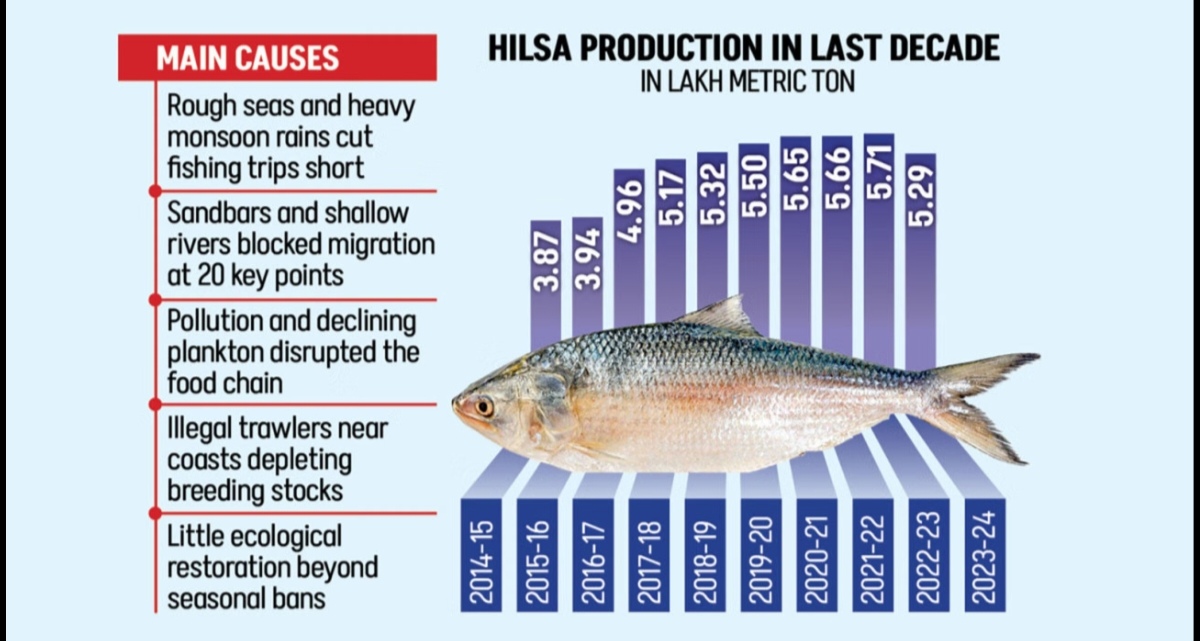
However, weather is only one factor. Poor river navigability, pollution, and altered river ecology are also affecting hilsa migration. Molla Emdadullah, project director of the Hilsa Development and Management Project (HDMP), explained: "Hilsa require ideal conditions—freshwater inflow, strong currents, river depths of at least 10m, and widths over 500m. When these are lacking, the fish migrate to other rivers, sometimes outside Bangladesh."
According to the Barishal Fisheries Office, hilsa migration is blocked at 20 points, including the Meghna, Payra, Baleshwar, Bishkhali, Andharmanik, Tetulia, Sugandha, and Gozaria rivers. A dredging proposal has been submitted to restore navigability.
A study by Sher-e-Bangla Agricultural University (2022–2025) reported a 30% decline in plankton levels in the Payra, Bishkhali, and Baleshwar rivers since 2020. "New sandbars have reduced water depth, further obstructing hilsa movement," said assistant professor Mir Mohammad Ali. Overfishing by deep-sea trawlers near the coast has also depleted hilsa, especially where water depth is only 18–20 meters—well below the 75–80 meters required for breeding.
When asked if the Department of Fisheries has taken steps beyond fishing bans, HDMP’s director replied no, but plans are underway to develop projects aimed at improving river environments for hilsa breeding. "If we do not act, pollution in the Meghna will reach hilsa nurseries, threatening the future of the species," he warned.
From 2003 to 2023, national hilsa output rose steadily, only to decline by 42,000 tonnes in 2024.
Publisher: Mustakim Nibir
Copyright © 2026 The Times OF Dhaka. All rights reserved. প্রিন্ট করুন
 সেভ করুন