Dhaka 11:19 pm, Monday, 9 March 2026

Classroom learning is weak; students rely mainly on coaching centers and private tutors

Niloy Mridha
  • Update Time : 06:17:52 am, Monday, 6 October 2025
  • / 1044 Time View

Inside Bangladesh’s Secondary Education Crisis: Too Few Teachers, Too Many Challenges

On September 11, inside the teachers’ lounge of the 190-year-old Dhaka Collegiate School—one of the oldest public high schools in the region—a teacher mentioned something striking. Although he is formally a business studies instructor, that day he had to teach both Bengali and agricultural studies. The reason? There simply aren’t enough teachers.

Another teacher, from the physics department, added that he regularly has to conduct physical education classes alongside his own subject. He said he teaches around 25 periods a week—five to six classes a day—making it almost impossible to teach well.

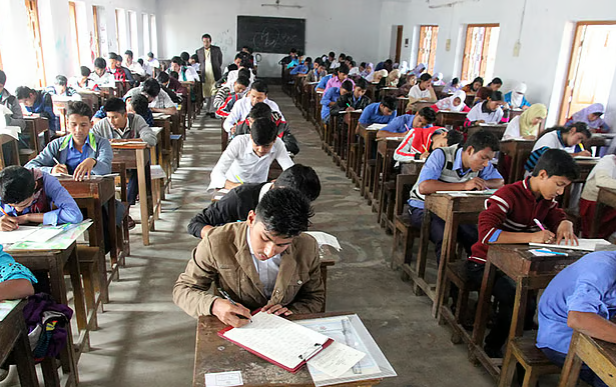
Dhaka Collegiate School, located in the Sadarghat area, runs in two shifts with nearly 2,000 students. Yet, there are only 39 teachers against 53 approved posts—14 positions remain vacant. That means roughly one teacher for every 51 students. The strain is severe, and meaningful teaching in the classroom suffers.

Two students said they rely heavily on coaching centers and private tutors. One spends about 6,500 taka a month on two home tutors.

But what’s happening at this historic school reflects a much wider national problem. Across Bangladesh, a shortage of teachers—especially subject-specific teachers—poor classroom quality, and weak instruction are preventing students from gaining essential skills. As a result, many drop out before completing secondary school. The Bangladesh Education Statistics 2023 report notes a 33% dropout rate at this level.

Families with money turn to coaching centers and private tutors. Middle-class parents are under pressure as tutoring costs mount. Poor and lower-income households simply cannot afford these supports, leaving their children academically disadvantaged.

Public schools and those under the MPO (Monthly Pay Order) system receive taxpayer funding, while private schools charge high tuition and admission fees. Yet the quality of education remains questionable.

This isn’t just a Dhaka issue—it’s nationwide. In Mymensingh, the father of an eighth grader explained his child’s daily schedule: coaching in the morning, school afterward, coaching again in the afternoon, and a private tutor at home in the evening. “It’s expensive,” he said, “but what choice do we have?”

Despite forming 11 policy commissions, the current interim government did not include education. A committee headed by Emeritus Professor Manzoor Ahmad was earlier tasked with advising improvements in primary and non-formal education, but its recommendations remain largely unimplemented.

“Classes in name only”

Professor Muhammad Azad Khan, Director General of the Directorate of Secondary and Higher Education (DSHE), admitted that the crisis is long-standing. A lack of teachers and functional management has allowed coaching and private tutoring to become alternatives to school education. Students from low-income families are falling behind or dropping out.

He also pointed to obstacles such as vacant teaching posts, delays in MPO approval, weak management committees, and political interference. Although he claims the issues have been identified and solutions are being pursued, progress is slow.

Secondary level: Too many students, too few teachers

Grades 6–10 are considered secondary education in practice, although past education policies recommended making Class 8 the end of primary and Class 12 the end of secondary.

The original goal of secondary schooling, according to the Kudrat-e-Khuda Commission (1974), was twofold: prepare skilled workers for the job market and ready capable students for higher education. Today, it does neither effectively.

According to BANBEIS (Bangladesh Bureau of Educational Information and Statistics), the country has about 18,968 general secondary schools, only 628 of which are government-run. These schools serve around 8.17 million students and employ about 247,000 teachers. There are also 1,480 “school and college” institutions that teach secondary grades, with roughly 1.61 million students and 55,000 teachers.

Public school teacher vacancies are a critical problem. DSHE data shows that around 3,500 teaching positions—about 20% of total sanctioned posts—are unfilled in government secondary schools. Many administrative positions in the sector are also vacant.

There was a target to reach a 1:30 teacher-student ratio by 2018, but government schools still average about 1:37, with some schools having far more students per teacher.

At Government Laboratory High School—one of the notable public schools—the principal’s post has been vacant for about a year. The acting headmaster is also serving in another role simultaneously, weakening administration.

To fill shortages, the authorities are considering recruiting non-cadre candidates who passed the civil service exam (BCS) but did not secure cadre posts.

Pay, promotion, and staffing frustrations

Most government secondary teachers begin as assistant teachers in the 10th grade of the salary structure. Many retire after 30–35 years without promotion. In 2018, a “senior teacher” post at the 9th grade was created, and promotions were given in 2021—but none since then.

Teachers complain that while other public sectors, like administration and police, receive timely promotions—even when new posts must be created—teachers are overlooked. Low salary and minimal career advancement discourage talented youth from entering the profession.

Coaching dependence and weak classroom standards

Schools are often closed or inactive for large portions of the year. One study showed that between August 2023 and September 2024, schools were open only 148 days out of 427.

Overcrowded classrooms prevent individualized attention, pushing families toward tutoring. A 2024 report by the Campaign for Popular Education found that household spending per student increased 25% at the primary level and 51% at the secondary level compared to the previous year. Most of that cost goes to coaching, private tutors, and guidebooks.

A 2023 UNESCO report found that 71% of education costs in Bangladesh are borne by families. Experts argue that government spending on health and education should be far higher.

Monitoring data by DSHE shows a further decline in English and mathematics proficiency among secondary students. Even Bengali language skills have worsened.

Parents often allege that teachers prioritize private tutoring over classroom teaching and that students who don’t sign up get poorer exam scores.

According to a 2012 policy, teachers are not allowed to tutor their own students and may teach only up to 10 students from other institutions per day. But this rule is largely ignored, and coaching centers frequently operate near schools, often with teachers involved.

Guidebooks have replaced textbooks as the main resource for many. Some teachers reportedly push students to purchase guides from specific publishers.

Frequent shifts in curriculum

Teacher training and capacity are already weak, and the problem is aggravated by constant policy shifts.

Creative question formats were introduced in 2008. A new curriculum followed in 2012. After the fall of the Awami League government in 2024, the interim government scrapped the 2022 curriculum and reverted to the 2012 one, even though ninth graders had already spent nearly a year under the newer system. For one year only, next year’s SSC exams will be based solely on the Grade 10 syllabus.

Now, a new curriculum is planned again for 2027. Education experts say such frequent shifts turn students into “lab experiments,” causing confusion and inconsistency.

What needs to change?

Mohammad Habib Ullah Khan, who retired on October 3 as the principal of Dhaka Collegiate School after more than three decades of teaching and administrative work, believes improving secondary education requires:

  • Filling teacher vacancies promptly

  • Proper, updated training for teachers

  • Better salaries and career opportunities to attract capable graduates

  • A stable and well-planned education framework

He argues that Bangladesh must rethink secondary education from the ground up—otherwise, inequality will keep growing, quality will keep falling, and the future workforce will remain unprepared.


Tag :

Please Share This Post in Your Social Media

Classroom learning is weak; students rely mainly on coaching centers and private tutors

Update Time : 06:17:52 am, Monday, 6 October 2025

Inside Bangladesh’s Secondary Education Crisis: Too Few Teachers, Too Many Challenges

On September 11, inside the teachers’ lounge of the 190-year-old Dhaka Collegiate School—one of the oldest public high schools in the region—a teacher mentioned something striking. Although he is formally a business studies instructor, that day he had to teach both Bengali and agricultural studies. The reason? There simply aren’t enough teachers.

Another teacher, from the physics department, added that he regularly has to conduct physical education classes alongside his own subject. He said he teaches around 25 periods a week—five to six classes a day—making it almost impossible to teach well.

Dhaka Collegiate School, located in the Sadarghat area, runs in two shifts with nearly 2,000 students. Yet, there are only 39 teachers against 53 approved posts—14 positions remain vacant. That means roughly one teacher for every 51 students. The strain is severe, and meaningful teaching in the classroom suffers.

Two students said they rely heavily on coaching centers and private tutors. One spends about 6,500 taka a month on two home tutors.

But what’s happening at this historic school reflects a much wider national problem. Across Bangladesh, a shortage of teachers—especially subject-specific teachers—poor classroom quality, and weak instruction are preventing students from gaining essential skills. As a result, many drop out before completing secondary school. The Bangladesh Education Statistics 2023 report notes a 33% dropout rate at this level.

Families with money turn to coaching centers and private tutors. Middle-class parents are under pressure as tutoring costs mount. Poor and lower-income households simply cannot afford these supports, leaving their children academically disadvantaged.

Public schools and those under the MPO (Monthly Pay Order) system receive taxpayer funding, while private schools charge high tuition and admission fees. Yet the quality of education remains questionable.

This isn’t just a Dhaka issue—it’s nationwide. In Mymensingh, the father of an eighth grader explained his child’s daily schedule: coaching in the morning, school afterward, coaching again in the afternoon, and a private tutor at home in the evening. “It’s expensive,” he said, “but what choice do we have?”

Despite forming 11 policy commissions, the current interim government did not include education. A committee headed by Emeritus Professor Manzoor Ahmad was earlier tasked with advising improvements in primary and non-formal education, but its recommendations remain largely unimplemented.

“Classes in name only”

Professor Muhammad Azad Khan, Director General of the Directorate of Secondary and Higher Education (DSHE), admitted that the crisis is long-standing. A lack of teachers and functional management has allowed coaching and private tutoring to become alternatives to school education. Students from low-income families are falling behind or dropping out.

He also pointed to obstacles such as vacant teaching posts, delays in MPO approval, weak management committees, and political interference. Although he claims the issues have been identified and solutions are being pursued, progress is slow.

Secondary level: Too many students, too few teachers

Grades 6–10 are considered secondary education in practice, although past education policies recommended making Class 8 the end of primary and Class 12 the end of secondary.

The original goal of secondary schooling, according to the Kudrat-e-Khuda Commission (1974), was twofold: prepare skilled workers for the job market and ready capable students for higher education. Today, it does neither effectively.

According to BANBEIS (Bangladesh Bureau of Educational Information and Statistics), the country has about 18,968 general secondary schools, only 628 of which are government-run. These schools serve around 8.17 million students and employ about 247,000 teachers. There are also 1,480 “school and college” institutions that teach secondary grades, with roughly 1.61 million students and 55,000 teachers.

Public school teacher vacancies are a critical problem. DSHE data shows that around 3,500 teaching positions—about 20% of total sanctioned posts—are unfilled in government secondary schools. Many administrative positions in the sector are also vacant.

There was a target to reach a 1:30 teacher-student ratio by 2018, but government schools still average about 1:37, with some schools having far more students per teacher.

At Government Laboratory High School—one of the notable public schools—the principal’s post has been vacant for about a year. The acting headmaster is also serving in another role simultaneously, weakening administration.

To fill shortages, the authorities are considering recruiting non-cadre candidates who passed the civil service exam (BCS) but did not secure cadre posts.

Pay, promotion, and staffing frustrations

Most government secondary teachers begin as assistant teachers in the 10th grade of the salary structure. Many retire after 30–35 years without promotion. In 2018, a “senior teacher” post at the 9th grade was created, and promotions were given in 2021—but none since then.

Teachers complain that while other public sectors, like administration and police, receive timely promotions—even when new posts must be created—teachers are overlooked. Low salary and minimal career advancement discourage talented youth from entering the profession.

Coaching dependence and weak classroom standards

Schools are often closed or inactive for large portions of the year. One study showed that between August 2023 and September 2024, schools were open only 148 days out of 427.

Overcrowded classrooms prevent individualized attention, pushing families toward tutoring. A 2024 report by the Campaign for Popular Education found that household spending per student increased 25% at the primary level and 51% at the secondary level compared to the previous year. Most of that cost goes to coaching, private tutors, and guidebooks.

A 2023 UNESCO report found that 71% of education costs in Bangladesh are borne by families. Experts argue that government spending on health and education should be far higher.

Monitoring data by DSHE shows a further decline in English and mathematics proficiency among secondary students. Even Bengali language skills have worsened.

Parents often allege that teachers prioritize private tutoring over classroom teaching and that students who don’t sign up get poorer exam scores.

According to a 2012 policy, teachers are not allowed to tutor their own students and may teach only up to 10 students from other institutions per day. But this rule is largely ignored, and coaching centers frequently operate near schools, often with teachers involved.

Guidebooks have replaced textbooks as the main resource for many. Some teachers reportedly push students to purchase guides from specific publishers.

Frequent shifts in curriculum

Teacher training and capacity are already weak, and the problem is aggravated by constant policy shifts.

Creative question formats were introduced in 2008. A new curriculum followed in 2012. After the fall of the Awami League government in 2024, the interim government scrapped the 2022 curriculum and reverted to the 2012 one, even though ninth graders had already spent nearly a year under the newer system. For one year only, next year’s SSC exams will be based solely on the Grade 10 syllabus.

Now, a new curriculum is planned again for 2027. Education experts say such frequent shifts turn students into “lab experiments,” causing confusion and inconsistency.

What needs to change?

Mohammad Habib Ullah Khan, who retired on October 3 as the principal of Dhaka Collegiate School after more than three decades of teaching and administrative work, believes improving secondary education requires:

  • Filling teacher vacancies promptly

  • Proper, updated training for teachers

  • Better salaries and career opportunities to attract capable graduates

  • A stable and well-planned education framework

He argues that Bangladesh must rethink secondary education from the ground up—otherwise, inequality will keep growing, quality will keep falling, and the future workforce will remain unprepared.