Allegations of Design Changes and Corruption in the Kewatkhali Bridge Project

- Update Time : 10:16:15 am, Saturday, 14 June 2025
- / 755 Time View
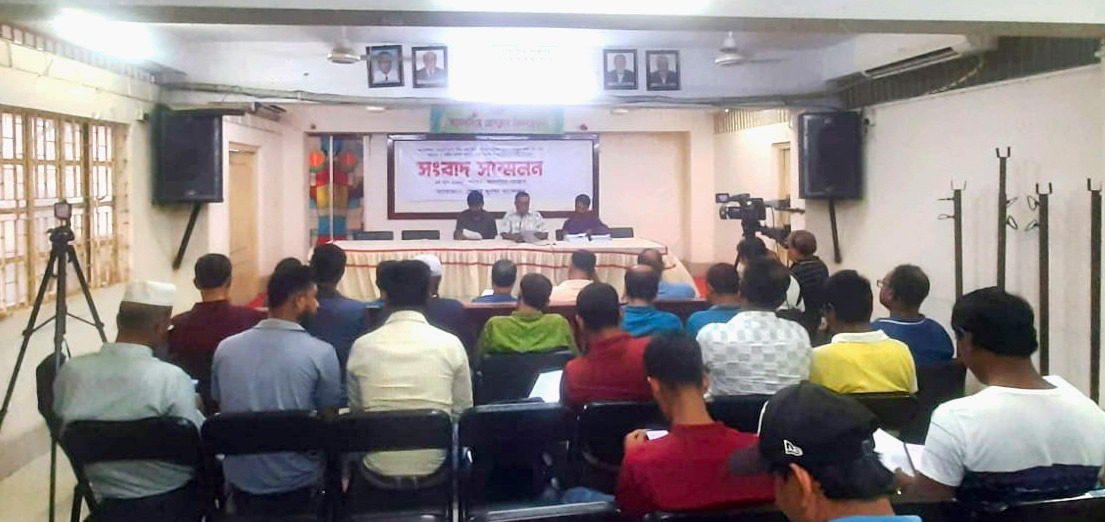

Citizens’ group Brahmaputra Protection Movement has raised allegations of unauthorized design changes, irregularities in land acquisition, and misuse of public funds in the long-anticipated Kewatkhali Arch Steel Bridge project in Mymensingh. At a press conference held on Saturday at the Mymensingh Press Club, the group called for an investigation and appropriate action against those involved in altering the design approved by the Executive Committee of the National Economic Council (ECNEC), including the unauthorized construction of the connecting roads.
The organization’s coordinator, Abul Kalam Al Azad, read the written statement, where he alleged that “deliberate alterations have been made to the connecting roads of the project, ignoring the original ECNEC-approved design, apparently to benefit certain influential real estate companies. This not only disrupts proper development but also leads to an abnormal increase in project costs.”
According to him, the project was approved by ECNEC on September 23, 2021. The approved design specified a 320-meter-long main bridge with 5.1 kilometers of connecting roads on both sides, totaling 6.2 kilometers in length, at an estimated cost of Tk 3,263 crore. However, during implementation, the length of the connecting roads was increased to 8.2 kilometers without ECNEC approval.
Additionally, the land acquisition requirement has reportedly been expanded from 81.56 acres to 113 acres, which will result in approximately Tk 500 crore in additional acquisition costs. A significant portion of this additional land is owned by politically influential individuals, raising further concerns of corruption, he claimed.
The unauthorized 2.1-kilometer extension of the connecting road will now require the construction of several new small and large bridges, ramps, and overpasses. This is likely to lead to the eviction of agricultural land, educational institutions, religious structures, and residential properties. Moreover, five important roads may have to be closed, potentially increasing project costs by an additional Tk 2,000 crore, said Faisal Farnim, spokesperson for the Mymensingh Student Movement Against Discrimination.
Another member of the organization, Biplob Nib, added, “The revised connecting road is being linked to the old China Bridge highway. Instead of easing traffic congestion, this will actually worsen it and make the road more accident-prone.” Mymensingh is already ranked as the ninth slowest city in the world in terms of traffic, and with the implementation of the modified design, it could become the fifth slowest, he warned.
The press conference also revealed that a public interest writ petition was filed in the High Court on June 4 by the citizens of Mymensingh, under the title Abul Kalam Al Azad vs. Government of Bangladesh and Others, seeking the implementation of the project in accordance with the ECNEC-approved design. The court has already issued a ruling in this regard.
Although the Ministry of Road Transport and Highways has formed a four-member investigation committee following local demands, the investigation report has yet to be published.
At the press conference, the Brahmaputra Protection Movement placed six demands:
1. The Kewatkhali Steel Arch Bridge must be built according to the original ECNEC-approved design.
2. The approved design must be publicly displayed at key locations.
3. Those involved in changing the design must be identified through investigation.
4. Strict punitive measures must be taken against individuals involved in corruption.
5. Public participation in the project implementation process must be ensured.
6. Land acquisition and construction of the connecting roads must be suspended until the investigation is completed.
Abul Kalam Al Azad concluded, “We are not against the Steel Arch Bridge itself. Rather, we want the project to be implemented quickly, transparently, and in the public interest—so that it does not become a burden for the people of Mymensingh but instead serves as a benefit.”
Journalists, civil society members, student representatives, and environmental activists were present at the press conference.
Attachments:
1. Photos from the press conference
2. ECNEC-approved and unauthorized design maps