Will US trade barriers on China and India open doors for Bangladesh?

- Update Time : 07:34:50 am, Thursday, 4 September 2025
- / 338 Time View

Higher US Tariffs on India and China Could Boost Bangladesh’s Garment Exports, Say Local Experts
The recent move by the Trump administration to impose higher reciprocal tariffs on India and China—two of Bangladesh’s main competitors in the global ready-made garment (RMG) sector—is being seen as a potential advantage for Bangladeshi exporters.
However, industry insiders caution that it is too early to celebrate, as several factors could limit the benefits.
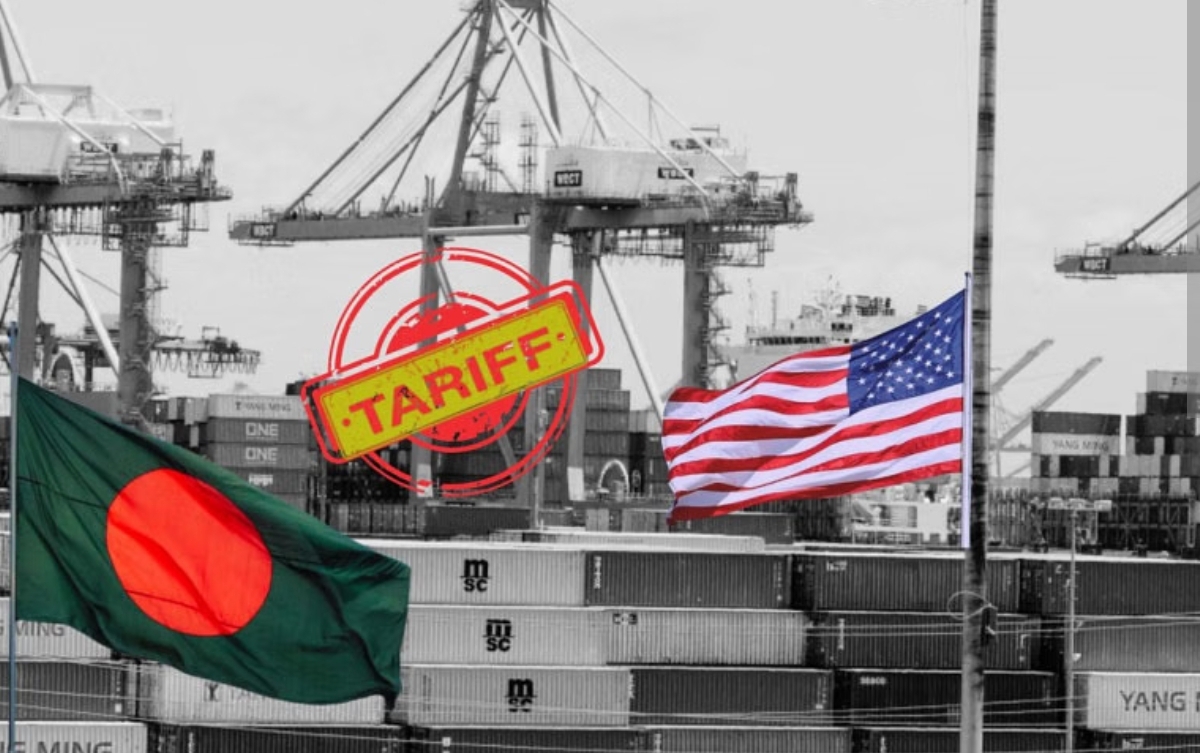
The United States has levied tariffs of 50% on Indian shipments and 30% on Chinese shipments, while Bangladeshi goods face only a 20% rate. This differential gives Bangladesh a potential edge as an alternative sourcing destination for international retailers and brands.
Speaking at a recent event, Zahid Hussain, former lead economist at the World Bank’s Dhaka office, suggested that Bangladesh’s RMG sector could see up to $2 billion in additional orders, largely redirected from India and China due to the tariff advantage.
Still, exporters emphasize that precise estimates are difficult, and Bangladesh may not yet be prepared to handle such a major shift.
Fazlul Hoque, managing director of Plummy Fashions, said, “It is too early to celebrate. Many uncertainties remain. Trump’s policies are unpredictable, and negotiations could lower tariffs for India and China at any time.” He added that Bangladesh’s industry is still developing and may not be ready to attract $2 billion worth of shifting orders immediately.
Nonetheless, Hoque acknowledged the potential upside: “If circumstances align, the actual redirected orders could even exceed the $2 billion estimate.”
Shovon Islam, managing director of Sparrow Group, a major supplier to the US market, confirmed that some orders are already moving to Bangladesh. “American retailers and brands have started issuing work orders following the tariff announcement. But it is unrealistic to expect that Bangladesh will secure all the business overnight,” he noted.
Islam highlighted domestic limitations, including production capacity and technical readiness, which may constrain the country’s ability to fulfill large volumes or higher-value orders. He also pointed out that India’s strength in value-added garment production may limit order shifts to simpler, basic apparel.
Some Indian exporters are reportedly sharing the tariff burden with US buyers, which reduces the overall impact of the higher duties and helps maintain competitiveness. Moreover, future negotiations between India and the US could lower tariffs for India, further affecting the flow of redirected orders.
Mahmud Hasan Khan, president of the Bangladesh Garment Manufacturers and Exporters Association (BGMEA), said it is still too early to quantify the gains. “There is no verified data on how much business might shift. The impact could be less than $2 billion or even higher, depending on competitor behavior and market responses. The opportunity exists, but it is still in its early stages.”
He added that only after a few months will it become clearer how Bangladesh might benefit from the new US tariff regime.