Trump claims international law is unnecessary, says his policy is enough

- Update Time : 09:44:16 am, Friday, 9 January 2026
- / 223 Time View


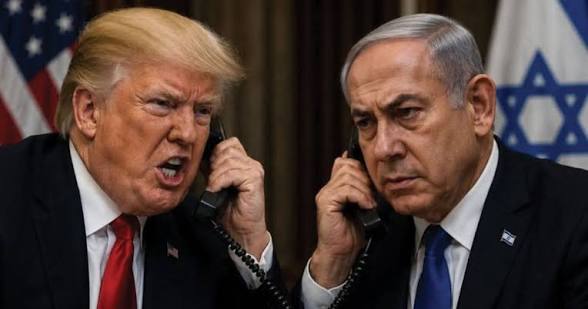
Declaring that he does not feel bound by international law, US President Donald Trump has said that his own moral judgment is sufficient to guide what he described as America’s aggressive actions around the world. He made the remarks amid rising global tension following the detention of Venezuelan President Nicolás Maduro.
In an interview with The New York Times, Trump said he does not need international law and insisted that he has no intention of harming people. When asked whether global legal frameworks should be respected, he replied that it depends on how international law is defined. His comments suggest a willingness to rely on personal judgment rather than established international norms.
Trump has also hinted at the use of overwhelming military force to advance his foreign policy agenda.
Early Saturday morning, US forces launched attacks inside Venezuela. Explosions were reported in the capital, Caracas, as well as at several military installations. During the operation, Venezuelan President Nicolás Maduro was taken into US custody. Critics argue that the action represents a clear violation of the United Nations Charter, which prohibits the use or threat of force against the territorial integrity or political independence of another state.
Following the Venezuela operation, Trump’s rhetoric has grown even more confrontational. He stated that the United States would now “manage” Venezuela and make use of the country’s vast oil reserves. At the same time, his administration has publicly expressed support for Venezuela’s interim president, Delcy Rodríguez.
However, in an interview with The Atlantic published on Sunday, Trump issued a warning, saying that Rodríguez could face consequences even greater than Maduro’s if she failed to comply with US plans.
Meanwhile, protests have erupted in Caracas demanding the release of the detained Venezuelan president. Demonstrators took to the streets on January 7, calling the incident an act of abduction and a violation of national sovereignty.
Earlier this week, Trump also suggested that military action against Colombia’s leftist president, Gustavo Petro, could not be ruled out. In addition, he has intensified efforts related to taking control of Greenland, an autonomous territory under Denmark. Previously, in June, Trump directly involved the United States in war by ordering airstrikes on three major Iranian nuclear facilities.
Experts have warned that such disregard for international law could lead to serious global consequences. Yasra Sweidi, a professor of international law at the University of Manchester, told Al Jazeera that Trump’s stance sends an extremely dangerous signal. She cautioned that it could encourage countries such as China or Russia to adopt similar approaches toward Taiwan or Ukraine.
Concerns have also been raised within international legal circles. Margaret Satterthwaite, the UN special rapporteur on the independence of judges and lawyers, warned that the world may be sliding back into a new era of imperialism. Ignoring international law, she said, risks emboldening hostile states to act more aggressively.
Ian Hurd, a political science professor at Northwestern University in Illinois, pointed to the long and painful history of US intervention in Latin America. Citing examples such as Chile, Nicaragua, and Haiti, he said past interventions have repeatedly led to regret rather than success, arguing that such actions rarely produce positive outcomes.