Young Leaders Step Forward with a 24-Point Plan

- Update Time : 07:19:02 am, Monday, 6 January 2025
- / 524 Time View
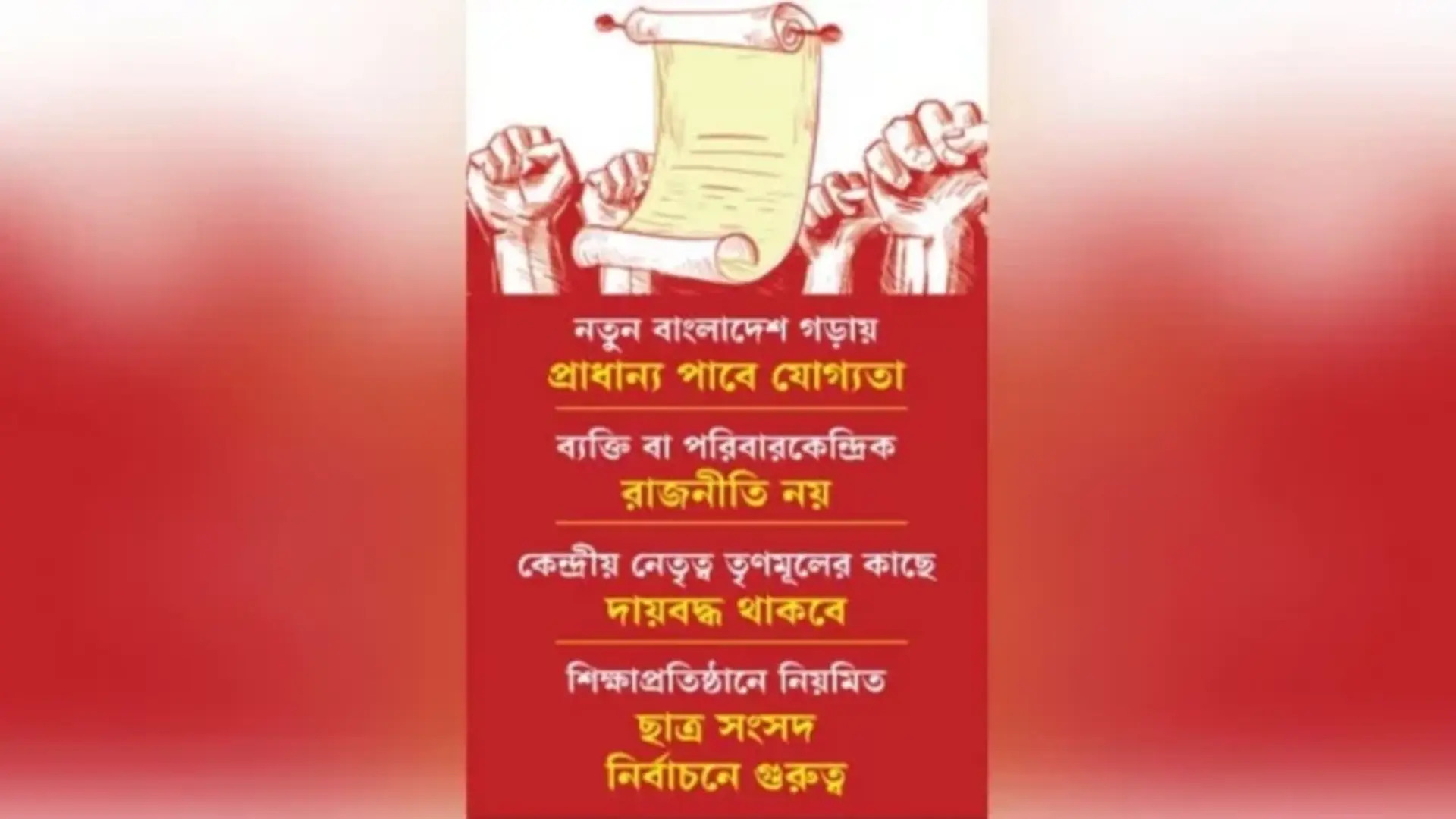

The National Citizens’ Committee is expanding its organizational presence nationwide with the aim of forming a political party. The youth-led movement, which embraces the spirit of student and public uprisings, plans to unveil its 24-point manifesto (manifesto) for creating a new nation. This manifesto will outline how the party envisions the country’s political, cultural, and economic development, with a roadmap for building a new state. National unity will be the core principle of the party.
Rather than becoming a political party, the Citizens’ Committee will remain a platform. To prevent any individual from assuming sole control, a democratic process will be established to remove leaders. The party’s structure will emphasize merit over familial connections, allowing capable individuals to rise from grassroots to central leadership. The party leader will not hold any executive positions, including the role of head of government.
The National Citizens’ Committee made its public debut at the Central Shaheed Minar in Dhaka, following a student movement against discrimination. They have already formed over 160 representative committees across the country, with significant expansion beyond Dhaka, including committees in Tangail and Madhupur. According to spokesperson Samantha Sharmeen, the manifesto will advocate for constitutional revision, the restructuring of constitutional institutions, and the guarantee that no one faces persecution due to religion or ethnicity.
The committee’s secretary, Akhtar Hossain, mentioned that while not all members of the district committees will join the new political party, most are expected to do so. The party aims to announce itself in February, with a focus on promoting leadership by many rather than by one individual. The leadership will come from the youth who have fought against fascism and led uprisings.
The committee is working on the party’s structure and the manifesto, which will include visions for cultural, political, and economic reforms. The manifesto will also introduce measures such as limiting individuals to two terms as prime minister and supporting small and medium-sized entrepreneurs to break up large mafia syndicates. Additionally, student union elections will be mandated annually in educational institutions.
The committee aims to ensure that its leadership remains accountable to the grassroots and operates based on merit. The party’s structure will allow for democratic control over the leader, with provisions for their removal if necessary.
Co-spokesperson Saleh Uddin Sifat emphasized that the party will prioritize youth involvement and work based on their aspirations for a new Bangladesh. The committee is also considering various proposals regarding the party’s name and leadership, but no decisions have been made yet.
The National Citizens’ Committee is viewed as a large-scale political initiative, incorporating various wings, including professional, research, cultural, and labor sectors. While not all members will join the political party, the committee is analyzing the structures of domestic and international political parties to create an ideal model. The party’s financial policies are also being finalized.
Monira Sharmeen, the joint convener, stated that the committee is working in teams to finalize the party’s structure, and while nothing is definitive yet, the manifesto will reflect the aspirations of the people and establish a democratic structure within the party. Unity will be the main principle for the party, which aims to offer a blueprint for the desired new Bangladesh. They are also working on outreach programs to communicate their message to the public and analyze the weaknesses of other political parties.
Central committee member Alauddin Mohammad highlighted that the party will reflect the constitution written during the public uprisings and prioritize the families of the injured and martyrs in its committees. The manifesto will outline the path for state reform and the creation of a new republic, with a national consensus on sovereignty and the foundation for making Bangladesh a republic.