Behind the glitter of Gulshan–Banani lies a parallel city ruled by money, power and midnight disorder
Dhaka After Dark: A Hidden City Behind the Glitz of Gulshan–Banani

- Update Time : 01:17:43 pm, Sunday, 7 December 2025
- / 585 Time View
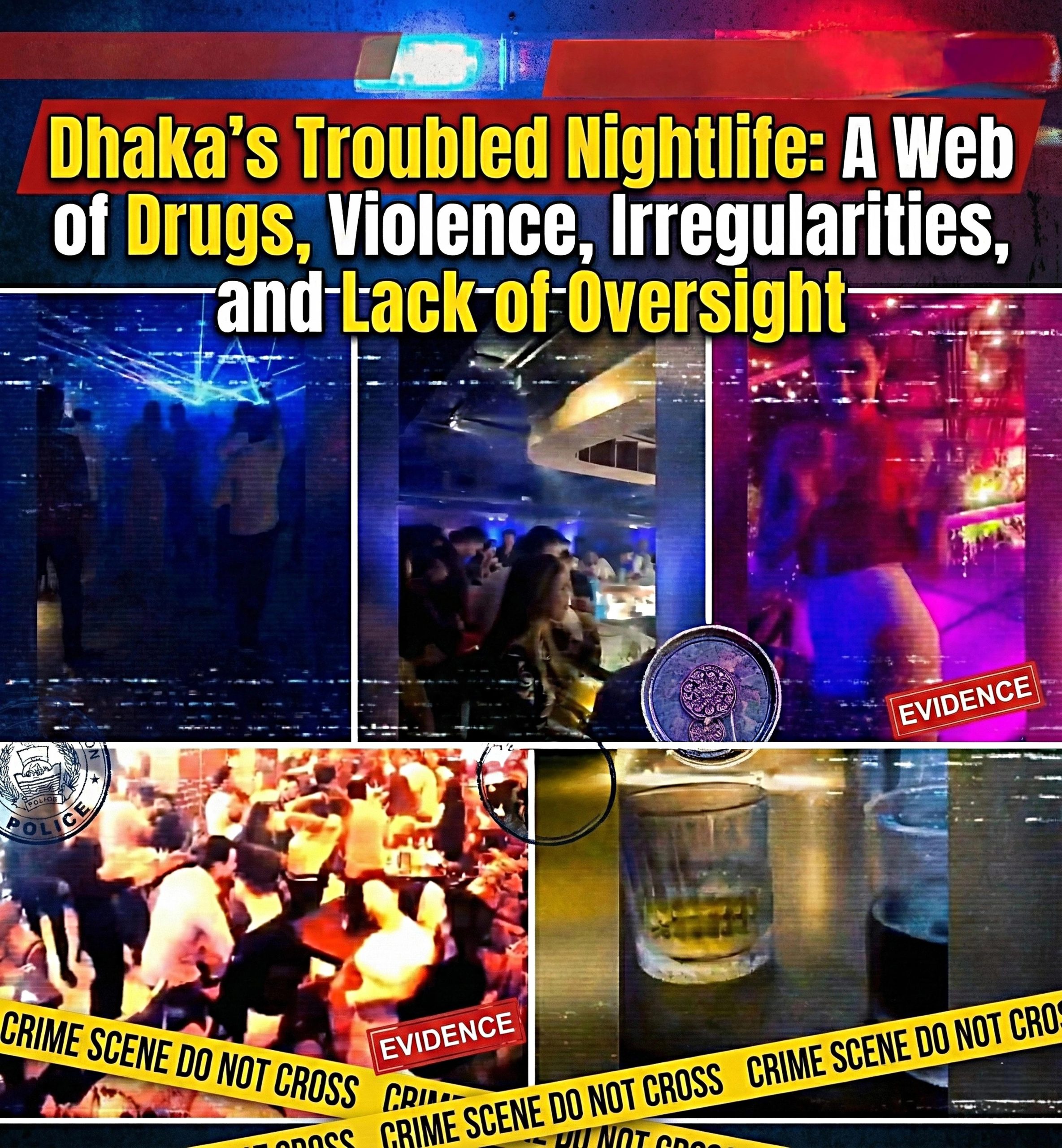

An in-depth look at the spiralling problems of Dhaka’s night economy—crime, drugs, disorder and a vacuum of regulation
By day, Dhaka presents itself as a clean, organised and globally connected metropolis. But as night descends, a very different city begins to surface—one driven by unregulated nightlife, drug circulation, loud parties, violence and the invisible presence of powerful networks.
In neighbourhoods like Gulshan, Banani and Baridhara, the scene changes dramatically. Once the sun sets, these elite zones often slip under the influence of groups who run a parallel nighttime world, where luxury entertainment masks a deeper, darker ecosystem.
Diplomatic zones that remain orderly and secure during the day transform rapidly after midnight. Rooftop parties, hotel-based entertainment, exclusive lounges and private events dominate the landscape. This shift goes far beyond noise or crowds—it exposes an entire economy operating outside consistent oversight, deeply rooted in influence and money.
When Night Falls, the Neighbourhood Changes
Residents say the hours between 11 pm and 3 am have become the riskiest. While most people prepare to rest, nightlife activity begins to peak: rows of cars, booming DJ music, crowds outside hotels and long queues for private parties.
Many who invested heavily to live in “quiet, premium” neighbourhoods now feel betrayed.
One resident said:
“I spent a huge amount expecting peace. Now it feels like the area is rented out every night for business.”
Another added:
“After 2 am, the noise—from horns to shouting—makes normal life impossible.”
Shisha Lounges Shut Down—but More Dangerous Operations Continue in Secret
Following the government’s ban on shisha lounges, many assumed the disturbances would reduce. Instead, the business only moved underground—to rooftops, hotel basements, VIP suites and themed lounges.
Deputy Director of the Department of Narcotics Control, Shamim Ahmed, said:
“Shisha lounges are illegal and cannot be authorised. We conduct raids, but eliminating them completely requires cross-agency coordination.”
Despite laws, powerful networks ensure these setups continue with ease.
A Million-Dollar Nightlife Industry—Insiders Admit the Truth
Why do secret lounges and private events survive frequent crackdowns? Several owners, speaking anonymously, provided the answer.
One operator confessed:
“This is not a small business—it’s a multimillion-taka system. People at many levels benefit. Otherwise we couldn’t run even a day.”
“Either regulate us with licences or shut everything down completely. Operating in a grey zone is the biggest risk.”
Their comments expose a tightly woven ecosystem involving money, influence and multiple layers of protection.
Drugs, Excitement and Violence—Murders in Elite Zones
Drug-linked altercations and late-night clashes in affluent areas have surged. What begins as a party dispute sometimes ends in fatal violence.
At Gulshan’s Bills Art Bar, a minor argument escalated into a stabbing that killed youth leader Diburul Islam.
Months earlier, young man Rahat Rabbi was killed outside Banani’s 360 Degree Lounge.
Security expert Brig. Gen. (Retd.) Mahbubur Rashid noted:
“Those who break rules in elite zones are rarely ordinary people. To dismantle this network, investigations must start from the top.”
Police Say Their Role Is Limited—But Where Does Responsibility Lie?
According to DMP official Khaled:
“Police do not issue licences for bars or lounges. We only maintain law and order. Patrols have increased.”
But residents argue that patrols alone cannot control an operation that is highly coordinated, well-funded and protected by influential circles.
Urban planner Farhana Nasrin says:
“Gulshan and Banani were designed as residential zones. Excessive commercial approvals have destabilised the entire area.”
An Unregulated Nightlife Is Affecting Mental Health Too
Experts warn that unchecked night activity does more than increase crime—it affects mental health, community values and family stability.
Urban sociologist Dr. Tahmina Sultana explains:
“Safety shouldn’t disappear at night. The uncertainty in Gulshan–Banani sends a harmful message to young people that anything goes.”
The absence of healthy entertainment spaces, she cautions, can push youth toward unsafe alternatives.
Dhaka’s Night Economy—A System too Complex to Control Easily
Studies show that Dhaka’s nighttime ecosystem has evolved into a multi-layered structure:
rooftop parties
hotel-suite events
secret lounge operations
drug supply chains
intermediaries and fixers
private security and management teams
The involvement of diverse groups makes the network resilient and difficult to dismantle.
Experts Recommend Clear Reforms—Where Is the Solution?
To restore order, specialists propose:
banning late-night entertainment in residential areas
designating specific night zones for such businesses
strict licensing for entertainment venues
forming a joint task force of police, narcotics control and city authorities
enhancing CCTV surveillance
engaging neighbourhood committees
creating safe entertainment options for youth
Without these measures, they warn, the situation will worsen.
Final Thoughts: Is Night-Time Dhaka Safe Anymore?
The shadowy world operating at night in Gulshan and Banani reflects a broader picture of Dhaka where wealth, influence, drugs, luxury and crime intersect. This turbulent environment robs residents of peace and exposes young people to dangerous temptations.
For a capital city aiming for international standards, a safe and well-regulated night environment is now a critical need.
If the influence of powerful groups isn’t curbed, the bright city lights may one day conceal a city sinking deeper into darkness.