Economy Shows Tentative Signs of Recovery

- Update Time : 03:49:48 am, Saturday, 9 August 2025
- / 402 Time View

When Salehuddin Ahmed became finance adviser to Bangladesh’s interim government in August 2024, the economy was in deep distress. Growth was slowing, inflation had been stuck in double digits, foreign reserves were shrinking rapidly, the banking sector faced turmoil, and unpaid external bills—particularly in energy—were piling up. Revenue collection was also falling well short of targets.
A year later, the emergency has eased, though the challenges remain.
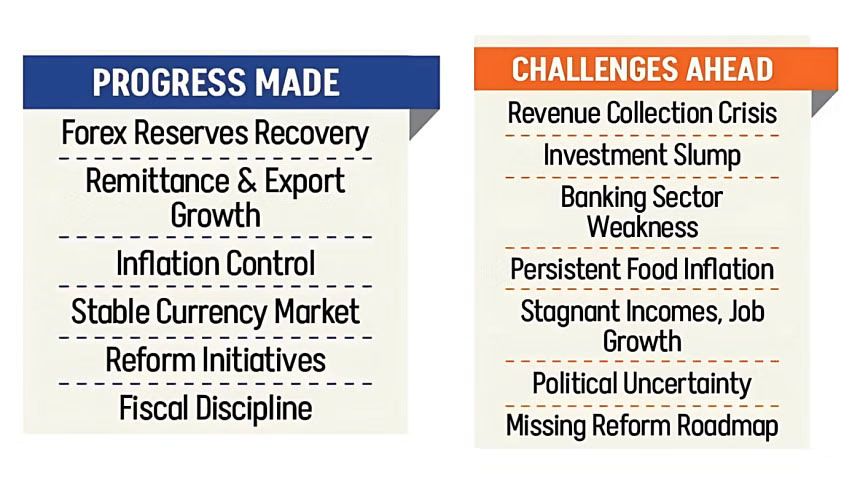
“In August last year, macroeconomic stability was in disarray,” Ahmed recalled in a recent interview. “Things were precarious then, but now reserves are climbing, remittances are up, exports are growing modestly, and the currency market is stable—even after liberalisation.”
While many credit the interim government for halting the downward spiral, analysts say the achievements so far are more about stabilisation than transformation.
Zahid Hussain, former lead economist at the World Bank’s Dhaka office, observed that the administration’s measures were largely conventional. “The new government implemented the old budget alongside its own, but no major policy shifts have been seen,” he said.
Taming Inflation
By July 2024, inflation had hit 12 percent year-on-year and had stayed above 9 percent for nearly three years. Economists blame previous policies that relied heavily on price controls and liquidity injections. The interim government quickly changed course, adopting a tighter monetary stance and allowing greater exchange rate flexibility.
Development spending was cut back, growth targets lowered, and repeated interest rate hikes were introduced. The foreign exchange rate was no longer artificially propped up, which helped remittance flows.
As a result, remittances surged by over 26 percent in FY25, while exports rose by nearly 9 percent after the previous year’s contraction. Foreign reserves, by Bangladesh Bank’s count, reached $32 billion by June 2025 (or $27 billion under IMF calculations).
Inflation dipped below 9 percent for the first time in almost three years, easing some pressure on household budgets. However, food prices remain high, and the 12-month average inflation rate is still in double digits, keeping the strain on low-income families.
Revenue Shortfall
If stabilising inflation and reserves counts as a success, revenue collection remains the weakest link. In FY25, tax revenue grew just 2.23 percent, falling over Tk 100,000 crore short of target. Bangladesh still has one of the lowest tax-to-GDP ratios in the world.
One bold reform—the separation of the tax and customs wings—has faced internal resistance but is moving forward, with completion expected by December 2025. Critics acknowledge this as a positive structural step.
Despite revenue weakness, the government avoided borrowing from Bangladesh Bank and kept bank borrowing well below targets.
Investment and Banking Woes
Private sector credit growth stood at just 6.4 percent in June 2025—far below the pace of a healthy economy. Imports of capital machinery and raw materials have also dropped sharply, and public investment has been sluggish, with development budget implementation at its lowest level since independence.
Ahmed partly blames political uncertainty ahead of the upcoming elections for dampening business confidence, as well as liquidity constraints in some banks. The banking sector, he admits, is still under repair, with troubled lenders awaiting restructuring.
Hussain and other analysts say a lack of clear timelines and reform roadmaps—particularly for banking, energy, and port sectors—is a key weakness. Without such plans, measuring progress becomes difficult.
A Fragile Stability
The interim administration has steered the economy away from the brink, but structural reforms remain unfinished. With elections due in February, the focus may shift from economic overhaul to ensuring a smooth political transition, leaving deeper reforms to the next elected government.
As Ahmed puts it, “Making policy is never easy. Push one side of the budget, and another side bulges.” Whether this period of relative stability can be turned into lasting recovery will depend on decisions made in the months ahead.