Vegetable prices soar, now 26% higher in markets

- Update Time : 04:15:24 am, Saturday, 23 August 2025
- / 679 Time View
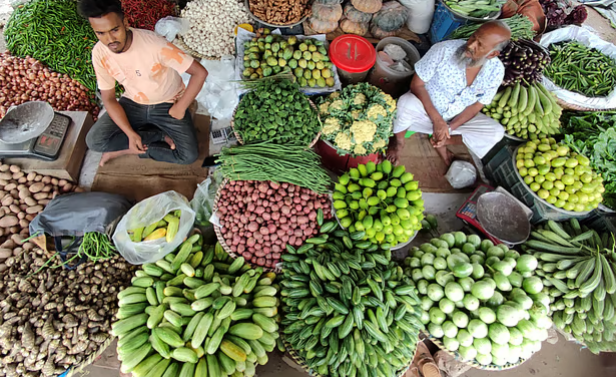

Vegetable and Fish Prices Keep Soaring, Straining Family Budgets
Pointed gourd (potol), once considered a cheap and common vegetable, is no longer easy on the wallet. Although hilsa curry with pointed gourd is a seasonal favorite during the monsoon, many households are avoiding it this year as the price of hilsa has jumped drastically. Pointed gourd itself is also selling at a premium.
Figures from the Department of Agricultural Marketing (DAM) show that pointed gourd now costs Tk 60–80 per kilo, about 75% higher than the same time last year.
The problem extends beyond one vegetable. A review of DAM’s price data for Dhaka Division reveals that on 21 August this year, the average price of 16 major vegetables was 26% higher compared to the same date last year.
Traditionally, vegetable production suffers from flooding and heavy rain in July–August, which pushes up prices. Commerce Secretary Mahbubur Rahman acknowledged this, saying, “Vegetable prices remain somewhat high before the winter harvest arrives. We are working to keep the market stable, but some seasonal pressure is normal.”
However, DAM data suggest that this year’s increase is sharper than the usual seasonal spike. Interestingly, the Bangladesh Meteorological Department (BMD) reported that rainfall this August has actually been lower than normal.
The strain is not limited to vegetables. Prices of fish have climbed an average of 18%, while meat and eggs are up around 7%, according to DAM. For households already struggling with high prices of rice, pulses, and cooking oil, this added burden makes daily meals increasingly unaffordable.
At Dhaka’s Karwan Bazar wholesale hub, the difference between wholesale and retail prices is striking. Vegetables bought at night often double in price by the next morning once they reach local markets. Markups vary from 30% to more than 100%.
Take the case of Shahadat Hossain, a resident of Shewrapara, who was seen buying three medium eggplants for Tk 60 from a van vendor. He said he avoided hilsa for most of August because prices were “beyond reach.” Eventually, he bought half a kilo for Tk 800—double last year’s price. “Even eggplant now sells for Tk 120 a kilo. If middle-income people can’t afford vegetables, fish, or eggs, what are they supposed to eat?” he asked.
Which Vegetables Cost How Much?
According to DAM’s latest price sheet, 14 out of 16 key vegetables are now priced at Tk 50 or above per kilo. These include eggplant, pointed gourd, okra, bitter gourd, yardlong beans, bottle gourd, cucumber, ridge gourd, sponge gourd, snake gourd, taro root, taro stalks, ash gourd, and teasel gourd. Last year, only seven of these exceeded Tk 50.
This year, just pumpkin (Tk 40–50) and green papaya (Tk 20–30) remain below that threshold. By contrast, nine types of vegetables were under Tk 45 last year.
Potatoes are the exception: prices have dropped to Tk 20–25 per kilo from last year’s Tk 55–60. But this decline has left farmers struggling to cover costs.
Why Are Prices Rising?
Interviews with traders and commission agents at Karwan Bazar point to multiple causes:
-
Crop damage from rain: Standing water has spoiled many fields, especially in Bogura and surrounding districts.
-
Return of middlemen: After last year’s political upheaval, when syndicates briefly disappeared, market practices are back to “business as usual,” pushing up costs at each handover.
-
Transport problems: Poor road conditions and higher truck rentals add to the final price.
A Tariff Commission report earlier this year also highlighted middlemen’s dominance, lack of reliable market data, extortion, and transport costs as key reasons behind inflated retail prices.
For example, top-grade eggplants sold wholesale at Tk 80 a kilo on Thursday night were being offered for Tk 160–180 a kilo at stalls the following day.
Fish and Meat No Relief Either
The price of rui, catla, pangas, tilapia, and hilsa has risen by nearly 18% on average. Chicken and mutton are also costlier, while beef remains expensive as before. Egg prices are slightly lower than last year but still high for many consumers.
Former Tariff Commission member Mostafa Abid Khan noted, “We know prices are going up, but only stopgap measures have been taken. A permanent strategy is needed to stabilize food inflation.”
The impact falls hardest on low- and middle-income families. While wealthier households can absorb the extra costs, most people are being forced to cut back on nutrition, replacing fish and vegetables with cheaper but less balanced options.