Dhaka 4:30 am, Thursday, 18 June 2026

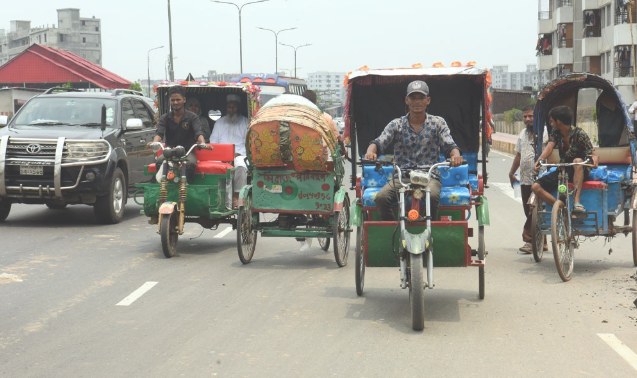
Electric rickshaws now a common sight across Dhaka

Niloy Mridha
  • Update Time : 09:27:03 am, Saturday, 6 September 2025
  • / 1104 Time View

Dhaka Faces Growing Crisis from Illegal Battery Rickshaws

Despite being officially banned, battery-powered rickshaws continue to dominate Dhaka’s streets. Once limited to narrow lanes, they now operate on major roads and even VIP routes, often making sudden turns that lead to accidents. Police interventions are rare, and drivers occasionally attack officers attempting to enforce the ban.

One Million Vehicles, Thousands of Charging Points

Although not legally authorised, roughly one million battery rickshaws are estimated to be operating in Dhaka. Around 5,000 charging stations have emerged across the city. While the vehicles are technically illegal, the government continues to provide them with electricity for recharging. Research by icddr,b has linked these rickshaws to extremely high levels of lead contamination in children, with blood lead levels up to ten times higher than safe limits. Dr. Mahbubur Rahman warned that with an average of 20kg of lead per rickshaw, the 4 million battery rickshaws nationwide could release approximately 800 million kg of lead into the environment annually. “Lead never degrades. Imagine where this pollution will take us in the next decade,” he said.

Illegal Garages Proliferate

Dhaka is home to thousands of legal and illegal garages. According to Dhaka Metropolitan Police (DMP), the city hosts 3,300 legal charging stations, 48,136 illegal charging points, and 992 garages providing charging services. Mirpur alone has nearly 4,000 illegal charging points and 259 garages, Wari over 3,500, Gulshan 2,643, Uttara 1,305, Motijheel 1,390, and Lalbagh 199, with many more across Tejgaon and Ramna. Each garage houses between 80 and 150 rickshaws.

Rapid Factory Expansion

Authorities report that 400–500 new battery rickshaws enter Dhaka’s streets daily, produced by at least 1,000 factories in areas including Kamrangirchar, Keraniganj, Kamalapur, Sabujbagh, Manda, Gazipur, and Tongi. Single-battery rickshaws cost around Tk80,000, while four-battery models range from Tk60,000–70,000. Intelligence reports suggest that under the previous administration, rickshaw drivers were used for political purposes. Investigations are ongoing.

Illegal Power Connections

Most of Dhaka’s battery rickshaws rely on stolen electricity. Police raids temporarily remove illegal connections, but these are often reinstalled with the help of corrupt officials and influential locals. In one Rampura garage, investigators found 350 rickshaws being charged daily, alongside pedal rickshaws being converted to battery models.

Government Provides Power Despite Ban

Each rickshaw requires four to five 12-volt batteries, consuming 5–6 units of electricity per set, straining the national grid. Although illegal in many cases, the Power Ministry has authorised 3,300 official charging stations, including 2,149 under DPDC. Daily consumption for charging totals 26.162 MW. Engineer Q M Shafiqul Islam, Executive Director (Operations), said: “Providing power is not ideal, but stopping it entirely would push users to steal electricity, causing even greater waste. Our patrol teams monitor and fine offenders where found.”

Companies Seek Formal Approval

Five companies—Monir Auto Engineering Ltd, Akij Motors, New Grameen, Dynamic, and Diestar Hitech Auto Ltd—have applied to city corporations for official approval for rickshaws designed under BUET specifications. Officials will inspect facilities next week and submit recommendations to the Local Government Ministry.

Children at Risk from Lead

Research by icddr,b indicates that even after batteries are disposed of, 80% of the lead remains, contaminating soil, water, fish, poultry, and livestock, entering the human body via the food chain, and even passing from mothers to unborn children. Informal battery-breaking factories employ children and unprotected workers, selling recovered lead to manufacturers. A survey of 500 children in Dhaka found that 98% had blood lead levels averaging 35 micrograms per decilitre—ten times above the safe limit. One child recorded 46 micrograms.

Union leader Mohammad Hanif Khokon noted that the number of battery rickshaws has surged from 200,000 two years ago to over a million today. He said that prior signals about legalisation triggered rapid growth, but despite policies advocating lithium batteries, acid batteries remain widespread.

“A Cancer for Dhaka”

BUET’s Associate Professor Kazi Saifun Newaz of the Accident Research Institute described battery rickshaws as a “cancer” for the city. He warned: “Immediate government action is required, or Dhaka cannot be saved. If strict controls had been enforced in 2014, this crisis could have been avoided. Illegal factories and charging stations must be stopped, and battery imports tightly regulated.”

Mozammel Haque, Secretary General of Bangladesh Passenger Welfare Association, estimates 6 million battery rickshaws nationwide, including 800,000 in Dhaka and 300,000 in Chattogram. “They are dangerous for major roads. A clear policy is essential. Corporate firms like Grameen Auto and Akij Motors have entered the business, and Walton is expected to follow. However, approved designs still fail to meet safety standards. Previous and current authorities have neglected public consultation, relying solely on bureaucrats,” he added.
Tag :

Please Share This Post in Your Social Media

Electric rickshaws now a common sight across Dhaka

Update Time : 09:27:03 am, Saturday, 6 September 2025

Dhaka Faces Growing Crisis from Illegal Battery Rickshaws

Despite being officially banned, battery-powered rickshaws continue to dominate Dhaka’s streets. Once limited to narrow lanes, they now operate on major roads and even VIP routes, often making sudden turns that lead to accidents. Police interventions are rare, and drivers occasionally attack officers attempting to enforce the ban.

One Million Vehicles, Thousands of Charging Points

Although not legally authorised, roughly one million battery rickshaws are estimated to be operating in Dhaka. Around 5,000 charging stations have emerged across the city. While the vehicles are technically illegal, the government continues to provide them with electricity for recharging. Research by icddr,b has linked these rickshaws to extremely high levels of lead contamination in children, with blood lead levels up to ten times higher than safe limits. Dr. Mahbubur Rahman warned that with an average of 20kg of lead per rickshaw, the 4 million battery rickshaws nationwide could release approximately 800 million kg of lead into the environment annually. “Lead never degrades. Imagine where this pollution will take us in the next decade,” he said.

Illegal Garages Proliferate

Dhaka is home to thousands of legal and illegal garages. According to Dhaka Metropolitan Police (DMP), the city hosts 3,300 legal charging stations, 48,136 illegal charging points, and 992 garages providing charging services. Mirpur alone has nearly 4,000 illegal charging points and 259 garages, Wari over 3,500, Gulshan 2,643, Uttara 1,305, Motijheel 1,390, and Lalbagh 199, with many more across Tejgaon and Ramna. Each garage houses between 80 and 150 rickshaws.

Rapid Factory Expansion

Authorities report that 400–500 new battery rickshaws enter Dhaka’s streets daily, produced by at least 1,000 factories in areas including Kamrangirchar, Keraniganj, Kamalapur, Sabujbagh, Manda, Gazipur, and Tongi. Single-battery rickshaws cost around Tk80,000, while four-battery models range from Tk60,000–70,000. Intelligence reports suggest that under the previous administration, rickshaw drivers were used for political purposes. Investigations are ongoing.

Illegal Power Connections

Most of Dhaka’s battery rickshaws rely on stolen electricity. Police raids temporarily remove illegal connections, but these are often reinstalled with the help of corrupt officials and influential locals. In one Rampura garage, investigators found 350 rickshaws being charged daily, alongside pedal rickshaws being converted to battery models.

Government Provides Power Despite Ban

Each rickshaw requires four to five 12-volt batteries, consuming 5–6 units of electricity per set, straining the national grid. Although illegal in many cases, the Power Ministry has authorised 3,300 official charging stations, including 2,149 under DPDC. Daily consumption for charging totals 26.162 MW. Engineer Q M Shafiqul Islam, Executive Director (Operations), said: “Providing power is not ideal, but stopping it entirely would push users to steal electricity, causing even greater waste. Our patrol teams monitor and fine offenders where found.”

Companies Seek Formal Approval

Five companies—Monir Auto Engineering Ltd, Akij Motors, New Grameen, Dynamic, and Diestar Hitech Auto Ltd—have applied to city corporations for official approval for rickshaws designed under BUET specifications. Officials will inspect facilities next week and submit recommendations to the Local Government Ministry.

Children at Risk from Lead

Research by icddr,b indicates that even after batteries are disposed of, 80% of the lead remains, contaminating soil, water, fish, poultry, and livestock, entering the human body via the food chain, and even passing from mothers to unborn children. Informal battery-breaking factories employ children and unprotected workers, selling recovered lead to manufacturers. A survey of 500 children in Dhaka found that 98% had blood lead levels averaging 35 micrograms per decilitre—ten times above the safe limit. One child recorded 46 micrograms.

Union leader Mohammad Hanif Khokon noted that the number of battery rickshaws has surged from 200,000 two years ago to over a million today. He said that prior signals about legalisation triggered rapid growth, but despite policies advocating lithium batteries, acid batteries remain widespread.

“A Cancer for Dhaka”

BUET’s Associate Professor Kazi Saifun Newaz of the Accident Research Institute described battery rickshaws as a “cancer” for the city. He warned: “Immediate government action is required, or Dhaka cannot be saved. If strict controls had been enforced in 2014, this crisis could have been avoided. Illegal factories and charging stations must be stopped, and battery imports tightly regulated.”

Mozammel Haque, Secretary General of Bangladesh Passenger Welfare Association, estimates 6 million battery rickshaws nationwide, including 800,000 in Dhaka and 300,000 in Chattogram. “They are dangerous for major roads. A clear policy is essential. Corporate firms like Grameen Auto and Akij Motors have entered the business, and Walton is expected to follow. However, approved designs still fail to meet safety standards. Previous and current authorities have neglected public consultation, relying solely on bureaucrats,” he added.