Dhaka 1:09 am, Monday, 23 November 2026

Passenger Numbers Rising, but Dhaka Airport Still Has Just One Runway: Congestion Fears Grow

Reporter Name
  • Update Time : 06:05:55 am, Saturday, 21 November 2026
  • / 41 Time View

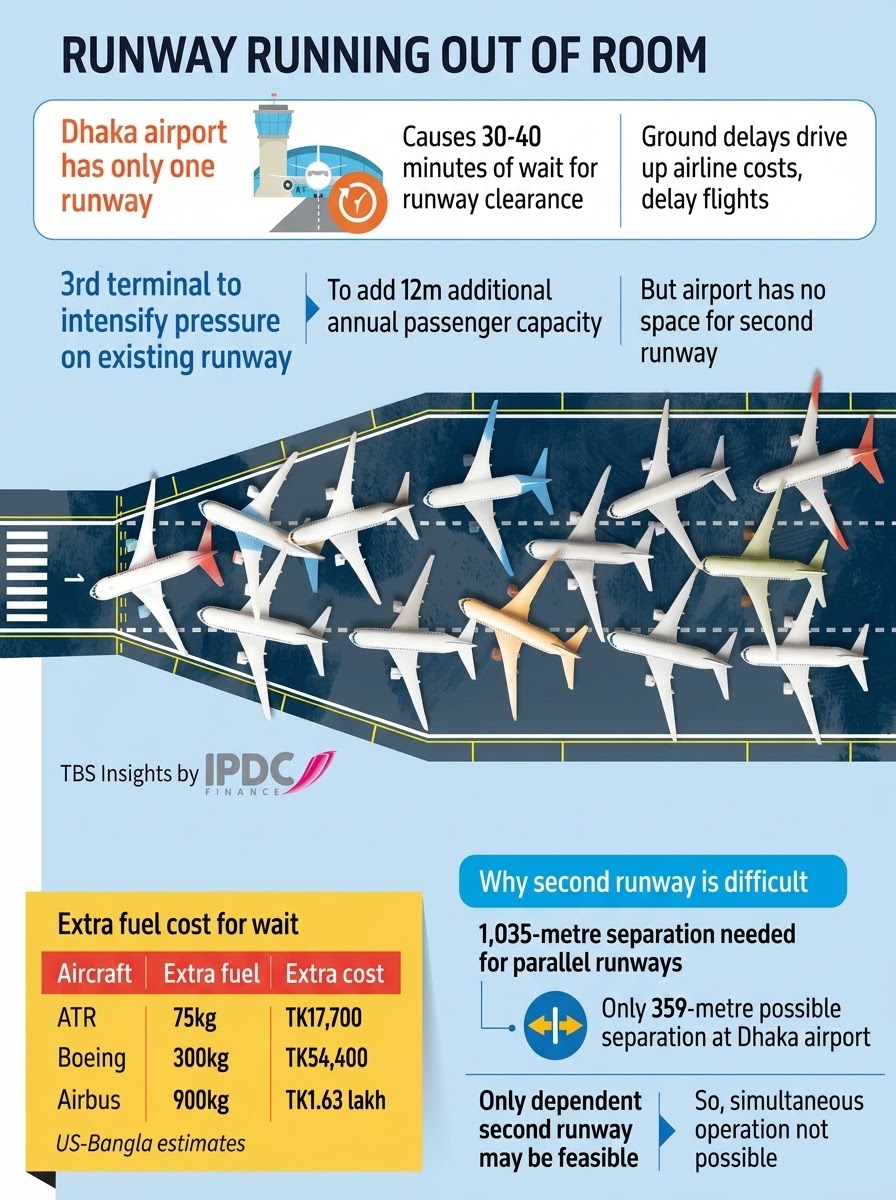
Airlines are already losing crores of taka due to fuel wastage and ground delays at Dhaka’s Hazrat Shahjalal International Airport, which operates with just one runway. The situation could become more severe once the airport’s Third Terminal opens, as passenger-handling capacity is set to double while runway capacity will remain unchanged.


The new terminal, built at a cost of Tk21,000 crore with funding from the Japan International Cooperation Agency (JICA), is scheduled to become operational on December 16, 2026. Once opened, it will increase the airport’s annual passenger-handling capacity from 12 million to around 24 million.


However, due to urbanisation around the airport, there is no room to build a second runway that could operate independently. As a result, the existing single runway will have to handle the additional flight traffic.


Industry stakeholders warn that increasing flight numbers without expanding runway capacity will lead to longer queues of aircraft on taxiways, higher fuel consumption and further deterioration in on-time performance.


Hazrat Shahjalal International Airport Executive Director Group Captain Ragib Samad acknowledged the problem, saying that operating with a single runway leads to aircraft congestion during peak hours as planes wait for clearance.


Speaking to The Business Standard (TBS), he said, “However, this is not a problem unique to Dhaka. Aircraft also have to wait for runway clearance during peak hours at other busy international airports.”


Ragib Samad said urbanisation has made it impossible to build a second runway capable of independent operations. Therefore, airlines will need to decentralise their operations by shifting domestic hubs to Chattogram, Sylhet and Cox’s Bazar.


“Instead of routing all domestic flights through Dhaka, airlines should expand their operations around these airports,” he said. He also noted that opportunities were being created to operate international flights from Cox’s Bazar.


Airlines Count the Cost of Runway Congestion


Hazrat Shahjalal International Airport currently serves 43 airlines, 39 of which operate international services. An average of 170 to 180 flights take off and land every day using its single runway.


According to data from the Civil Aviation Authority of Bangladesh (CAAB), the airport handled 12.72 million passengers through 159,407 domestic and international flights in 2025.


During peak periods—early morning, between 10am and noon, and after 6pm—aircraft regularly remain on taxiways with their engines running for 30 to 40 minutes while waiting for clearance or for parking bays to become available.


US-Bangla Airlines spokesperson Kamrul Islam said these ground delays directly increase fuel consumption and operating costs. As an example, he cited a recent domestic flight that had to wait on the taxiway for 27 minutes before take-off.


According to US-Bangla’s calculations, runway congestion results in additional fuel consumption of 75kg per flight for ATR aircraft, 300kg for Boeing aircraft and 900kg for Airbus aircraft.


At current market prices for jet fuel, this translates into additional costs of approximately Tk17,700, Tk54,400 and Tk163,000 per flight, respectively.


US-Bangla Airlines Managing Director Abdullah Al Mamun recently said runway congestion was making it difficult to maintain flight schedules. He estimated that the airline was losing around Tk20 lakh every day as a result.


A representative of a foreign airline, speaking on condition of anonymity, expressed similar concerns. The representative said ground delays regularly add 15 to 20 minutes to aircraft turnaround times, with delays reaching as much as 40 minutes during peak periods.


“With only one runway, one aircraft cannot take off while another is landing. Similarly, one aircraft cannot land while another is taking off,” the representative said.


Safety Risks and Space Constraints


Although a second runway had previously received approval in principle, urbanisation around the airport has created major technical obstacles.


According to International Civil Aviation Organization (ICAO) guidelines, two parallel runways must be at least 1,035 metres apart to operate independently. However, due to the surrounding urban development at Hazrat Shahjalal Airport, the maximum possible separation is just 359 metres.


Former CAAB chairman Air Vice Marshal Muhammad Mafidur Rahman said that, given the space constraints, only a “dependent” second runway could be built in Dhaka.


Under such an arrangement, the two runways would not be able to support simultaneous take-offs and landings independently. Consequently, the additional runway would not significantly increase flight-handling capacity.


However, Mafidur Rahman stressed that even a dependent runway would be essential for safety and maintenance.


He said the existing runway was currently being kept operational through makeshift repairs carried out at night. A second runway would allow the authorities to close the main runway for two hours every day for maintenance.


He described this as a prerequisite for upgrading the airport’s Instrument Landing System (ILS) to Category II, which helps aircraft land in conditions of poor visibility.


He further said a second runway could serve as a critical alternative if a disabled aircraft blocked the main runway. Under the current arrangement, such an incident would bring all international flight operations in Dhaka to a halt.


CAAB Member (Administration) S M Lablur Rahman acknowledged that the existing runway does not have sufficient capacity. The authorities are therefore trying to make the best possible use of the current infrastructure by reducing aircraft turnaround times.


He said constructing a dependent runway was still possible, but it would require extensive advance preparation.


Maximising the Use of the Existing Runway


For now, aviation authorities are relying on changes to existing infrastructure to manage the additional pressure expected from the Third Terminal.


At a recent event, CAAB Member (Air Traffic Management) Air Commodore Nur-e-Alam said Hazrat Shahjalal International Airport had originally been designed to handle eight million passengers annually. However, it currently serves more than 12.6 million passengers.


Although the Third Terminal will add another 12 million passengers to the airport’s annual handling capacity, the existing single runway can currently accommodate only 20 to 22 flights per hour.


He said the introduction of high-speed exit taxiways could increase that capacity to 26 to 28 flights per hour. This would allow the airport to handle a substantial increase in passenger numbers without a proportional rise in runway congestion.


Meanwhile, a proposed agreement between Bangladesh and a Japanese consortium for operating the Third Terminal reportedly stipulates that the government will not be allowed to open a competing civilian airport within 100 kilometres of Dhaka for the next 15 years.


As a result, Dhaka airport is expected to remain the capital’s only commercial airport for the foreseeable future.

Tag :

Please Share This Post in Your Social Media

Passenger Numbers Rising, but Dhaka Airport Still Has Just One Runway: Congestion Fears Grow

Update Time : 06:05:55 am, Saturday, 21 November 2026

Airlines are already losing crores of taka due to fuel wastage and ground delays at Dhaka’s Hazrat Shahjalal International Airport, which operates with just one runway. The situation could become more severe once the airport’s Third Terminal opens, as passenger-handling capacity is set to double while runway capacity will remain unchanged.


The new terminal, built at a cost of Tk21,000 crore with funding from the Japan International Cooperation Agency (JICA), is scheduled to become operational on December 16, 2026. Once opened, it will increase the airport’s annual passenger-handling capacity from 12 million to around 24 million.


However, due to urbanisation around the airport, there is no room to build a second runway that could operate independently. As a result, the existing single runway will have to handle the additional flight traffic.


Industry stakeholders warn that increasing flight numbers without expanding runway capacity will lead to longer queues of aircraft on taxiways, higher fuel consumption and further deterioration in on-time performance.


Hazrat Shahjalal International Airport Executive Director Group Captain Ragib Samad acknowledged the problem, saying that operating with a single runway leads to aircraft congestion during peak hours as planes wait for clearance.


Speaking to The Business Standard (TBS), he said, “However, this is not a problem unique to Dhaka. Aircraft also have to wait for runway clearance during peak hours at other busy international airports.”


Ragib Samad said urbanisation has made it impossible to build a second runway capable of independent operations. Therefore, airlines will need to decentralise their operations by shifting domestic hubs to Chattogram, Sylhet and Cox’s Bazar.


“Instead of routing all domestic flights through Dhaka, airlines should expand their operations around these airports,” he said. He also noted that opportunities were being created to operate international flights from Cox’s Bazar.


Airlines Count the Cost of Runway Congestion


Hazrat Shahjalal International Airport currently serves 43 airlines, 39 of which operate international services. An average of 170 to 180 flights take off and land every day using its single runway.


According to data from the Civil Aviation Authority of Bangladesh (CAAB), the airport handled 12.72 million passengers through 159,407 domestic and international flights in 2025.


During peak periods—early morning, between 10am and noon, and after 6pm—aircraft regularly remain on taxiways with their engines running for 30 to 40 minutes while waiting for clearance or for parking bays to become available.


US-Bangla Airlines spokesperson Kamrul Islam said these ground delays directly increase fuel consumption and operating costs. As an example, he cited a recent domestic flight that had to wait on the taxiway for 27 minutes before take-off.


According to US-Bangla’s calculations, runway congestion results in additional fuel consumption of 75kg per flight for ATR aircraft, 300kg for Boeing aircraft and 900kg for Airbus aircraft.


At current market prices for jet fuel, this translates into additional costs of approximately Tk17,700, Tk54,400 and Tk163,000 per flight, respectively.


US-Bangla Airlines Managing Director Abdullah Al Mamun recently said runway congestion was making it difficult to maintain flight schedules. He estimated that the airline was losing around Tk20 lakh every day as a result.


A representative of a foreign airline, speaking on condition of anonymity, expressed similar concerns. The representative said ground delays regularly add 15 to 20 minutes to aircraft turnaround times, with delays reaching as much as 40 minutes during peak periods.


“With only one runway, one aircraft cannot take off while another is landing. Similarly, one aircraft cannot land while another is taking off,” the representative said.


Safety Risks and Space Constraints


Although a second runway had previously received approval in principle, urbanisation around the airport has created major technical obstacles.


According to International Civil Aviation Organization (ICAO) guidelines, two parallel runways must be at least 1,035 metres apart to operate independently. However, due to the surrounding urban development at Hazrat Shahjalal Airport, the maximum possible separation is just 359 metres.


Former CAAB chairman Air Vice Marshal Muhammad Mafidur Rahman said that, given the space constraints, only a “dependent” second runway could be built in Dhaka.


Under such an arrangement, the two runways would not be able to support simultaneous take-offs and landings independently. Consequently, the additional runway would not significantly increase flight-handling capacity.


However, Mafidur Rahman stressed that even a dependent runway would be essential for safety and maintenance.


He said the existing runway was currently being kept operational through makeshift repairs carried out at night. A second runway would allow the authorities to close the main runway for two hours every day for maintenance.


He described this as a prerequisite for upgrading the airport’s Instrument Landing System (ILS) to Category II, which helps aircraft land in conditions of poor visibility.


He further said a second runway could serve as a critical alternative if a disabled aircraft blocked the main runway. Under the current arrangement, such an incident would bring all international flight operations in Dhaka to a halt.


CAAB Member (Administration) S M Lablur Rahman acknowledged that the existing runway does not have sufficient capacity. The authorities are therefore trying to make the best possible use of the current infrastructure by reducing aircraft turnaround times.


He said constructing a dependent runway was still possible, but it would require extensive advance preparation.


Maximising the Use of the Existing Runway


For now, aviation authorities are relying on changes to existing infrastructure to manage the additional pressure expected from the Third Terminal.


At a recent event, CAAB Member (Air Traffic Management) Air Commodore Nur-e-Alam said Hazrat Shahjalal International Airport had originally been designed to handle eight million passengers annually. However, it currently serves more than 12.6 million passengers.


Although the Third Terminal will add another 12 million passengers to the airport’s annual handling capacity, the existing single runway can currently accommodate only 20 to 22 flights per hour.


He said the introduction of high-speed exit taxiways could increase that capacity to 26 to 28 flights per hour. This would allow the airport to handle a substantial increase in passenger numbers without a proportional rise in runway congestion.


Meanwhile, a proposed agreement between Bangladesh and a Japanese consortium for operating the Third Terminal reportedly stipulates that the government will not be allowed to open a competing civilian airport within 100 kilometres of Dhaka for the next 15 years.


As a result, Dhaka airport is expected to remain the capital’s only commercial airport for the foreseeable future.