An explanation of why Pakistani troops ultimately surrendered to Indian forces

- Update Time : 08:36:53 am, Tuesday, 23 December 2025
- / 51 Time View
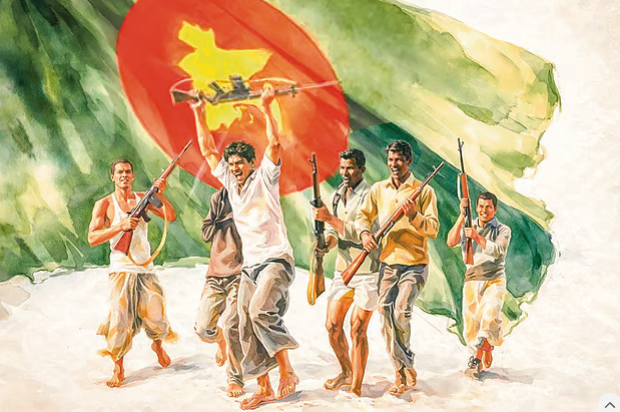

After nine months of brutal violence, the decisive moment of Bangladesh’s Liberation War arrived on 16 December 1971. At 4:31 pm, representatives of the Pakistan Army, the Indian Armed Forces, and the Bangladeshi freedom fighters assembled at Ramna Racecourse in Dhaka. In front of a large gathering of journalists, Pakistan formally surrendered. The instrument of surrender was signed on behalf of Pakistan by General A.A.K. Niazi, while Lieutenant General Jagjit Singh Aurora signed for the Allied Forces.
Although this iconic image symbolizes the final victory of the Bangladeshi state, questions have persisted even 54 years later. The people of Bangladesh fought continuously for nine months, while India entered the war directly for only 12 days. Yet, the Pakistani military surrendered to India. Why did this happen?
Many explanations have been offered over the years. This article explores how the issue was discussed inside the US White House during the war, drawing on official American diplomatic and intelligence records from 1971.
US archival records and the Liberation War
Under US diplomatic practice, detailed records of policy discussions, intelligence exchanges, and high-level meetings are preserved and later published by the Office of the Historian of the US State Department. These documents appear in the Foreign Relations of the United States (FRUS) series, covering the period from March 26, 1925, to 1991.
A recently reviewed volume—Foreign Relations of the United States, 1969–1976, Volume XI: South Asia Crisis, 1971—documents the American government’s internal assessment of events from the beginning of Bangladesh’s Liberation War to final victory. Copies of this volume are preserved in many public libraries across the United States.
At the time, President Richard Nixon assigned his National Security Adviser, Henry Kissinger, to oversee South Asia policy. Kissinger maintained direct communication with Indian Prime Minister Indira Gandhi and Pakistani President Agha Muhammad Yahya Khan, often acting as a diplomatic intermediary between the two sides. This article focuses primarily on developments during December 1971.
Why India entered the war
On 1 December 1971, US Ambassador to India Kenneth Keating met Prime Minister Indira Gandhi and later sent a cable to Washington. He reported that Gandhi said Pakistan had moved its troops close to the border but had not withdrawn them. She emphasized that India did not want war, but President Yahya Khan had created conditions that left India with limited options. India, she said, would not take any step that weakened its own position.
In response, the US State Department immediately instructed the American embassy in India to warn New Delhi that if Indian forces crossed into Pakistani territory, Washington would reconsider its military supply policy toward India. This included suspending a $2 million arms delivery agreement from 1 December. The US noted that similar restrictions had been applied earlier when West Pakistan attacked East Pakistan. Despite this pressure, Indian forces and Bangladeshi guerrillas continued their operations.
On 3 December, Indira Gandhi addressed the Indian nation, stating that Pakistan’s air force had attacked six Indian airbases in Kashmir and Punjab around 5:30 am. Under those circumstances, she declared, India had no alternative but to fight. However, a separate US diplomatic cable from Islamabad reported that Indian forces had launched attacks on Pakistan-controlled Kashmir and other locations earlier that same day.
India’s justification to Washington
On 5 December, Prime Minister Gandhi wrote directly to President Nixon, outlining India’s position. She recalled that since March 25, Pakistan had carried out mass killings and widespread violence in East Pakistan. As a result, India had already taken in around 10 million refugees, a number that continued to rise. Despite repeated provocations, India had shown restraint and had informed the United Nations and other international bodies of the situation.
She explained that Pakistan’s military had now expanded the conflict into a war against India in an attempt to crush Bangladesh’s independence struggle. Under such circumstances, India had no choice but to prepare for war to protect its national security and territorial integrity.
Pakistan’s weakening position
A US intelligence report submitted to the White House on 2 December indicated that Pakistani forces in East Pakistan were running short of supplies and manpower. In several areas, troops were retreating under pressure. Guerrilla fighters were reportedly flying the Bangladeshi flag just 17 miles from Dhaka. The report also noted the formation of a “Mukti Bahini Navy” to prevent supplies from reaching Pakistani forces.
On 3 December, President Yahya Khan wrote to President Nixon requesting three urgent actions: a public US statement condemning what he described as Indian aggression encouraged by the Soviet Union; strong pressure on Moscow to halt military support for India; and the continuation of US military assistance to Pakistan under a 1959 bilateral agreement.
Nixon reassured Yahya in a phone call and instructed US Ambassador Joseph Farland in Islamabad to convey similar support. Meanwhile, Henry Kissinger convened near-daily meetings of the US National Security Council. On 6 December, Kissinger asked senior military officials how long Pakistan could realistically hold East Pakistan. The assessment was grim: no more than three weeks.
Recognition of Bangladesh and Soviet involvement
On 6 December, India formally recognized Bangladesh. Kissinger asked the CIA what India intended to do next. CIA Director Richard Helms replied succinctly: to make Bangladesh independent.
At another US defense policy meeting that day, officials concluded that if India launched a full-scale offensive, Bangladeshi fighters could seize large parts of East Pakistan and establish a rebel government within 10 days. Discussions also considered whether Pakistan could receive supplies through a third country, such as Iran.
On 7 December, Yahya Khan again wrote to Nixon, reporting rapid deterioration on the eastern front. Pakistani troops lacked sufficient weapons and ammunition, and the Soviet Union was blocking UN action while providing political and military backing to India. Yahya warned that an Indian victory, backed by Moscow, would destabilize South Asia and urged Nixon to exert pressure on both India and the Soviet Union.
Soviet pressure and superpower diplomacy
After signing a treaty with India, the Soviet Union increased pressure on Pakistan. In response, Nixon wrote to Soviet leader Leonid Brezhnev on 6 December, accusing India of trying to impose political demands on a sovereign state through military force. He warned that Soviet support for India was complicating an already dangerous crisis.
Brezhnev replied that the people of East Pakistan had delivered a clear verdict in the 1970 elections, which the Pakistani government had ignored. Moscow had repeatedly called for a political settlement, but had not seen a clear position from Washington. On 5 December, the Soviet Union publicly called for an end to bloodshed through a political solution that respected the rights of East Pakistan’s population.
The Soviets also urged the US to support two UN proposals: an immediate ceasefire between India and Pakistan, and recognition by Islamabad of the political will of the people of East Pakistan.
Despite multiple diplomatic exchanges, tensions escalated. On 11 December, Kissinger informed Nixon that Soviet naval vessels—armed with surface-to-surface missiles, including a guided missile cruiser and a diesel-powered missile submarine—were moving toward the Indian Ocean. Combined with existing Soviet naval units in the region, this deployment increased pressure on Pakistan and its allies.
Conclusion
By mid-December 1971, Pakistan’s military position in East Pakistan had become untenable. International diplomacy, superpower rivalry, India’s direct intervention, and the sustained resistance of the Bangladeshi people collectively shaped the final outcome. These factors explain why, despite months of local resistance, the formal surrender ultimately took place in the presence of Indian military leadership—marking the birth of Bangladesh as an independent nation.