Critical Questions Linger Over Dhaka Jet Crash and Air Base Operations

- Update Time : 08:32:30 pm, Thursday, 31 July 2025
- / 477 Time View
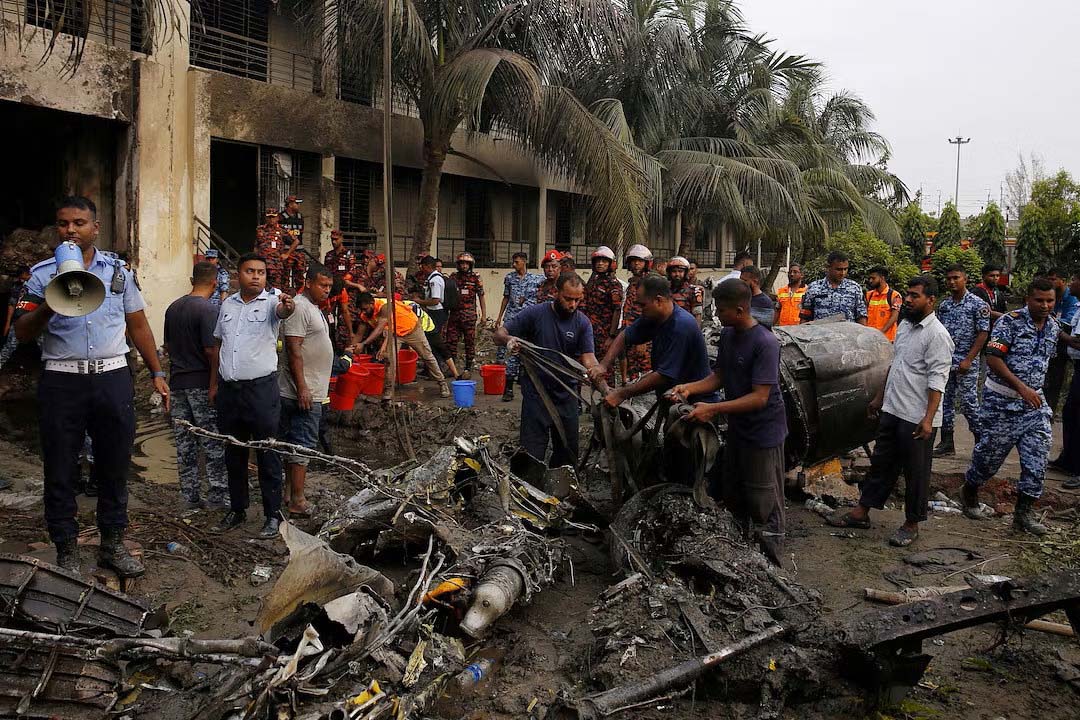

The recent crash of a fighter jet on a school compound in Dhaka has sparked public concern and raised long-avoided questions about the location and operation of the Bangladesh Air Force (BAF) base in Kurmitola. Despite its long-standing presence, the placement of an active airbase within such a densely populated urban area is now being scrutinized in the wake of this tragedy.
Following the incident, BAF Chief Air Chief Marshal Hasan Mahmood Khan addressed the nation from the tarmac of BAF Base Bir Uttam AK Khandker—situated right next to the capital’s international airport—defending the base’s strategic importance. Supporting his position, two senior BAF officers elaborated further in a press briefing on July 28, stating that the capital must have an airbase for national security and VIP protection. They emphasized that training flights are a routine part of airbase operations.
While these justifications have been put forward, several underlying questions remain unaddressed.
Is Dhaka Unique?
Officials claim it’s not unusual for capitals to host airbases. However, a quick survey of major cities suggests otherwise. Most airbases involved in fighter jet operations are located outside city limits:
-
India: While Hindon Air Force Station is close to Delhi, it’s not used for fighter operations. Ambala Airbase, which houses combat aircraft, is over 200 km away.
-
Pakistan: Nur Khan Airbase is in Rawalpindi, around 13 km from Islamabad’s parliament.
-
Sri Lanka: Katunayake, integrated with the international airport, is 30 km from Colombo.
-
US: Andrews Air Force Base is about 15 km from the Capitol but not within Washington, D.C.
-
UK: RAF Northolt is approximately 20 km from Westminster, outside London proper.
-
Russia: Kubinka Airbase lies 60 km from central Moscow.
These examples indicate a common pattern of keeping active military airbases—especially those used for fighter training—at a safer distance from dense urban zones. The necessity of such a base within Dhaka city remains unexplained beyond vague appeals to security.
Could Flight Training Be Relocated?
With the F-7’s high speed capability—Mach 2 or approximately 2,465 km/h—relocating training activities could still ensure rapid response times. For instance, a base in Arial Beel would be just a two-minute flight away at cruising speed; from Jashore, about seven minutes. The issue, therefore, is not speed or reach but planning and willingness to adapt to urban growth.
Historically, Kurmitola’s location made sense when Dhaka was much smaller and Uttara was uninhabited. But urban sprawl has changed that. Schools, homes, and businesses now lie directly in the flight path. That neither city authorities nor planners acted sooner to prevent residential development in high-risk zones is a serious oversight. Yet even if the airbase were removed, the civilian airport remains—a separate but overlapping risk factor.
The Investigation – Lacking in Expertise?
In response to the crash, a nine-member probe committee has been formed, led by a former government secretary. It includes high-ranking civil servants, a retired air force officer, and professionals such as an urban planner and a BUET mechanical engineering professor. However, notably absent are aviation safety experts, aeronautical engineers, or technical representatives from the aircraft’s manufacturer.
For comparison, India included Boeing representatives in its recent crash investigation in Ahmedabad. The absence of such expertise raises doubts about the committee’s ability to identify the technical causes of the accident. While it’s reasonable that a separate military investigation may be underway, and some findings may remain confidential for security reasons, the public deserves clear communication about the scope and intent of each inquiry.
Moving Toward Accountability
This tragedy has already claimed lives—children who were simply attending school. To truly honor their memory, the response must be meaningful. That means re-evaluating longstanding policies, reassessing the placement and function of high-risk infrastructure, and ensuring future decisions prioritize public safety.
So far, the government’s steps appear limited in scope—initiated more to contain public outcry than to implement lasting solutions. Unless deeper, more technically sound and transparent evaluations follow, this will risk becoming just another symbolic gesture in a long list of missed opportunities for reform.