Bangladesh Bank Suspends Binimoy Platform Over Contract Breaches and Irregularities

- Update Time : 04:24:04 pm, Monday, 4 August 2025
- / 1517 Time View
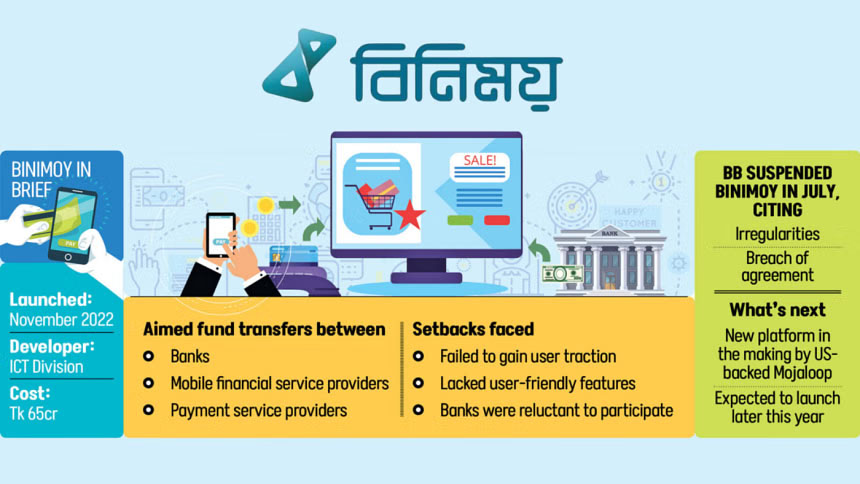

The Bangladesh Bank (BB) has officially suspended the interoperable digital payments platform Binimoy, citing serious irregularities and breaches of contract.
Binimoy was launched in November 2022 as a system designed to enable fund transfers between banks, mobile financial service (MFS) providers, and payment service providers (PSPs). The platform was developed by the Innovation Design and Entrepreneurship Academy (IDEA) under the ICT Division, at a reported cost of Tk 65 crore, during the previous Awami League administration. Its aim was to reduce the country’s reliance on cash transactions.
However, the platform faced persistent allegations of political interference and operational shortcomings since its inception.
According to Bangladesh Bank spokesperson and Executive Director Areif Hossain Khan, the central bank was pressured into signing the agreement to launch Binimoy without adequate time to review the terms. “The agreement was signed with irregularities from the start, and the central bank had no role in drafting the document,” Khan stated. “The platform was difficult to operate under these unsupported conditions.”
Khan added that the developers repeatedly failed to provide necessary operational and maintenance support and did not pay the fees owed to the bank for several months. “Following legal advice, we decided to terminate their services,” he said.
The initial deal, signed in 2019, intended for Bangladesh Bank to operate the platform funded by government resources. However, the bank reports that it has not received payments for the past seven to eight months.
To replace Binimoy, Bangladesh Bank is currently developing a new interoperable digital payment system in collaboration with Mojaloop, a US-based open-source project supported by the Gates Foundation. The new platform is expected to launch later this year. “The project is progressing, though it involves extensive documentation. We hope to finalize the agreement soon,” Khan explained.
Industry insiders note that Binimoy, modelled after India’s Unified Payments Interface (UPI), failed to gain traction due to limited user-friendly features, insufficient marketing, and hesitation from banks to participate.
Before its suspension, Binimoy was supported by eight banks—Sonali Bank, BRAC Bank, UCB Bank, Eastern Bank, Mutual Trust Bank, Pubali Bank, Al-Arafah Bank, and Midland Bank—as well as three MFS providers (bKash, Rocket, mCash) and two payment service providers.
Experts emphasize the need for an effective interoperable platform to advance Bangladesh’s digital payments infrastructure. While services like remittance reception and utility bill payments are available, peer-to-peer transfers across different MFS providers remain limited.
Syed Mahbubur Rahman, CEO of Mutual Trust Bank, stressed the importance of a user-friendly national payment system. “If the government and Bangladesh Bank can implement a seamless interoperable platform, it will revolutionize payments, especially for small-value transactions where fees matter greatly,” he said.