Hasina’s Fall from Power: The Day the Stronghold Crumbled

- Update Time : 07:36:55 am, Tuesday, 5 August 2025
- / 534 Time View
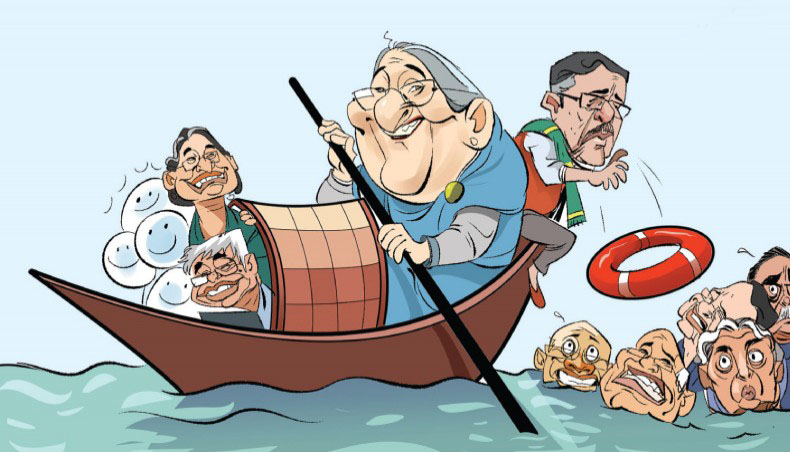

Once the most dominant political figure in Bangladesh, Sheikh Hasina now finds herself at the heart of over a hundred legal cases—including several filed before the very International Crimes Tribunal she once used to target her opponents. The tables have turned, and so has history.
The Collapse No One Saw Coming
It was 2:30pm, Dhaka time, on August 5, 2024, when Sheikh Hasina boarded a military helicopter, leaving behind her official residence for the last time. From there, she was swiftly flown to the airport and evacuated in a C-130 military transport aircraft—destination undisclosed.
As news of her departure spread, spontaneous celebration erupted across the country. For millions of Bangladeshis, it marked the end of a 16-year authoritarian reign that had tightened its grip on every facet of national life.
Dictatorship in Disguise
Hasina’s rule followed a pattern seen time and again across autocratic regimes. She silenced the press, weaponized the judiciary, and neutralized opposition forces through mass arrests, enforced disappearances, and politicized policing. Elections became mere formalities, stripped of credibility and manipulated to maintain the illusion of popular support.
Civil liberties shrank to near extinction. Surveillance, censorship, and the dismantling of dissent became everyday realities. What had begun as a promise of stability transformed into a regime of fear.
Corruption at the Core
Underneath the surface was a sprawling network of corruption that infiltrated every level of society. From state-owned banks to mega infrastructure projects, financial abuse flourished. Her administration fostered a culture of impunity where loyalty trumped law, and where public resources became private wealth.
Analysts now describe it as one of the most entrenched kleptocracies in South Asian history.
A Hollow Party, A Hollow Exit
Despite being the uncontested leader of the Awami League for decades, Hasina’s departure exposed how weakened and directionless the party had become. The very power structure she built collapsed with alarming speed—faster than even her harshest critics had anticipated.
Her once-formidable political machine stood exposed: brittle, isolated, and hollowed out from within.
Dark Secrets Unearthed
Since her fall, a flood of revelations has surfaced.
Among the most chilling: allegations of a covert network of detention centers referred to as “Ayanaghor”—places where political opponents and activists were reportedly tortured, disappeared, or detained indefinitely. Survivors and families have begun coming forward, many after years of silence.
One mother, holding a worn-out photograph, said: “I’ve searched for my son for 11 years. Now I know where he was taken.”
Justice in Motion
Hasina now faces an avalanche of legal scrutiny. Multiple charges have been filed across national courts, including serious human rights violations and crimes under international law. The International Crimes Tribunal—once her instrument for consolidating power—has now summoned her to account for past abuses.
These cases may shape not just her legacy, but also the future path of justice in a nation long scarred by impunity.
A Nation Moves Forward
With Hasina gone, Bangladesh faces the daunting task of reconstruction—not just of governance, but of public trust. Rebuilding institutions, safeguarding civil liberties, and delivering justice for past crimes will be critical to any lasting transition.
Still, for the people of Bangladesh, the 5th of August 2024 will be remembered as the day the tide finally turned. A day when decades of fear gave way to an outburst of hope—and when even the most entrenched power proved not immune to the will of the people.