Street collapse in Bangkok raises alarm for Dhaka

- Update Time : 07:59:01 am, Thursday, 25 September 2025
- / 517 Time View
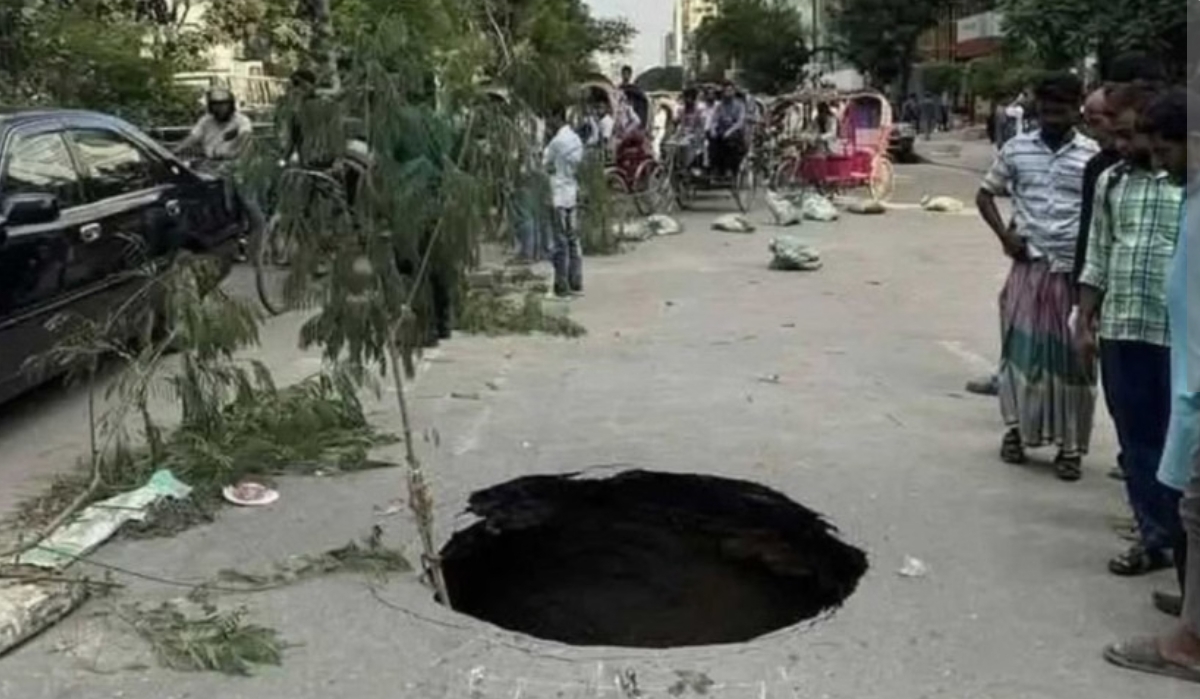

Bangkok Road Collapse Raises Alarm for Dhaka
A major road outside Bangkok’s Vajira Hospital caved in early on September 24, 2025, leaving a hole nearly 50 metres across. The collapse brought down nearby power lines and flooded the area after an underground water pipe burst, forcing evacuations and emergency repairs.
The incident has reignited concerns in Bangladesh, where planners warn that Dhaka could be vulnerable to similar failures if rapid urban expansion continues unchecked.
Earlier this year, on May 27, a cavity suddenly appeared near Shankar Footbridge in Dhanmondi. The crater, which quickly spread across social media, caused traffic disruption and panic among pedestrians before city officials filled it overnight.
Geologists later noted that Dhaka does not sit on limestone or gypsum-rich rock, the conditions that typically cause natural sinkholes. Instead, weak soil, leaking water pipes, and flawed underground construction were identified as possible triggers. Engineers traced the Dhanmondi incident to a damaged Wasa pipeline, which gradually washed away supporting sand during utility drilling.
Experts caution that this is only part of a bigger risk. Over 70 percent of Dhaka’s water is pumped from underground sources, steadily lowering groundwater levels each year. Urban planners fear this practice could hollow out the subsoil, increasing the likelihood of subsidence, structural instability, and even large-scale collapses.
“Dhaka has focused too much on surface-level planning while ignoring underground vulnerabilities,” said Professor Adil Muhammad Khan, president of the Bangladesh Institute of Planners. He warned that even minor tremors could destabilise high-rise foundations built on weak sediment.
Global cases highlight the danger: Guatemala City lost entire intersections to sinkholes in 2007 and 2010; Florida in the U.S. regularly reports sinkhole damage; and parts of China, Russia, and Jerusalem have all experienced ground failures linked to geology, rainfall, or construction activity.
Specialists stress that Dhaka must act now—limiting groundwater extraction, monitoring soil behaviour, and reinforcing underground infrastructure—before today’s warning signs grow into tomorrow’s catastrophe.