What makes the cricket board so irresistibly attractive?

- Update Time : 06:14:52 am, Monday, 6 October 2025
- / 300 Time View

Why Does Everyone Want a Seat at the Cricket Board?
In the past few days, many people have asked me the same question: Why is the Bangladesh Cricket Board election treated like a national-level political battle? I haven’t been able to give a straightforward answer—if anything, more questions have surfaced in my own mind.
From the outside, it appears that each of the 25 director positions in the Bangladesh Cricket Board (BCB) is extraordinarily valuable. Otherwise, why so much lobbying, backroom dealing, legal drama, and shameless compromise over one election? People are beginning to assume that the board must be hiding some enormous treasure. The only mystery is—what is that treasure, exactly? What is the “sweetness” that draws so many in?
To clarify, BCB directors don’t receive monthly salaries. They get a small honorarium only when attending board meetings—an amount trivial to most of them given their financial standing. There are also token gifts at the annual general meeting, open to all councilors. Beyond that, there isn’t much on paper. So what motivates people to fight so hard to secure a director’s chair?
When you ask some of the contenders themselves, the irony is remarkable. If you casually mention how everyone seems desperate to join the board—many with no background in cricket—you’ll hear them wonder out loud, “Yes, why is everyone so eager to get into the cricket board? What’s the attraction?” But the moment you ask why they personally are running, the tone shifts completely:
“Brother, someone has to save cricket. I’m juggling my business, my own responsibilities… yet I still make time because I’ve given my life to this game.”
It would be unfair to say no one is sincere. A handful genuinely care about cricket and want to contribute. They gain nothing apart from social respect and the prestige of the title “BCB Director.” But that group is tiny.
What happens instead? People who claim to “serve cricket” refuse to sit together, refuse to compromise, and instead spend weeks scheming against each other. The same individuals who insist they only want to help the sport do everything possible to block others from entering. There’s conflict, betrayal, and continuous plotting—apparently, all in the name of “saving cricket.”
This raises another question: if someone truly wanted to work for cricket, couldn’t they do that from their club, district association, or regional organization? Most have those affiliations. Very few do anything meaningful there. Yet they want to jump straight to the national board, where the competition is fiercer and the politics dirtier.
In earlier days, club organizers would support teams year-round, invest in players, and eventually earn their place as councilors. Now, one election year is enough—just pay a significant sum and you can secure a spot as a “guest councilor.” Many did exactly that this time. Some of these patrons, after failing to get board positions, have already disappeared, leaving the actual club administrators scrambling to keep operations running.
So what is the reward? Glamour. Visibility. Influence. Even a BCB director gets media coverage that many ministers don’t. Their names appear in newspapers. Their clips run on TV. For businesspeople, that visibility translates into credibility and leverage. For politicians, it builds a public image—“our MP is also on the cricket board”—a line that boosts local prestige and votes.
And then there are the perks. In the last board’s term, foreign trips became routine. On many tours, at least one or two directors joined the national team delegation—sometimes with justification, often without. Their travel was business class. Hotels were five-star. Over the years, the number of traveling officials grew. In the final stretch, even staffers were going abroad to “watch” matches.
Accusations of corruption have also circulated. Some claim to have become millionaires through board connections. There is talk of investigations, but history shows that allegations vanish when power shifts. One group accuses the other while out of office, then drops everything once they gain control. The cycle repeats.
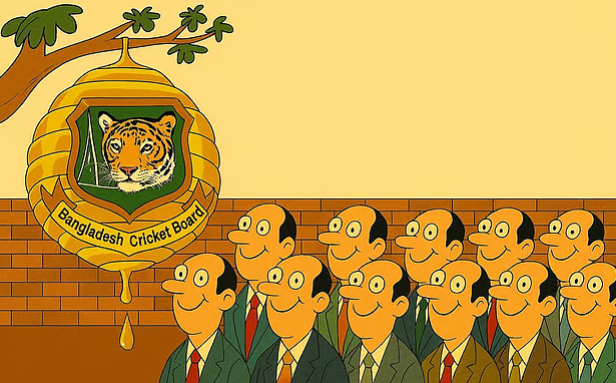
Perhaps this is the real explanation: the cricket board is a beehive. Knocking it over risks chaos. But keeping it intact lets everyone dip in for honey at the right time.
So, again—what’s the secret attraction? Maybe the better question is: who actually wants to protect cricket, and who wants to protect access to the honeycomb?