Rooppur Nuclear Power Plant Set for Trial Connection to National Grid Tomorrow, May Supply 300–400 MW

- Update Time : 02:43:53 pm, Monday, 16 November 2026
- / 32 Time View
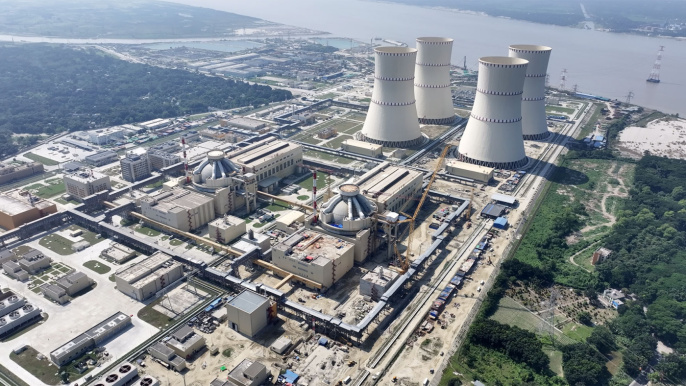

Bangladesh’s first nuclear power facility, the Rooppur Nuclear Power Plant (RNPP), is scheduled to be connected to the national grid on a trial basis for the first time tomorrow, November 17. The move is being viewed as a major milestone in the testing programme of the country’s first nuclear power plant.
The trial connection will assess how electricity generated by the plant is transmitted to the national grid and how the power system responds to the additional supply, particularly its ability to maintain grid frequency stability.
Mohammad Rezaul Karim, chairman of the Bangladesh Power Development Board (BPDB), told The Business Standard (TBS) that preparations were underway to connect the plant to the grid. He said the project director of the Rooppur Nuclear Power Plant had informed him about the planned connection.
“The project director of the Rooppur Nuclear Power Plant has informed me that it will be connected to the national grid by tomorrow,” he said.
However, an official of Power Grid Bangladesh PLC (PGB) said several previous attempts to synchronise the plant with the grid had been unsuccessful.
“A test has been scheduled, and there is a possibility that it will take place. However, I cannot confirm exactly when it will happen. It is expected to be completed very soon,” the official said.
According to information from the Rooppur Nuclear Power Plant authorities, the facility may initially supply around 300–400 megawatts of electricity to the national grid.
Mohammad Anwar Hossain, secretary of the Ministry of Science and Technology, told TBS that the plant was now ready to transmit generated electricity to the grid, making the synchronisation process part of its testing programme.
He said connecting the plant to the power grid was part of a broader test to assess how the national grid responds when electricity is supplied by a nuclear power facility, particularly whether the entire system can maintain a stable frequency.
He added that turbine synchronisation work had already been completed. The next step would be to monitor how the grid responds once electricity is supplied.
“The plant must ultimately be connected to the grid. The turbine synchronisation work has been completed. Once it is connected, we will observe how the grid responds, what happens to the frequency and whether the entire system remains stable,” Anwar Hossain said.
The plant will remain connected to the grid for a specified period for further observation before being shut down again for additional tests. Authorities have described the process as a normal part of commissioning the facility.
“After the connection, they will monitor it for some time and then shut it down again to carry out further tests. These are normal procedures,” Anwar Hossain said.
He said that if the initial synchronisation is successful and the grid remains stable, the plant could continue operating for several hours. However, it would have to be shut down immediately if any technical complications arise.
“If everything works properly and the system remains stable, it could operate for several hours. If any complications arise, it will be shut down immediately. It may then be connected again,” he added.