Dhaka 8:27 am, Thursday, 18 June 2026

Collusion Behind Massive Stone Looting at Sada Pathor, Sylhet

Niloy Mridha
  • Update Time : 08:03:59 am, Thursday, 14 August 2025
  • / 701 Time View

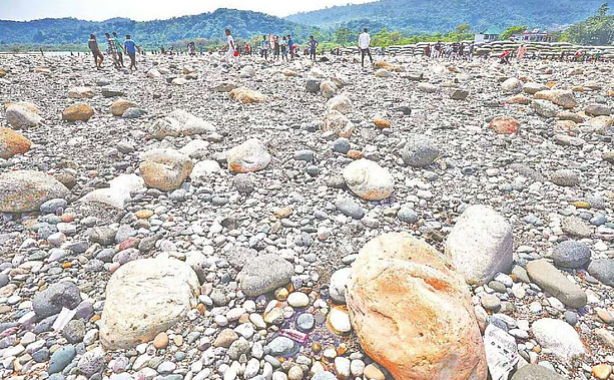
he once-picturesque Sada Pathor area in Bholaganj, Sylhet — famous for its clear streams flowing between large, smooth stones — has been stripped of most of its natural beauty. Where tourists once relaxed on boulders and admired the scenery, deep pits and bare ground now remain.

Over the last four months, large-scale stone theft has taken place in broad daylight. Despite media coverage and public awareness, the plundering continued almost unchecked. Local authorities made some attempts to intervene, but these were too weak to have any real effect.

A site visit last week revealed that roughly 80% of the stones had been removed. Tourist numbers have plummeted.


Political Unity in Exploitation

While political parties in Sylhet frequently clash on other issues, leaders from multiple groups have acted in concert when it comes to stone extraction. Figures from BNP, Jamaat-e-Islami, the National Citizen Party (NCP), and other parties have been linked to the trade — covering extraction, transport, storage, and sales.

Local politicians have also openly supported the resumption of quarry operations. When official approval was not granted, large-scale illegal mining began. Environmental campaigners hold influential politicians responsible, noting that some have since gone into hiding after being named in investigations.


Quarries and Legal Context

Bangladesh has 51 designated quarry sites, eight of them in Sylhet. Other stone-rich areas like Sada Pathor, Jaflong, Bichhnakandi, and Utmachhara are also tourist attractions. Stones in Sylhet are naturally deposited by river currents from India’s Meghalaya hills.

Since 2020, quarry leases in Sylhet have been suspended due to environmental concerns. Jaflong, for example, has been declared an Ecologically Critical Area (ECA), making extraction there punishable by law. Despite this, illegal mining has continued.

The construction sector’s demand for stone is huge, with millions of tonnes imported annually. Locally, Sylhet stones sell for Tk 60–150 per cubic foot, and the total value of stolen stones from Sada Pathor is estimated at around Tk 20 billion.


Timeline of the Looting

After the Awami League government was ousted in August 2024, local BNP-aligned groups gained control of quarries. With little police intervention, illegal extraction surged at sites across the district, emptying many within a year.

When those areas were depleted, attention turned to Sada Pathor. Looting there began in late April 2025, escalating rapidly in July and August.


Individuals Named in Allegations

Numerous local political activists have been accused, including leaders from BNP’s main party, youth wing (Jubo Dal), and student wing (Chhatra Dal). Some Awami League members have also been implicated. Allegations point to organised involvement — from operating extraction sites to owning the trucks and boats that transport the stolen stones.

Storage yards in various villages are reportedly owned or rented by politically connected individuals. Many of these stones are later sold to local crushing plants, which are also linked to political figures.


Public Backlash and Official Inaction

Local residents have staged human chains to protest both stone and sand extraction, warning that unregulated digging is damaging infrastructure, including bridges.

Environmental activists argue that public statements by politicians supporting quarry reopening have encouraged theft. Officials have made promises to stop illegal mining, but enforcement has been inconsistent.

High-level government advisers have visited Sylhet and declared that no new quarry leases will be issued in the region to protect the environment. They also ordered power to be cut from stone-crushing machines. While hundreds of machines were disconnected, protests from traders and workers followed — and enforcement slowed dramatically after meetings between local administrators, business leaders, and political figures.


Tag :

Please Share This Post in Your Social Media

Collusion Behind Massive Stone Looting at Sada Pathor, Sylhet

Update Time : 08:03:59 am, Thursday, 14 August 2025

he once-picturesque Sada Pathor area in Bholaganj, Sylhet — famous for its clear streams flowing between large, smooth stones — has been stripped of most of its natural beauty. Where tourists once relaxed on boulders and admired the scenery, deep pits and bare ground now remain.

Over the last four months, large-scale stone theft has taken place in broad daylight. Despite media coverage and public awareness, the plundering continued almost unchecked. Local authorities made some attempts to intervene, but these were too weak to have any real effect.

A site visit last week revealed that roughly 80% of the stones had been removed. Tourist numbers have plummeted.


Political Unity in Exploitation

While political parties in Sylhet frequently clash on other issues, leaders from multiple groups have acted in concert when it comes to stone extraction. Figures from BNP, Jamaat-e-Islami, the National Citizen Party (NCP), and other parties have been linked to the trade — covering extraction, transport, storage, and sales.

Local politicians have also openly supported the resumption of quarry operations. When official approval was not granted, large-scale illegal mining began. Environmental campaigners hold influential politicians responsible, noting that some have since gone into hiding after being named in investigations.


Quarries and Legal Context

Bangladesh has 51 designated quarry sites, eight of them in Sylhet. Other stone-rich areas like Sada Pathor, Jaflong, Bichhnakandi, and Utmachhara are also tourist attractions. Stones in Sylhet are naturally deposited by river currents from India’s Meghalaya hills.

Since 2020, quarry leases in Sylhet have been suspended due to environmental concerns. Jaflong, for example, has been declared an Ecologically Critical Area (ECA), making extraction there punishable by law. Despite this, illegal mining has continued.

The construction sector’s demand for stone is huge, with millions of tonnes imported annually. Locally, Sylhet stones sell for Tk 60–150 per cubic foot, and the total value of stolen stones from Sada Pathor is estimated at around Tk 20 billion.


Timeline of the Looting

After the Awami League government was ousted in August 2024, local BNP-aligned groups gained control of quarries. With little police intervention, illegal extraction surged at sites across the district, emptying many within a year.

When those areas were depleted, attention turned to Sada Pathor. Looting there began in late April 2025, escalating rapidly in July and August.


Individuals Named in Allegations

Numerous local political activists have been accused, including leaders from BNP’s main party, youth wing (Jubo Dal), and student wing (Chhatra Dal). Some Awami League members have also been implicated. Allegations point to organised involvement — from operating extraction sites to owning the trucks and boats that transport the stolen stones.

Storage yards in various villages are reportedly owned or rented by politically connected individuals. Many of these stones are later sold to local crushing plants, which are also linked to political figures.


Public Backlash and Official Inaction

Local residents have staged human chains to protest both stone and sand extraction, warning that unregulated digging is damaging infrastructure, including bridges.

Environmental activists argue that public statements by politicians supporting quarry reopening have encouraged theft. Officials have made promises to stop illegal mining, but enforcement has been inconsistent.

High-level government advisers have visited Sylhet and declared that no new quarry leases will be issued in the region to protect the environment. They also ordered power to be cut from stone-crushing machines. While hundreds of machines were disconnected, protests from traders and workers followed — and enforcement slowed dramatically after meetings between local administrators, business leaders, and political figures.