Dhaka 3:22 pm, Monday, 9 November 2026

Israel Built Its Nuclear Programme Behind a Textile Factory Cover for 60 Years, Evading Even US Inspectors

Reporter Name
  • Update Time : 08:14:19 am, Monday, 9 November 2026
  • / 15 Time View

In the early 1960s, a group of American diplomats was flying over Israel in an Israeli helicopter when one of them noticed a large construction site emerging from the Negev Desert, about 20 miles west of the Dead Sea.

The American official pointed towards the structure and asked their guide, Adi Cohen of Israel’s Finance Ministry, what was being built there.

Cohen reportedly told the Americans that it was a “textile factory”. The group included Ogden Reid, then the US ambassador to Israel.

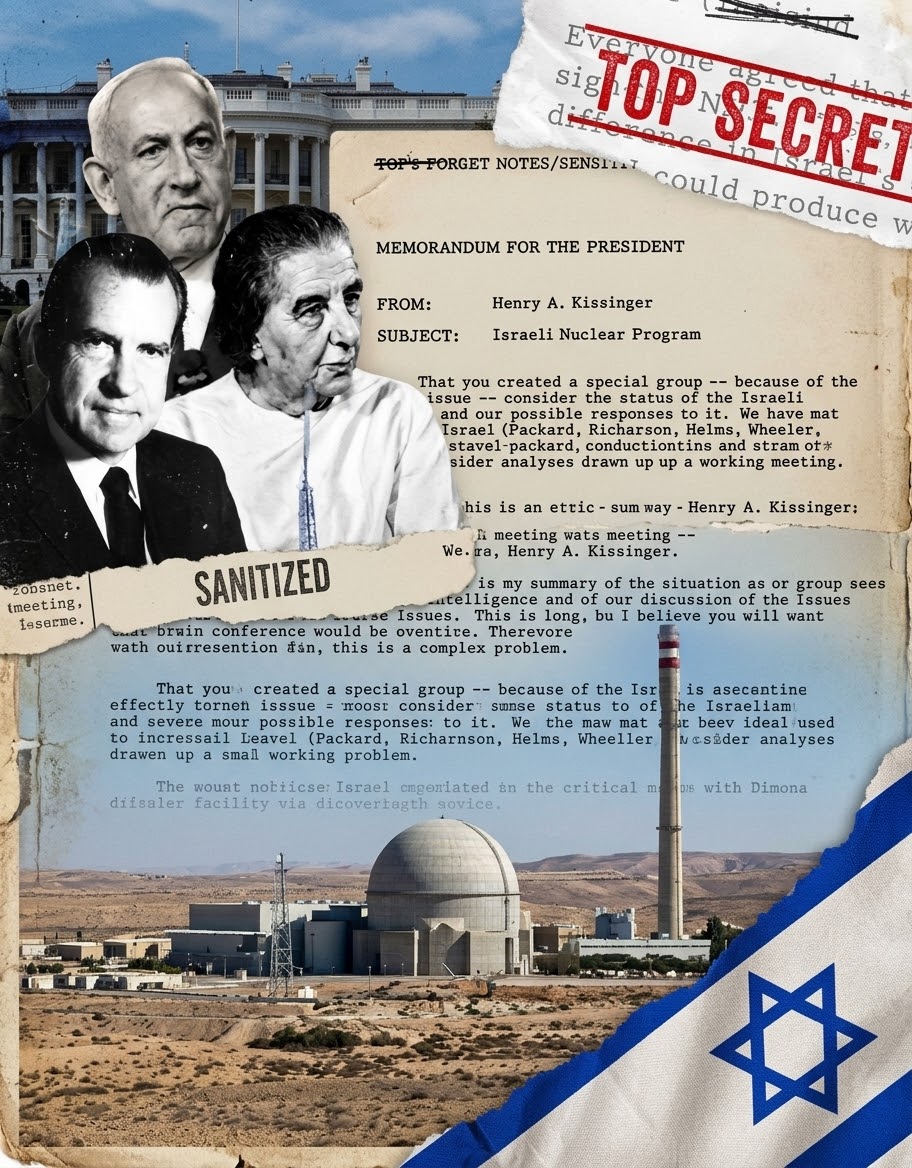
The facility was, in fact, the Dimona nuclear complex, widely regarded as the birthplace of the Middle East’s only nuclear arsenal. Months after US intelligence agencies began suspecting the site’s actual purpose, Ambassador Reid requested a meeting with Cohen.

A classified US diplomatic cable preserved by the National Security Archive provides details of the helicopter tour. It says that although Cohen initially treated the matter lightly, there were indications that he believed the reactor might eventually be used to produce weapons.

Five years later, American nuclear officials discovered that hundreds of pounds of weapons-grade enriched uranium had gone missing from a uranium facility in Pennsylvania. According to some US intelligence officials and a recent documentary, the material was diverted for use in Israel’s nuclear programme.

For roughly six decades, the United States and Israel have maintained a policy of deliberate ambiguity over the country’s nuclear weapons. Neither government has formally acknowledged that Israel possesses a nuclear arsenal.

Cohen’s alleged “textile factory” explanation has since become a widely recognised metaphor for this longstanding policy. Israeli Prime Minister Benjamin Netanyahu even referred to the phrase in a speech on July 14, recalling a meeting with the head of Israel’s Atomic Energy Commission.

Avner Cohen, an Israeli-American historian specialising in Israel’s nuclear history, describes the arrangement as one of the world’s biggest open secrets. Under this policy of ambiguity, officials may hint at the existence of nuclear weapons but avoid formally confirming them.

The approach has allowed Washington to publicly oppose nuclear proliferation elsewhere while avoiding difficult questions about how Israel acquired its nuclear capabilities—or whether it has nuclear weapons at all.

However, the longstanding arrangement may now be under increasing pressure as other countries in the region pursue nuclear ambitions. A proposed nuclear cooperation agreement between the United States and Saudi Arabia is also awaiting congressional approval.

Washington’s traditionally unwavering support for Israel’s military ambitions may also be showing signs of strain. President Donald Trump recently said the United States could halt nearly $4 billion in military assistance to Israel by the end of the year.

Meanwhile, Democratic lawmakers and advocacy groups have increasingly argued that Washington can no longer pretend not to know about Israel’s nuclear arsenal.

Democratic Congressman Joaquin Castro told CNN that the US policy of ambiguity over Israel’s nuclear weapons had become outdated and was now “reckless and dangerous”.

Castro, a member of the House Foreign Affairs and Intelligence committees, said it was risky for the United States to enter a conflict alongside Israel without knowing what its nuclear red lines might be. He also questioned the absence of clear contingency plans in the event that Israel deployed nuclear weapons or its nuclear facilities came under attack.

Ending the policy of ambiguity could also reopen questions about the origins of Israel’s nuclear technology and expose decades of efforts to conceal evidence of its weapons programme.

US inspectors, for example, never discovered a secret underground facility beneath Dimona that was reportedly used to produce weapons-grade plutonium. A Hebrew-language television documentary, The Atom and Me, released in 2024, featured interviews made public after the death of a former Israeli intelligence chief. According to the interviews, Israeli officials would seal off the elevator and access route to the underground facility before inspectors arrived.

Greater transparency could further damage Washington’s credibility, given its longstanding opposition to new countries joining the nuclear club. It could also raise questions about whether existing provisions for economic sanctions and arms sales restrictions against countries pursuing nuclear weapons should be applied to Israel.

A State Department spokesperson said: “It is longstanding State Department policy not to comment publicly on reports concerning specific military platforms and strategic positions.”

The White House did not respond to a request for comment. The Israeli Embassy in Washington referred CNN’s questions to the Israeli Prime Minister’s Office, which also did not respond.

Matthew Kroenig, a nuclear strategist and professor of political science at Georgetown University, warned that an official Israeli declaration of nuclear status could encourage other countries in the region to follow suit.

“An uncontrolled nuclear arms race in the Middle East would not be a positive development for US policy,” he said.

During a public congressional hearing in June, Castro pressed Secretary of State Marco Rubio on the issue. Rubio offered what was arguably one of the most candid public assessments by a senior US official.

“I think most of the world assumes that Israel has them. But we have never—and they have never—publicly acknowledged it. And as a feature of our foreign policy, for a variety of reasons, we don’t really discuss it,” Rubio said.

How the Policy of Denial Took Shape

Experts told CNN that the policy of nuclear ambiguity emerged from the geopolitical realities of the Cold War. Both Washington and Israel feared that Arab countries, potentially backed by the Soviet Union, might develop nuclear weapons.

Israel was also concerned about the diplomatic consequences of openly declaring itself a nuclear-armed state.

The year American officials first discovered the missing uranium from the Pennsylvania facility, Henry Kissinger visited Tel Aviv. At the time, Kissinger was a professor in Harvard University’s Department of Government and a foreign policy adviser to influential Republicans. Less than four years later, in 1969, he became national security adviser under the Nixon administration.

A declassified memorandum preserved by the National Security Archive summarised Kissinger’s discussions with Israeli officials. According to the document, Kissinger firmly believed Israel had already embarked on a nuclear weapons programme, despite efforts by then-President John F. Kennedy to prevent it.

During a meeting with Israeli Deputy Defence Minister Shimon Peres, Kissinger found that Peres and other senior officials supported the development of nuclear weapons. The memorandum noted that Israeli scientists had no doubts about the necessity of developing such capabilities.

However, Kissinger identified one particularly important concern among Israeli officials: they did not want Israel to appear to be the first country in the region to introduce nuclear weapons.

Historian Avner Cohen argues that American and Israeli officials deliberately avoided agreeing on a precise definition of what constituted the introduction of a nuclear weapon.

During discussions in November 1968 over the sale of advanced F-4 Phantom fighter jets, then-Israeli Ambassador to the United States Yitzhak Rabin reportedly told American officials that a weapon should not be considered introduced until it had been tested and publicly declared.

Washington, meanwhile, feared that public confirmation of Israel’s nuclear arsenal could push Arab countries—many still struggling with the defeat of the 1967 Six-Day War—to seek nuclear weapons or security guarantees from the Soviet Union.

A report attached to a memorandum Kissinger sent to President Richard Nixon in July 1969 warned that Israel’s acquisition of nuclear weapons could substantially increase the likelihood of another country using nuclear weapons out of anger.

Kissinger nevertheless understood that Washington might be unable to stop Israel, even by threatening an arms embargo.

Cutting off weapons supplies while keeping the nuclear programme secret could anger Congress and create a domestic political crisis. Publicly exposing the programme to increase diplomatic pressure, meanwhile, could lead the Soviet Union and Arab states to accuse Washington of complicity.

The solution was to accept and preserve the ambiguity. Israel also refused to sign the Treaty on the Non-Proliferation of Nuclear Weapons (NPT).

In the July 1969 memorandum, Kissinger wrote: “What we want at a minimum is that the fact of Israel’s possession of nuclear weapons should not become an internationally established fact.”

The memorandum does not record Nixon’s final decision, and there is no known official document identifying the precise moment when nuclear ambiguity became a joint US-Israeli policy.

Historian Cohen said that in September of that year, Nixon and Israel’s new prime minister, Golda Meir, held a private meeting at the White House without aides present. He believes they may have reached an understanding on the basic rules governing Israel’s nuclear programme during that meeting.

No written record of their conversation is known to exist. Following the meeting, American pressure on Israel over its nuclear programme effectively came to an end.

Throughout the 1970s, media reports and accidental disclosures of government information increasingly suggested that Israel had developed nuclear weapons.

However, international suspicions were further reinforced in 1986 when Mordechai Vanunu, a former reactor technician at Dimona, provided detailed information and secretly taken photographs of the facility to Britain’s Sunday Times newspaper.

According to a 1999 book by investigative journalist Peter Hounam, who helped expose the programme, a young Mossad agent lured Vanunu to Rome shortly before the newspaper published its findings. There, Israeli intelligence operatives allegedly drugged him, rendered him unconscious and transferred him to a secret Israeli naval cargo ship waiting in international waters.

Despite Hounam’s testimony in Vanunu’s defence during the widely publicised trial, Vanunu was convicted of treason and espionage. He spent 18 years in an Israeli prison, most of that time in solitary confinement.

Israel later relaxed some restrictions on discussing its nuclear programme. The country’s military censorship board allows publishers to report on the subject only if they include a disclaimer stating that the material is “based on foreign reports”.

In a 2018 CNN interview, Netanyahu was questioned about Israel’s nuclear capabilities. Rather than directly acknowledging or denying them, he repeated that Israel would not be the first country in the region to introduce nuclear weapons.

The official position, however, remains unchanged: neither the United States nor Israel formally acknowledges that Israel possesses nuclear weapons.

The nonprofit Nuclear Threat Initiative estimates that Israel currently has approximately 90 nuclear warheads.

When Could the Culture of Denial End?

Rubio’s June remarks and growing pressure from US lawmakers suggest that the longstanding policy of ambiguity may be beginning to weaken.

The conflict involving Iran and Israel, alongside the military advances of Yemen’s Houthi forces and disruptions to shipping through the Red Sea, have added to regional tensions.

It remains unclear how Trump’s reported plans to reduce military assistance to Israel could affect the policy.

Kroenig said Iran’s more visible nuclear programme had already encouraged regional countries such as Saudi Arabia to consider alternative security arrangements.

Saudi Crown Prince Mohammed bin Salman has repeatedly warned that his country would develop nuclear weapons if Iran acquired a bomb.

A nuclear cooperation agreement between Washington and Riyadh is currently under congressional review. Subject to certain conditions and US approval, the agreement could provide Saudi Arabia with a pathway to enrich uranium on its own territory.

Despite months of conflict involving the United States and Israel, Iran is still believed to possess approximately 1,000 pounds of highly enriched uranium. Much of the material is reportedly buried beneath facilities damaged in US airstrikes last year.

James Acton, a nuclear expert at the Carnegie Endowment for International Peace, told CNN that he sees a 50-50 chance of Iran acquiring a nuclear bomb within the next three years.

Castro agrees that the US policy of ambiguity over Israel’s nuclear arsenal may once have been strategically useful, but argues that the time has come to abandon it.

“Much has changed since the days of the 1950s, 1960s and 1970s. The geopolitical landscape is completely different now, but this policy of ambiguity has never changed,” he said.

Kroenig believes that an Iranian nuclear test could create an “inevitable” scenario in which the United States and Israel would need to reconsider their policy of ambiguity.

During his June discussion with Rubio on Capitol Hill, Castro argued that the nuclear rivalry between Israel and Iran deserves open scrutiny, even if only one side in the conflict possesses nuclear weapons.

Rubio avoided directly addressing the question, suggesting instead that he could discuss the issue more candidly in a closed-door meeting.

Tag :

Please Share This Post in Your Social Media

Israel Built Its Nuclear Programme Behind a Textile Factory Cover for 60 Years, Evading Even US Inspectors

Update Time : 08:14:19 am, Monday, 9 November 2026

In the early 1960s, a group of American diplomats was flying over Israel in an Israeli helicopter when one of them noticed a large construction site emerging from the Negev Desert, about 20 miles west of the Dead Sea.

The American official pointed towards the structure and asked their guide, Adi Cohen of Israel’s Finance Ministry, what was being built there.

Cohen reportedly told the Americans that it was a “textile factory”. The group included Ogden Reid, then the US ambassador to Israel.

The facility was, in fact, the Dimona nuclear complex, widely regarded as the birthplace of the Middle East’s only nuclear arsenal. Months after US intelligence agencies began suspecting the site’s actual purpose, Ambassador Reid requested a meeting with Cohen.

A classified US diplomatic cable preserved by the National Security Archive provides details of the helicopter tour. It says that although Cohen initially treated the matter lightly, there were indications that he believed the reactor might eventually be used to produce weapons.

Five years later, American nuclear officials discovered that hundreds of pounds of weapons-grade enriched uranium had gone missing from a uranium facility in Pennsylvania. According to some US intelligence officials and a recent documentary, the material was diverted for use in Israel’s nuclear programme.

For roughly six decades, the United States and Israel have maintained a policy of deliberate ambiguity over the country’s nuclear weapons. Neither government has formally acknowledged that Israel possesses a nuclear arsenal.

Cohen’s alleged “textile factory” explanation has since become a widely recognised metaphor for this longstanding policy. Israeli Prime Minister Benjamin Netanyahu even referred to the phrase in a speech on July 14, recalling a meeting with the head of Israel’s Atomic Energy Commission.

Avner Cohen, an Israeli-American historian specialising in Israel’s nuclear history, describes the arrangement as one of the world’s biggest open secrets. Under this policy of ambiguity, officials may hint at the existence of nuclear weapons but avoid formally confirming them.

The approach has allowed Washington to publicly oppose nuclear proliferation elsewhere while avoiding difficult questions about how Israel acquired its nuclear capabilities—or whether it has nuclear weapons at all.

However, the longstanding arrangement may now be under increasing pressure as other countries in the region pursue nuclear ambitions. A proposed nuclear cooperation agreement between the United States and Saudi Arabia is also awaiting congressional approval.

Washington’s traditionally unwavering support for Israel’s military ambitions may also be showing signs of strain. President Donald Trump recently said the United States could halt nearly $4 billion in military assistance to Israel by the end of the year.

Meanwhile, Democratic lawmakers and advocacy groups have increasingly argued that Washington can no longer pretend not to know about Israel’s nuclear arsenal.

Democratic Congressman Joaquin Castro told CNN that the US policy of ambiguity over Israel’s nuclear weapons had become outdated and was now “reckless and dangerous”.

Castro, a member of the House Foreign Affairs and Intelligence committees, said it was risky for the United States to enter a conflict alongside Israel without knowing what its nuclear red lines might be. He also questioned the absence of clear contingency plans in the event that Israel deployed nuclear weapons or its nuclear facilities came under attack.

Ending the policy of ambiguity could also reopen questions about the origins of Israel’s nuclear technology and expose decades of efforts to conceal evidence of its weapons programme.

US inspectors, for example, never discovered a secret underground facility beneath Dimona that was reportedly used to produce weapons-grade plutonium. A Hebrew-language television documentary, The Atom and Me, released in 2024, featured interviews made public after the death of a former Israeli intelligence chief. According to the interviews, Israeli officials would seal off the elevator and access route to the underground facility before inspectors arrived.

Greater transparency could further damage Washington’s credibility, given its longstanding opposition to new countries joining the nuclear club. It could also raise questions about whether existing provisions for economic sanctions and arms sales restrictions against countries pursuing nuclear weapons should be applied to Israel.

A State Department spokesperson said: “It is longstanding State Department policy not to comment publicly on reports concerning specific military platforms and strategic positions.”

The White House did not respond to a request for comment. The Israeli Embassy in Washington referred CNN’s questions to the Israeli Prime Minister’s Office, which also did not respond.

Matthew Kroenig, a nuclear strategist and professor of political science at Georgetown University, warned that an official Israeli declaration of nuclear status could encourage other countries in the region to follow suit.

“An uncontrolled nuclear arms race in the Middle East would not be a positive development for US policy,” he said.

During a public congressional hearing in June, Castro pressed Secretary of State Marco Rubio on the issue. Rubio offered what was arguably one of the most candid public assessments by a senior US official.

“I think most of the world assumes that Israel has them. But we have never—and they have never—publicly acknowledged it. And as a feature of our foreign policy, for a variety of reasons, we don’t really discuss it,” Rubio said.

How the Policy of Denial Took Shape

Experts told CNN that the policy of nuclear ambiguity emerged from the geopolitical realities of the Cold War. Both Washington and Israel feared that Arab countries, potentially backed by the Soviet Union, might develop nuclear weapons.

Israel was also concerned about the diplomatic consequences of openly declaring itself a nuclear-armed state.

The year American officials first discovered the missing uranium from the Pennsylvania facility, Henry Kissinger visited Tel Aviv. At the time, Kissinger was a professor in Harvard University’s Department of Government and a foreign policy adviser to influential Republicans. Less than four years later, in 1969, he became national security adviser under the Nixon administration.

A declassified memorandum preserved by the National Security Archive summarised Kissinger’s discussions with Israeli officials. According to the document, Kissinger firmly believed Israel had already embarked on a nuclear weapons programme, despite efforts by then-President John F. Kennedy to prevent it.

During a meeting with Israeli Deputy Defence Minister Shimon Peres, Kissinger found that Peres and other senior officials supported the development of nuclear weapons. The memorandum noted that Israeli scientists had no doubts about the necessity of developing such capabilities.

However, Kissinger identified one particularly important concern among Israeli officials: they did not want Israel to appear to be the first country in the region to introduce nuclear weapons.

Historian Avner Cohen argues that American and Israeli officials deliberately avoided agreeing on a precise definition of what constituted the introduction of a nuclear weapon.

During discussions in November 1968 over the sale of advanced F-4 Phantom fighter jets, then-Israeli Ambassador to the United States Yitzhak Rabin reportedly told American officials that a weapon should not be considered introduced until it had been tested and publicly declared.

Washington, meanwhile, feared that public confirmation of Israel’s nuclear arsenal could push Arab countries—many still struggling with the defeat of the 1967 Six-Day War—to seek nuclear weapons or security guarantees from the Soviet Union.

A report attached to a memorandum Kissinger sent to President Richard Nixon in July 1969 warned that Israel’s acquisition of nuclear weapons could substantially increase the likelihood of another country using nuclear weapons out of anger.

Kissinger nevertheless understood that Washington might be unable to stop Israel, even by threatening an arms embargo.

Cutting off weapons supplies while keeping the nuclear programme secret could anger Congress and create a domestic political crisis. Publicly exposing the programme to increase diplomatic pressure, meanwhile, could lead the Soviet Union and Arab states to accuse Washington of complicity.

The solution was to accept and preserve the ambiguity. Israel also refused to sign the Treaty on the Non-Proliferation of Nuclear Weapons (NPT).

In the July 1969 memorandum, Kissinger wrote: “What we want at a minimum is that the fact of Israel’s possession of nuclear weapons should not become an internationally established fact.”

The memorandum does not record Nixon’s final decision, and there is no known official document identifying the precise moment when nuclear ambiguity became a joint US-Israeli policy.

Historian Cohen said that in September of that year, Nixon and Israel’s new prime minister, Golda Meir, held a private meeting at the White House without aides present. He believes they may have reached an understanding on the basic rules governing Israel’s nuclear programme during that meeting.

No written record of their conversation is known to exist. Following the meeting, American pressure on Israel over its nuclear programme effectively came to an end.

Throughout the 1970s, media reports and accidental disclosures of government information increasingly suggested that Israel had developed nuclear weapons.

However, international suspicions were further reinforced in 1986 when Mordechai Vanunu, a former reactor technician at Dimona, provided detailed information and secretly taken photographs of the facility to Britain’s Sunday Times newspaper.

According to a 1999 book by investigative journalist Peter Hounam, who helped expose the programme, a young Mossad agent lured Vanunu to Rome shortly before the newspaper published its findings. There, Israeli intelligence operatives allegedly drugged him, rendered him unconscious and transferred him to a secret Israeli naval cargo ship waiting in international waters.

Despite Hounam’s testimony in Vanunu’s defence during the widely publicised trial, Vanunu was convicted of treason and espionage. He spent 18 years in an Israeli prison, most of that time in solitary confinement.

Israel later relaxed some restrictions on discussing its nuclear programme. The country’s military censorship board allows publishers to report on the subject only if they include a disclaimer stating that the material is “based on foreign reports”.

In a 2018 CNN interview, Netanyahu was questioned about Israel’s nuclear capabilities. Rather than directly acknowledging or denying them, he repeated that Israel would not be the first country in the region to introduce nuclear weapons.

The official position, however, remains unchanged: neither the United States nor Israel formally acknowledges that Israel possesses nuclear weapons.

The nonprofit Nuclear Threat Initiative estimates that Israel currently has approximately 90 nuclear warheads.

When Could the Culture of Denial End?

Rubio’s June remarks and growing pressure from US lawmakers suggest that the longstanding policy of ambiguity may be beginning to weaken.

The conflict involving Iran and Israel, alongside the military advances of Yemen’s Houthi forces and disruptions to shipping through the Red Sea, have added to regional tensions.

It remains unclear how Trump’s reported plans to reduce military assistance to Israel could affect the policy.

Kroenig said Iran’s more visible nuclear programme had already encouraged regional countries such as Saudi Arabia to consider alternative security arrangements.

Saudi Crown Prince Mohammed bin Salman has repeatedly warned that his country would develop nuclear weapons if Iran acquired a bomb.

A nuclear cooperation agreement between Washington and Riyadh is currently under congressional review. Subject to certain conditions and US approval, the agreement could provide Saudi Arabia with a pathway to enrich uranium on its own territory.

Despite months of conflict involving the United States and Israel, Iran is still believed to possess approximately 1,000 pounds of highly enriched uranium. Much of the material is reportedly buried beneath facilities damaged in US airstrikes last year.

James Acton, a nuclear expert at the Carnegie Endowment for International Peace, told CNN that he sees a 50-50 chance of Iran acquiring a nuclear bomb within the next three years.

Castro agrees that the US policy of ambiguity over Israel’s nuclear arsenal may once have been strategically useful, but argues that the time has come to abandon it.

“Much has changed since the days of the 1950s, 1960s and 1970s. The geopolitical landscape is completely different now, but this policy of ambiguity has never changed,” he said.

Kroenig believes that an Iranian nuclear test could create an “inevitable” scenario in which the United States and Israel would need to reconsider their policy of ambiguity.

During his June discussion with Rubio on Capitol Hill, Castro argued that the nuclear rivalry between Israel and Iran deserves open scrutiny, even if only one side in the conflict possesses nuclear weapons.

Rubio avoided directly addressing the question, suggesting instead that he could discuss the issue more candidly in a closed-door meeting.