Fresh fish worth Tk 10 billion being shipped nationwide

- Update Time : 05:56:53 am, Thursday, 15 January 2026
- / 148 Time View
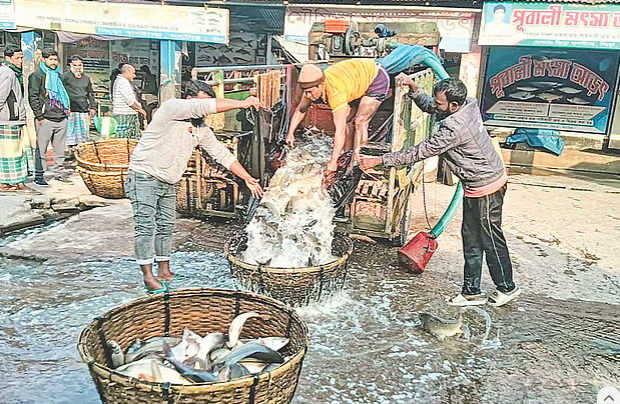

Not long ago, many people in Bangladesh hesitated to buy fish from local markets due to fears of formalin contamination, forcing authorities to remain on constant alert. That situation has changed significantly. Today, consumers can confidently purchase fresh, pond-raised fish, much of which is supplied nationwide by traders from Natore.
Fish traders from the district now play a major role in supplying fresh fish across the country. Every day, at least 500 metric tons of live fish are transported directly from Natore to markets nationwide. Over the course of a year, this amounts to approximately 182,500 metric tons. At an average price of Tk 400 per kilogram, the annual market value stands at around Tk 73 billion.
A major fish-producing region
Those involved in fish farming say Natore is one of the country’s leading fish-producing areas. The district is dotted with ponds and enriched by wetlands such as Chalan Beel, Halti Beel, and numerous canals. Official fisheries data estimate annual production at about 100,000 metric tons, though local experts believe the real figure is nearly double. Production far exceeds local demand.
Before the Jamuna Bridge opened in 1998, surplus fish had to be transported using ice and preservatives, often including formalin. This resulted in lower prices for farmers and significant spoilage. From around 2000, traders began adopting a new method—transporting live fish in water-filled trucks. Within four to five hours, the fish could reach urban markets alive, directly into consumers’ hands.
As a result, demand for fresh fish surged rapidly in cities. The supply network expanded beyond Dhaka to Gazipur, Chattogram, Sylhet, and Noakhali, while the number of traders involved continued to grow.
Currently, between noon and evening each day, at least 500 trucks loaded with fresh fish leave Natore for different districts. Each truck carries roughly one ton of fish.
How live fish are transported
To transport live fish, small trucks are converted into mobile fish tanks. To reduce costs, many traders use reinforced polythene tanks instead of metal ones. A shallow engine-powered pump is installed at the front of the tank to circulate water continuously, ensuring oxygen mixes properly with the water.
The tanks are covered with nets to prevent fish from jumping out. Fish are placed directly into the tanks after being harvested from ponds. Depending on travel distance, water may be replaced periodically. Some traders also use oxygen bags and saline solutions for added protection. The movement of water caused by the truck and pump helps keep the fish healthy, allowing them to survive long journeys.
Benefits for farmers, traders, and consumers
Previously, fish farmers had to transport their catch to wholesale markets themselves. Now, traders arrive directly at ponds to buy live fish. This has reduced transportation costs for farmers and minimized losses from spoilage.
Traders benefit by selling fresh fish at competitive prices after assessing market demand. The system has created jobs for transport workers and logistics providers. Consumers benefit most by gaining access to chemical-free, fresh fish, avoiding spoiled or preserved products.
Veteran fish farmer Golam Nabi from Natore Sadar has been farming fish since 1981. He recalls that sending surplus fish to distant districts was once extremely difficult. After the Jamuna Bridge shortened travel distances, the idea of marketing live fish gradually took hold. Today, at least 1,000 out of 25,000 fish farmers in the district use this method.
Golam Nabi says around 500 trucks of fresh fish are now shipped daily to Dhaka, Gazipur, Narayanganj, Sylhet, and Noakhali. While profits have increased, he notes challenges such as occasional theft by criminal groups on highways and alleged harassment during police checks.
The highest volume of fish is supplied from Gurudaspur, Natore Sadar, and Singra upazilas. Fish trader Zakir Hossain from Maharajpur in Gurudaspur says the availability of fresh fish has boosted sales and created employment for hundreds of people.
Fish farmer Arun Kumar Ghosh, active since the 1980s, believes fresh fish distribution has strengthened Natore’s economy. However, he expresses concern over the sharp rise in fish feed prices.
Official perspective
Senior fisheries officer Nazim Uddin, who has worked in Natore Sadar and Lalpur for many years, says the concept of marketing live fish originated with local farmers. What began on a small scale has grown into a daily operation involving hundreds of trucks. He adds that neighboring districts such as Naogaon and Rajshahi are now following the same model.
District Fisheries Officer Omar Ali says the live fish supply chain is boosting the regional economy while ensuring consumers receive formalin-free fish. He describes the system as a positive development for farmers, traders, and consumers alike.