Commerce Ministry moves to scrap bond facilities on yarn imports from India

- Update Time : 01:15:52 pm, Sunday, 18 January 2026
- / 410 Time View
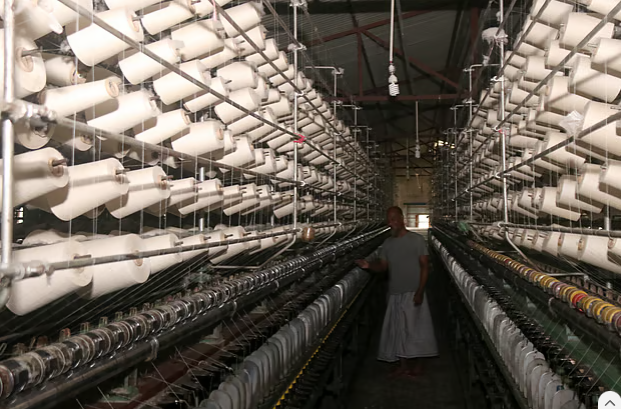

Since the 1980s, Bangladesh has provided duty-free bonded facilities on yarn imports to support its export-oriented garment industry and keep it competitive globally. However, domestic textile mill owners now want this privilege withdrawn, arguing that low-cost yarn imports—mainly from neighboring countries—are threatening their survival. The Bangladesh Trade and Tariff Commission (BTTC) has agreed with their concerns, and the Ministry of Commerce has also recommended removing bonded benefits on cotton yarn imports from neighboring countries.
The authority to make a final decision, however, lies with the National Board of Revenue (NBR). On January 12, the Ministry of Commerce formally wrote to the NBR requesting necessary steps to withdraw the bonded facility. The recommendation does not apply to all yarn types; it specifically targets cotton yarn in the 10 to 30 count range, which accounts for the bulk of Bangladesh’s bonded yarn imports.
The Bangladesh Textile Mills Association (BTMA) submitted applications to the Ministry of Commerce on September 17 and again on December 29. Following these requests, and on the ministry’s advice, the BTTC prepared a detailed report and submitted it on January 6. The commerce ministry referenced this report in its letter to the NBR.
NBR Chairman Md. Abdur Rahman Khan said on Saturday that the issue is being examined from multiple perspectives and that a decision will be taken after careful consideration of all factors.
According to the Ministry of Commerce, the textile and garment sector generates 84 percent of Bangladesh’s export earnings, with knitwear alone accounting for 55 percent of that figure. Cotton yarn in the 10–30 count range is a key raw material for knit garments and is largely imported from India.
BTMA estimates that producing one kilogram of yarn in Bangladesh costs about $3, while similar-quality yarn is produced in India for between $2.85 and $2.90 per kilogram. Indian exporters are currently selling yarn to Bangladesh at around $2.50 per kilogram, putting local mills at a serious disadvantage.
What “count” means
In textiles, “count” refers to yarn fineness. A higher count indicates finer yarn, while a lower count means thicker yarn.
Why bonded facilities exist
Bonded facilities allow export-oriented garment manufacturers to import raw materials without paying duties and taxes, reducing production costs and improving export competitiveness. Imported yarn must be used to produce export goods within a set timeframe and is stored in customs-approved bonded warehouses.
Impact on local mills
The Ministry of Commerce informed the NBR that bonded yarn imports have surged over the past two fiscal years, sharply reducing demand for domestically produced yarn. Local spinning mills are now operating at only about 60 percent of capacity, while 50 factories have already shut down due to financial losses. Industry leaders warn that more closures are likely if the current trend continues.
The ministry also cautioned that widespread mill closures would eventually force knitwear producers to rely entirely on imported yarn, undermining competitiveness, increasing lead times, reducing value addition, and negatively affecting foreign currency reserves.
BGMEA Vice President Md. Shihab Uddoja Chowdhury warned that withdrawing bonded benefits on Indian yarn could be politically sensitive for India and may further strain bilateral relations. He noted that even after land-route yarn imports were halted, imports from India actually increased. He added that global demand for garments has fallen by 15–16 percent, and buyers are unwilling to pay higher prices, making low-cost raw material imports essential for survival.
According to BTMA data, the association has 1,869 members, including 527 yarn producers. Investment in the primary textile sector stands at $23 billion, equivalent to approximately BDT 2.8 trillion, and the sector contributes more than 13 percent to Bangladesh’s GDP.
BTMA Vice President Md. Shamim Islam said withdrawing bonded benefits would provide temporary relief to the textile sector. He noted that the cost gap with Indian producers, once 10–15 cents per kilogram, has widened to about 50 cents. He suggested that the policy could be reviewed later if necessary.
Value addition concerns after LDC graduation
Bangladesh is expected to graduate from least developed country (LDC) status in November 2026. After graduation, duty-free access to key markets such as the EU, US, UK, and Japan will gradually end. To retain preferential access, export products will need to meet value-addition requirements of 40–50 percent, and in some cases undergo double-stage processing. Excessive reliance on imported yarn could make meeting these thresholds difficult.
At a press conference on December 28, BTMA said that in addition to factory closures, unsold yarn worth BDT 12,000 crore remains in stock. The current budget has imposed duties on cotton imports, raised corporate tax from 12.5 percent to 27 percent, and cut cash incentives from 4 percent to 1.5 percent, while India continues to heavily subsidize its textile sector.
Former BTTC member and trade expert Mostafa Abid Khan cautioned that withdrawing bonded facilities could raise export prices and slow export growth—something Bangladesh may not be able to absorb at this time. He questioned whether exporters would be able to negotiate higher prices with foreign buyers and suggested exploring alternative support measures for the textile sector instead of immediately withdrawing bonded benefits.