Dhaka 12:45 am, Friday, 18 September 2026
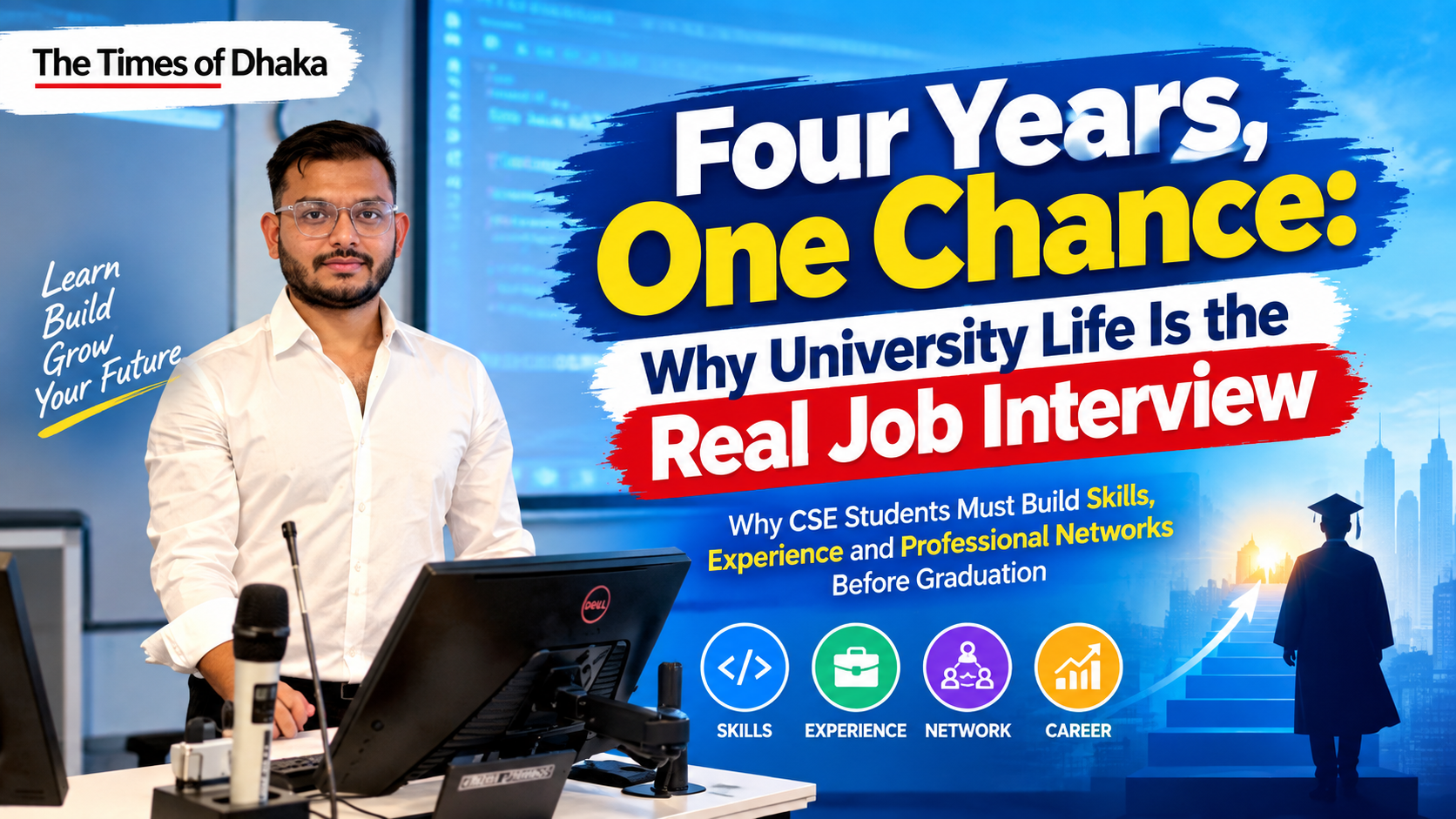
Why CSE Students Must Build Skills, Experience and Professional Networks Before Graduation

Four Years, One Chance: Why University Life Is the Real Job Interview**

Staff Correspondent:
  • Update Time : 09:27:39 am, Wednesday, 16 September 2026
  • / 531 Time View

Four Years, One Chance: Why University Life Is the Real Job Interview


University life is more than a journey toward earning a degree. For Computer Science and Engineering (CSE) students, the four years of university can also be a critical period for developing practical skills, gaining professional experience, building networks and preparing for the job market.


This perspective has been highlighted by Engr. Tazwar Noor Adib Bhuiyan, Academic Lab Demonstrator at the University of Newcastle, Australia, in an advisory article aimed at CSE students in Bangladesh.


According to him, students often consider university the best four years of their lives. However, those years can also serve as a long-term preparation period for their future careers.


A Degree Is the Minimum, Not the Finish Line


Academic qualifications and CGPA remain important for scholarships, higher education and initial CV screening. However, simply completing a degree may not be enough to stand out in an increasingly competitive technology job market.


With thousands of CSE graduates entering the workforce, practical skills, project experience, internships and professional exposure can help candidates demonstrate their abilities beyond academic results.


Start Preparing From First Year


Students are encouraged to become familiar with the technology industry from their first year rather than waiting until graduation.


Following local and international technology companies on LinkedIn and regularly reviewing job postings can help students understand the programming languages, frameworks and technical skills employers are currently seeking.


The article also encourages students to explore internship opportunities from their second year. Working on real projects, collaborating with teams, meeting deadlines and experiencing professional workflows can provide valuable preparation alongside academic studies.


Learn Beyond the Syllabus


The technology sector changes rapidly, while university curricula may take longer to adapt. Students therefore need to supplement classroom learning with independent study.


Free and accessible resources such as freeCodeCamp, The Odin Project, Harvard’s CS50, Coursera audit courses, YouTube tutorials and official documentation can help students develop skills in web development, data structures, cloud computing and artificial intelligence.


Platforms including GitHub, HackerRank, LeetCode and Kaggle can also help students practise technical skills and demonstrate their work through tangible projects.


Students may explore areas such as web development, mobile application development, data science, cybersecurity, DevOps and AI/ML before developing deeper expertise in a field that aligns with their interests and career goals.


Build Professional Networks Early


Networking can also play an important role in career development.


Students can connect with professors, senior students, alumni and technology professionals through LinkedIn, university clubs, hackathons, technology meetups and industry events.


The article highlights organizations such as the Bangladesh Association of Software and Information Services (BASIS) and university-based CSE clubs as potential avenues for students to interact with professionals and gain insight into the technology industry.


Turn the CV Into a Story


A strong CV should demonstrate more than academic performance.


Alongside a CSE degree and CGPA, students can highlight internships, personal projects, GitHub contributions, hackathon participation, freelance work and other practical experiences.


These accomplishments can help recruiters understand what a graduate has actually built, learned and achieved during university.


Four Years, Four Stages


The article suggests viewing university life through four broad career-development stages:


Year 1: Explore the technology industry, build foundational skills and follow companies and professionals.


Year 2: Develop small projects, seek internship opportunities and expand professional networks.


Year 3: Build deeper expertise and gain more substantial experience through internships, freelancing or real-world projects.


Year 4: Convert the skills, experience, portfolio and professional network developed over the previous three years into opportunities for full-time employment.


The central message is that university can be much more than a pathway to a degree. For CSE students, it can be a four-year opportunity to develop practical capabilities, professional networks and a portfolio that can support their transition into the technology industry.


Author:

Engr. Tazwar Noor Adib Bhuiyan

Academic Lab Demonstrator

University of Newcastle, Australia

Tag :

Please Share This Post in Your Social Media

Why CSE Students Must Build Skills, Experience and Professional Networks Before Graduation

Four Years, One Chance: Why University Life Is the Real Job Interview**

Update Time : 09:27:39 am, Wednesday, 16 September 2026

Four Years, One Chance: Why University Life Is the Real Job Interview


University life is more than a journey toward earning a degree. For Computer Science and Engineering (CSE) students, the four years of university can also be a critical period for developing practical skills, gaining professional experience, building networks and preparing for the job market.


This perspective has been highlighted by Engr. Tazwar Noor Adib Bhuiyan, Academic Lab Demonstrator at the University of Newcastle, Australia, in an advisory article aimed at CSE students in Bangladesh.


According to him, students often consider university the best four years of their lives. However, those years can also serve as a long-term preparation period for their future careers.


A Degree Is the Minimum, Not the Finish Line


Academic qualifications and CGPA remain important for scholarships, higher education and initial CV screening. However, simply completing a degree may not be enough to stand out in an increasingly competitive technology job market.


With thousands of CSE graduates entering the workforce, practical skills, project experience, internships and professional exposure can help candidates demonstrate their abilities beyond academic results.


Start Preparing From First Year


Students are encouraged to become familiar with the technology industry from their first year rather than waiting until graduation.


Following local and international technology companies on LinkedIn and regularly reviewing job postings can help students understand the programming languages, frameworks and technical skills employers are currently seeking.


The article also encourages students to explore internship opportunities from their second year. Working on real projects, collaborating with teams, meeting deadlines and experiencing professional workflows can provide valuable preparation alongside academic studies.


Learn Beyond the Syllabus


The technology sector changes rapidly, while university curricula may take longer to adapt. Students therefore need to supplement classroom learning with independent study.


Free and accessible resources such as freeCodeCamp, The Odin Project, Harvard’s CS50, Coursera audit courses, YouTube tutorials and official documentation can help students develop skills in web development, data structures, cloud computing and artificial intelligence.


Platforms including GitHub, HackerRank, LeetCode and Kaggle can also help students practise technical skills and demonstrate their work through tangible projects.


Students may explore areas such as web development, mobile application development, data science, cybersecurity, DevOps and AI/ML before developing deeper expertise in a field that aligns with their interests and career goals.


Build Professional Networks Early


Networking can also play an important role in career development.


Students can connect with professors, senior students, alumni and technology professionals through LinkedIn, university clubs, hackathons, technology meetups and industry events.


The article highlights organizations such as the Bangladesh Association of Software and Information Services (BASIS) and university-based CSE clubs as potential avenues for students to interact with professionals and gain insight into the technology industry.


Turn the CV Into a Story


A strong CV should demonstrate more than academic performance.


Alongside a CSE degree and CGPA, students can highlight internships, personal projects, GitHub contributions, hackathon participation, freelance work and other practical experiences.


These accomplishments can help recruiters understand what a graduate has actually built, learned and achieved during university.


Four Years, Four Stages


The article suggests viewing university life through four broad career-development stages:


Year 1: Explore the technology industry, build foundational skills and follow companies and professionals.


Year 2: Develop small projects, seek internship opportunities and expand professional networks.


Year 3: Build deeper expertise and gain more substantial experience through internships, freelancing or real-world projects.


Year 4: Convert the skills, experience, portfolio and professional network developed over the previous three years into opportunities for full-time employment.


The central message is that university can be much more than a pathway to a degree. For CSE students, it can be a four-year opportunity to develop practical capabilities, professional networks and a portfolio that can support their transition into the technology industry.


Author:

Engr. Tazwar Noor Adib Bhuiyan

Academic Lab Demonstrator

University of Newcastle, Australia