Gaza Siblings Witness Mother’s Death, Forced to Move Between Relatives’ Tents

- Update Time : 02:57:32 pm, Saturday, 24 October 2026
- / 18 Time View
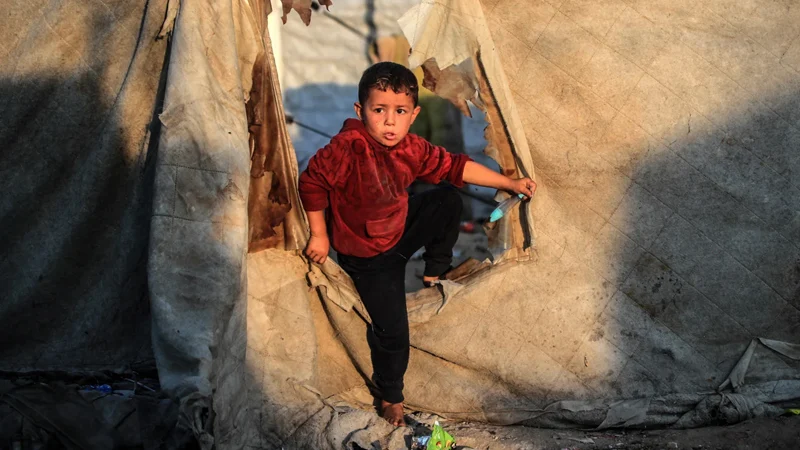

Twelve-year-old Jibril was sitting in his mother’s lap alongside his two sisters, Mariam and Aya, when an Israeli bombing struck their makeshift tent. Their mother, Islam, was killed before their eyes, while Jibril was also injured. Since then, the three siblings have struggled to survive, moving between the tents of different relatives.
Mariam, Aya and Jibril are now 16, 14 and 12 years old, respectively. Their lives have been marked by uncertainty since their mother was killed in an Israeli attack in October 2025. Without a permanent home or the comfort of parental care, they depend on relatives to meet their basic needs.
The siblings had already experienced the loss of a parent. Their father was killed during an Israeli military operation in Gaza in 2014, leaving their mother, Islam, as their sole source of support.
When Israel’s war on Gaza began in October 2023, their family home in Gaza City was destroyed. The three children fled with their mother to a makeshift tent in Deir al-Balah, in central Gaza, hoping to find safety.
But displacement did not protect them. On October 10, 2025, 19 days after a ceasefire took effect, a bombing struck their tent and killed Islam. Jibril was sitting in her lap when she died and was wounded in the attack. The siblings were left without either parent, losing what little security and stability remained in their lives.
Moving Between Relatives’ Tents Every Two Nights
The three children have no permanent home. They sometimes stay with their paternal grandmother and at other times with their maternal aunts. They move from one aunt’s tent to another, often after spending just two nights in each place.
Their aunt, Wardah al-Muzeini, a widow herself, said the children had no permanent residence and generally stayed with their grandmother while spending two nights at a time with their maternal aunts.
Jibril faces additional difficulties. Beyond his physical injuries, he witnessed his mother’s death at close range, an experience that has made the prospect of returning to a normal life particularly challenging.
Their relatives are struggling to provide emotional support while also meeting the children’s needs for food, clothing and other essentials.
Wardah is raising four children alone after her husband was killed in an Israeli airstrike during the war. With no job or reliable source of income, even securing one meal a day for her own children has become difficult.
She and her sisters must now also care for their late sister’s three children.
Wardah said the family was already struggling to feed its own children but could not abandon their orphaned nieces and nephew. The three sisters have therefore divided the responsibilities as best they can. One may buy clothes, another sandals, while another provides a little money to cover the children’s expenses for a few days.
Gaza Has at Least 71,000 Orphaned Children
Thousands of children across Gaza have lost one or both parents and now face similarly uncertain futures.
According to figures from Gaza’s Ministry of Social Development, at least 71,000 children in the territory have been orphaned. Of these, 54,468 lost one or both parents following the outbreak of the war in October 2023.
The ministry also estimates that at least 64,000 women in Gaza have been widowed. These figures include people who lost family members during earlier Israeli military operations as well.
Data from the ministry’s registration system indicate that approximately 3,000 children have no registered guardian, responsible adult or caregiver.
Ministry spokesperson Aziza al-Khalout said statistics alone could not fully capture the daily suffering of these children and women.
A child who loses both parents loses not only security and care but also opportunities for education and a normal childhood, she said. Such children are often forced to shoulder responsibilities far beyond their years.
Al-Khalout also warned that poverty, displacement, inadequate shelter and the loss of a family’s main breadwinner were increasing the risks of child labour, school dropout and early marriage in Gaza.
A Child Struggling to Survive Alone
Some children in Gaza have lost every member of their immediate family and are left to navigate life almost entirely on their own.
One of them is Wafa al-Attar, who was 10 when an Israeli airstrike struck the Deir al-Balah area on February 22, 2024, killing her parents and four siblings.
Wafa had gone to her uncle’s house to charge her father’s mobile phone. When she returned, she found that her family home had been destroyed. She later learned that none of her immediate family members had survived.
Wafa said she had lost her entire family in an instant and struggled for a long time to come to terms with the grief. At times, she thought that if she had stayed at home with them, she might have died alongside them.
She eventually began living with her uncle and his wife. Their support has brought her some comfort, but it has not filled the void left by the loss of her family.
For children such as Wafa and the three siblings moving between relatives’ tents, survival remains a daily struggle shaped by grief, displacement and the absence of a stable home.
Source: Middle East Eye