Dhaka 9:26 pm, Tuesday, 27 October 2026

India Deploys Hundreds of Security Personnel in Arunachal Pradesh Amid Protests Over Mega Dam Near China Border

Reporter Name
  • Update Time : 02:27:40 pm, Tuesday, 27 October 2026
  • / 16 Time View

India has deployed hundreds of additional security personnel in Arunachal Pradesh after protests against a major hydropower dam project near the Chinese border escalated into violent clashes between police and local residents.

Authorities announced the increased security measures on Tuesday following last week’s unrest in the Siang Valley, near the Tibetan border. The proposed dam is part of India’s efforts to respond to a massive hydropower project planned by China upstream. Police have arrested at least 21 people in connection with the protests.

According to local authorities, police fired tear gas to disperse demonstrators, while angry youths allegedly threw stones at officers and set fire to a local police station and an office of the state-owned National Hydroelectric Power Corporation (NHPC).

Arunachal Pradesh Police Chief S.D. Singh Jamwal told Reuters that additional police and armed personnel were being deployed wherever heightened security was required.

“We will not allow the law-and-order situation to deteriorate under any circumstances,” Jamwal said.

Opposition to the proposed 11,200-megawatt Siang Upper Multipurpose Project has persisted in the Siang Valley for the past two years, with residents holding repeated meetings and demonstrations against the plan. The project is being developed by NHPC, a state-owned Indian company.

Local communities, particularly members of the Adi tribe, fear that construction of the massive dam would submerge their ancestral villages and disrupt their traditional way of life.

Gegong Jijong, a member of the Siang Indigenous Farmers Forum, told Reuters that the community would continue resisting the project until the government cancelled it.

He claimed that at least 27 ancestral Adi villages would be completely submerged if the dam were built, while another 40 to 50 villages would be directly affected.

The dispute has also heightened strategic concerns between India and China over control of water resources along the transboundary river system.

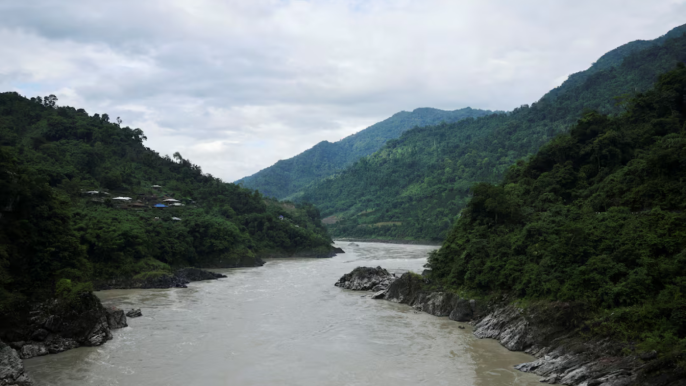
The river originates in Tibet, where it is known as the Yarlung Tsangpo, before entering India through Arunachal Pradesh as the Siang and continuing downstream as the Brahmaputra. In December 2024, China formally announced plans for what is expected to be the world’s largest hydropower dam near the Tibetan border.

The announcement prompted concerns in New Delhi that Beijing could potentially use its control over the river’s upstream flow as a geopolitical tool.

China has long claimed Arunachal Pradesh as its territory, referring to the region as Zangnan, or southern Tibet. India firmly rejects that claim and maintains that Arunachal Pradesh is an integral part of the country.

The chief minister of Arunachal Pradesh, a senior leader of Prime Minister Narendra Modi’s Bharatiya Janata Party (BJP), has described China’s hydropower project as a potential existential threat to India.

He has also assured residents that the government will protect national interests while taking the rights and expectations of communities in the Siang Valley into account when making decisions about the proposed dam.
Tag :

Please Share This Post in Your Social Media

India Deploys Hundreds of Security Personnel in Arunachal Pradesh Amid Protests Over Mega Dam Near China Border

Update Time : 02:27:40 pm, Tuesday, 27 October 2026

India has deployed hundreds of additional security personnel in Arunachal Pradesh after protests against a major hydropower dam project near the Chinese border escalated into violent clashes between police and local residents.

Authorities announced the increased security measures on Tuesday following last week’s unrest in the Siang Valley, near the Tibetan border. The proposed dam is part of India’s efforts to respond to a massive hydropower project planned by China upstream. Police have arrested at least 21 people in connection with the protests.

According to local authorities, police fired tear gas to disperse demonstrators, while angry youths allegedly threw stones at officers and set fire to a local police station and an office of the state-owned National Hydroelectric Power Corporation (NHPC).

Arunachal Pradesh Police Chief S.D. Singh Jamwal told Reuters that additional police and armed personnel were being deployed wherever heightened security was required.

“We will not allow the law-and-order situation to deteriorate under any circumstances,” Jamwal said.

Opposition to the proposed 11,200-megawatt Siang Upper Multipurpose Project has persisted in the Siang Valley for the past two years, with residents holding repeated meetings and demonstrations against the plan. The project is being developed by NHPC, a state-owned Indian company.

Local communities, particularly members of the Adi tribe, fear that construction of the massive dam would submerge their ancestral villages and disrupt their traditional way of life.

Gegong Jijong, a member of the Siang Indigenous Farmers Forum, told Reuters that the community would continue resisting the project until the government cancelled it.

He claimed that at least 27 ancestral Adi villages would be completely submerged if the dam were built, while another 40 to 50 villages would be directly affected.

The dispute has also heightened strategic concerns between India and China over control of water resources along the transboundary river system.

The river originates in Tibet, where it is known as the Yarlung Tsangpo, before entering India through Arunachal Pradesh as the Siang and continuing downstream as the Brahmaputra. In December 2024, China formally announced plans for what is expected to be the world’s largest hydropower dam near the Tibetan border.

The announcement prompted concerns in New Delhi that Beijing could potentially use its control over the river’s upstream flow as a geopolitical tool.

China has long claimed Arunachal Pradesh as its territory, referring to the region as Zangnan, or southern Tibet. India firmly rejects that claim and maintains that Arunachal Pradesh is an integral part of the country.

The chief minister of Arunachal Pradesh, a senior leader of Prime Minister Narendra Modi’s Bharatiya Janata Party (BJP), has described China’s hydropower project as a potential existential threat to India.

He has also assured residents that the government will protect national interests while taking the rights and expectations of communities in the Siang Valley into account when making decisions about the proposed dam.