Bangladesh Police Chief Says Force Could Resort to ‘Crossfire’ if Government Allows It

- Update Time : 11:37:03 am, Monday, 26 October 2026
- / 25 Time View
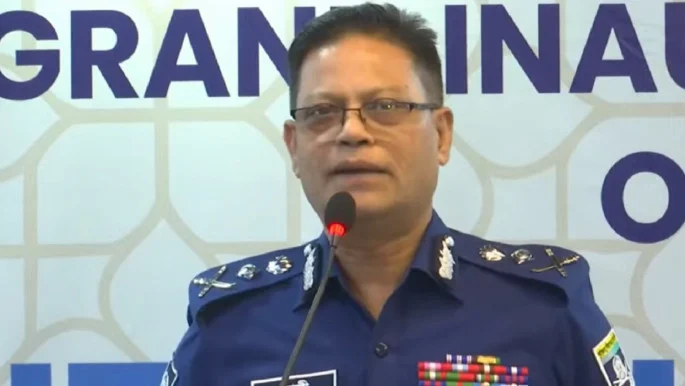

Bangladesh’s Inspector General of Police (IGP), Ali Hossain Fakir, has said police would not hesitate to resort to “crossfire” if the government authorised such action, prompting criticism from human rights advocates and legal experts who warned against extrajudicial killings.
Fakir made the remarks on Monday at the inauguration of the Community Islamic Bank System in Dhaka’s Chawkbazar area.
“Police are necessary for people to live in peace and security. Having freedom does not mean people can do whatever they want,” the IGP said, urging citizens not to take the law into their own hands. He also cautioned against routinely holding police responsible for every incident.
Addressing questions about law enforcement responsibilities, Fakir said the police would act in accordance with the law and the Constitution, regardless of political developments.
“Who will come, when a particular leader will return, or what will happen—that is not for law enforcement agencies to decide. Our responsibility is to apply the law and Constitution wherever and whenever necessary. If crossfire becomes necessary and the government allows it, we will do so,” he said.
The term “crossfire” has frequently been used in Bangladesh to describe deaths during alleged exchanges of gunfire involving law enforcement agencies. Human rights groups and critics have raised concerns that some such incidents may involve extrajudicial killings.
IGP Alleges Police Links to Drug Trade
Fakir also alleged that members of the now-banned Awami League, along with some police personnel, had contributed to the spread of drugs and drug trafficking in neighbourhoods across the country.
“Today, drugs are widespread at gatherings in neighbourhoods. Who created this situation? If you look closely, you will see that leaders of the then-ruling party supported those behind it. Some members of our own police force were also involved, and some remain involved,” he said.
The IGP said police had taken action against officers suspected of wrongdoing, claiming that approximately 27 police officers had been sent to jail over the preceding two months.
“We are cleaning up our own house first. You are witnessing that process, yet even this is being misinterpreted in various ways,” he said.
Human Rights Advocate Condemns the Remarks
Human rights activist Nur Khan Liton told The Business Standard (TBS) that remarks suggesting the use of crossfire from the country’s highest police office raised serious legal and constitutional concerns.
He argued that officials responsible for unlawful actions should be held accountable under the law.
“In Bangladesh, crossfire incidents are not necessarily exchanges of gunfire between two sides. People are taken into custody and killed, and attempts are then made to present those deaths as crossfire. Everyone knows this,” Liton said.
He further questioned whether an IGP who made such remarks should remain in office, describing the statement as irresponsible and potentially damaging to the government.
Lawyer Says Extrajudicial Killings Have No Place Under the Rule of Law
Supreme Court lawyer Advocate Manzill Murshid also criticised the remarks, arguing that many incidents previously described as crossfire were, in his assessment, planned killings rather than genuine exchanges of gunfire.
He estimated that perhaps 10 per cent of past cases involved actual crossfire, while the remaining 90 per cent were presented under that description. These figures were his assessment, rather than an independently verified official count.
“If we believe in constitutional law and the rule of law, there can be no place for this kind of crossfire. If someone commits a crime, they must be tried under the existing legal system. If convicted, they may receive the death penalty, life imprisonment or another punishment prescribed by law. There is no scope for killing someone outside the judicial process,” Murshid said.
He initially interpreted the IGP’s remarks as an emotional statement, suggesting that the police chief was likely aware that such actions would be unlawful.
Murshid said there had been relatively few publicly reported instances of such operations at the state level since the previous government was replaced, apart from a small number of incidents.
Lawyer Calls for Clarification
Murshid said the IGP should not have publicly suggested seeking government authorisation for crossfire operations.
He speculated that the remarks might have been made in the context of anti-drug operations or other law enforcement concerns, rather than representing a formal policy proposal.
“I do not think the government will give him such permission,” he said, noting that opposition to crossfire and protests against violations of human rights had been important elements of the political movement against the previous government.
However, Murshid urged caution before drawing final conclusions, saying the IGP might clarify the context and intended meaning of his remarks.
He added that it was also important to establish whether the media had reproduced the statement accurately or highlighted only a particular portion of it.