Dhaka 2:08 am, Friday, 26 June 2026

Narsingdi Quake: Ground Cracks Not a Threat

Reporter Name
  • Update Time : 06:04:06 am, Monday, 24 November 2025
  • / 303 Time View

Bangladesh Narsingdi Quake Epicenter: Experts Say Ground Cracks Are Not Dangerous

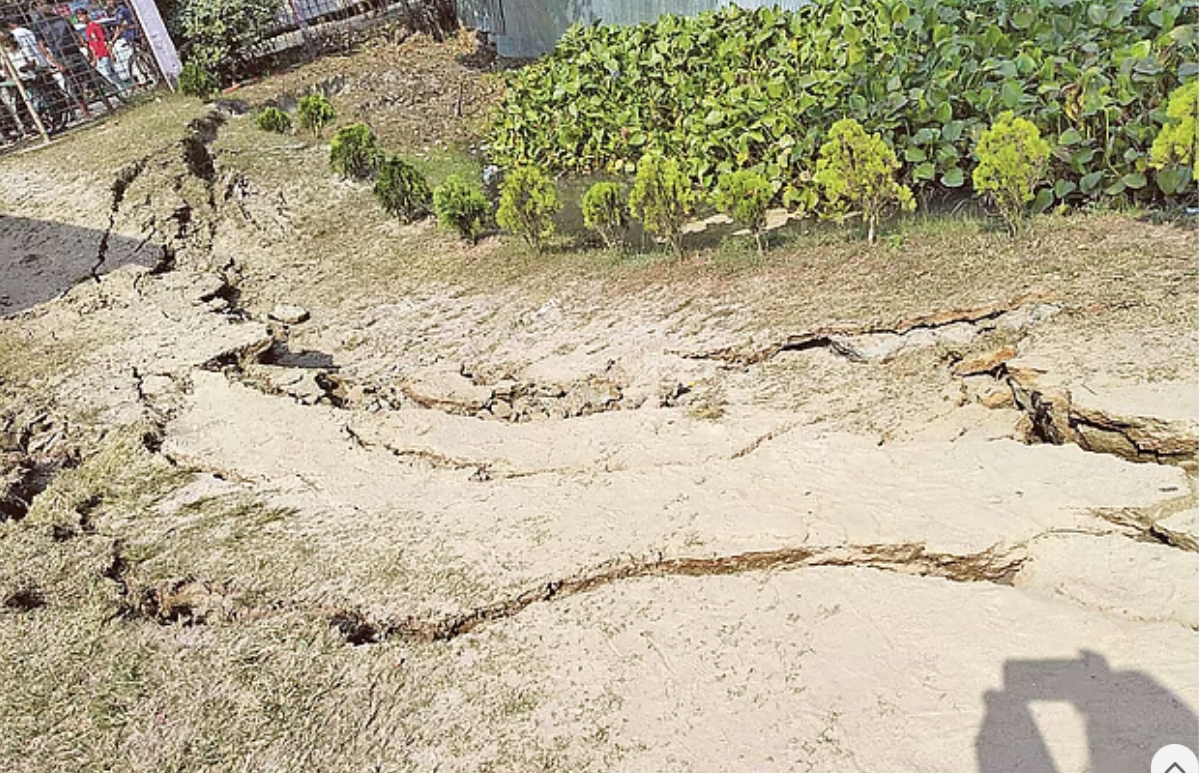
Following Friday morning’s earthquake, cracks appeared in the soil across several parts of Narsingdi district. However, the Bangladesh Geological Survey (GSB) has confirmed that these fissures are not linked to the main fault line of the quake and pose no real threat.

A three-member GSB expert team visited different locations in Narsingdi on Saturday to examine the geological impact. They inspected cracks in at least three locations and found them to be shallow, stretching roughly 4 to 30 meters in length.

According to the initial assessment, all of the cracked areas were situated beside water bodies. During the quake, pressure from pond and canal water loosened the surrounding soil, leading to surface cracks.

GSB Deputy Director Md Mahmud Hossain Khan explained that the phenomenon is known as liquefaction—where loose, dry sand near water sources temporarily loses its strength due to intense shaking. As the soil behaves like a thick fluid for a moment, the top layer collapses or splits, forming cracks. These, he added, can easily be filled with soil and do not indicate deeper geological danger.

The earthquake struck at 10:38 a.m. on Friday, shaking Dhaka and nearby areas, with its origin in Narsingdi. Another tremor followed on Saturday morning, also from the same epicenter. Friday’s quake left 10 people dead—including five in Narsingdi—and injured more than 600. In Palash upazila, cracks appeared in at least two locations as a result of the shaking.


Tag :

Please Share This Post in Your Social Media

6

Narsingdi Quake: Ground Cracks Not a Threat

Update Time : 06:04:06 am, Monday, 24 November 2025

Bangladesh Narsingdi Quake Epicenter: Experts Say Ground Cracks Are Not Dangerous

Following Friday morning’s earthquake, cracks appeared in the soil across several parts of Narsingdi district. However, the Bangladesh Geological Survey (GSB) has confirmed that these fissures are not linked to the main fault line of the quake and pose no real threat.

A three-member GSB expert team visited different locations in Narsingdi on Saturday to examine the geological impact. They inspected cracks in at least three locations and found them to be shallow, stretching roughly 4 to 30 meters in length.

According to the initial assessment, all of the cracked areas were situated beside water bodies. During the quake, pressure from pond and canal water loosened the surrounding soil, leading to surface cracks.

GSB Deputy Director Md Mahmud Hossain Khan explained that the phenomenon is known as liquefaction—where loose, dry sand near water sources temporarily loses its strength due to intense shaking. As the soil behaves like a thick fluid for a moment, the top layer collapses or splits, forming cracks. These, he added, can easily be filled with soil and do not indicate deeper geological danger.

The earthquake struck at 10:38 a.m. on Friday, shaking Dhaka and nearby areas, with its origin in Narsingdi. Another tremor followed on Saturday morning, also from the same epicenter. Friday’s quake left 10 people dead—including five in Narsingdi—and injured more than 600. In Palash upazila, cracks appeared in at least two locations as a result of the shaking.